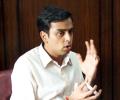
Milind Deora, minister of state for communication and information technology and shipping, is one of the Congress' young guns under Rahul Gandhi. He tells Kavita Chowdhury that the core problem for the United Progressive Alliance in its second term has been its inability to communicate effectively. Edited excerpts:

Finance Minister Arun Jaitley said the inflation index would determine the nominal growth figure, and it is better to set modest targets and outperform them.

China's economy is in transition, with rising wage costs and massive overcapacity.

Lunch with BS: Sukhbir Singh Badal, deputy chief minister, Punjab

Chief Economic Advisor Arvind Subramanian's interview.

In a marathon address to the nation from the ramparts of the Red Fort, Prime Minister Narendra Modi on Saturday underlined India's unity and diversity and the progress of his 15-month-old government's policies.

'This has to be seen in the context not only of the legacy we inherited, but also of global economic weakness.'
'If after inheriting the very bad situation we have reached this level despite consecutive years of drought and no growth in the world economy, it is no accident.' 'It is a result of the sound macro economic policies followed by this government.' 'We have eschewed populism and stuck to a path of fiscal prudence.'
Chief economic advisor Arvind Subramanian discusses the Budget, goods and services tax, Centre-state relationship and larger issues facing the economy

'When he first came to office, my belief is that the PM's reading of the landscape was that, with a vanquished Congress and fragmented Opposition, he was looking at least at two terms in office. This reading perhaps allows for a more cautious, gradual approach.' 'It was only a matter of time before the government was forced to come face-to-face with a serious corruption scandal. This is not a commentary on the BJP, but a statement about India's political economy.' 'There is growing concern about the government's commitment to freedom of expression, religious tolerance, and an independent civil society. Thus far, the positive movement on strategic and economic matters has crowded out these concerns, but they are lingering beneath the surface.'

Only three percent of Indians pay income tax; our tax-GDP ratio is among the lowest in the world. This must change. Our elites must realise that India's poverty has damaging consequences for them, and that they can help decrease it. The food security bill, with all its limitations, will hopefully contribute to generating such awareness, says Praful Bidwai.
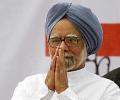
The most immediate cause of worry is the recent volatility in foreign exchange markets, Prime Minister Manmohan Singh tells the Assocham annual general meeting.

Indian economy about to take-off
 © 2026 Rediff.com - Investor Information - Advertise with us - Disclaimer - Privacy Policy - Sitemap - Feedback - About us - Terms of use - Grievances