
'Whatever you work towards, be dedicated, do your best. Never go to bed thinking I could have put in more effort'

'With deep regret, it has now been ascertained that Gen Bipin Rawat, Mrs Madhulika Rawat and 11 other persons on board have died in the unfortunate accident,' the IAF tweeted.
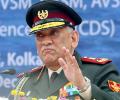
The tearing hurry to form theatre commands has to be replaced by a balanced and deliberate approach. We need to accept that this process will take time if executed correctly and in the best interests of the Indian armed forces, argues Commodore Venugopal Menon (retd).

Lieutenant General P C Bhardwaj, a special operations expert, on Thursday took over as Vice Chief of the Army. Lt Gen Bhardwaj, who was commissioned to the First Battalion Parachute Regiment in June 1970, was hitherto the Udhampur-based Army Northern Command General Officer Commanding-in-Chief.

Group Captain Singh was conferred with the Shaurya Chakra, India's third highest peacetime gallantry award, in August this year for averting a possible mid-air accident after his Tejas light combat aircraft was hit by a major technical problem last year.

Lt Gen Sarath Chand was commissioned into the Garhwal Rifles in June 1979 and has had an outstanding professional career spanning over 38 years.
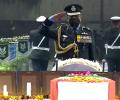
To ensure the morale of the pilots does not suffer, flying activity continues without a pause. Pilots take to the sky like they would on any other day.

A quintessential military commander, Gen Bipin Rawat possessed an uncanny understanding of geopolitical upheavals, calibrated a tri-services military doctrine to make India face myriad security challenges, and is largely credited with bringing down militancy in the Northeast and Jammu and Kashmir.
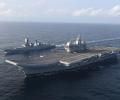
In a record time of 13 years, the Indigenous Aircraft Carrier Vikrant is now ready for formal induction into the Indian Navy.

Singh said in a statement in the Lok Sabha that all efforts were being made to save IAF Group Captain Varun Singh, the lone survivor of the crash near Coonoor in Tamil Nadu on Wednesday, who was on life support at the military hospital in Wellington.

Singh will succeed Admiral Sunil Lanba who retires on May 31.

He was the lone survivor of the crash in which Chief of Defence Staff Gen Bipin Rawat, his wife Madhulika and 11 armed forces personnel were killed.

Vice Admiral Lanba, who will proceed to New Delhi to take over as the Chief of Naval Staff on Tuesday, handed over the command to Luthra at a ceremonial parade in Mumbai on Monday morning.

58-year-old Lanba, a specialist in Navigation and Direction, will have the full three-year tenure as the Navy Chief. He will succeed Admiral R K Dhowan who is retiring.
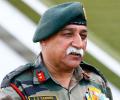
Commissioned into the 5th Gorkha Rifles regiment, he has had an illustrious military career spanning 36 years during which he held several prestigious command, staff and instructional appointments

As Navy chief, Admiral Singh's immediate priority will be to expedite the long-delayed modernisation of the Indian Navy, including by inducting new warships, submarines and aircraft.

'An armed helicopter equipped with counter-drone systems will provide the airborne counter-drone capability and flexibility needed to protect India's critical assets.'

Gen Rawat will be able to serve as CDS for a period of up to three years after the government amended the rules extending the age of retirement to 65 years.

'India needs offensive and defensive security measures to protect itself.'
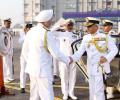
Vice Admiral Sunil Lanba on Sunday took charge as the Flag Officer Commanding-in-Chief of the Western Naval Command from Vice Admiral S P S Cheema at a ceremonial parade held in Mumbai.

Robin K Dhowan on Thursday took over as chief of the Indian Navy nearly two months after D K Joshi quit the post in the wake of a series of mishaps.

'It is pure luck that we did not have any body bags, otherwise things could have been nasty.'
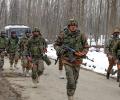
We have a generation of youth in our country with fire in their bellies and the 'tamanna' to emulate the Indian soldier. Such is the image that has been created by our soldiers over time. The proposal for civilians into the Military fray for a short stint must be considered favourably keeping the national interests foremost, says Air Commodore Nitin Sathe (retd).

We salute the Mi-8 today on the occasion of the 32nd anniversary of Operation Cactus. Through its glorious service career, the Mi-8 left an indelible mark on the future by providing the IAF with a lineage of professional helicopter aircrew, says Air Commodore Nitin Sathe (retd).

Defence ministry says the focus was on suitability and merit for the selection of the new Army chief.

Expressing dismay over reports of Indian Coast Guard participating in naval exercises with Sri Lankan Navy, Tamil Nadu Chief Minister J Jayalalithaa on Saturday asked Prime Minister Manmohan Singh to recall the two ships and Coast Guard personnel participating in the event in the island nation.

India and the United States are working on efforts to improve cooperation on UN terrorist designations and expand the sharing of information on known or suspected terrorists "no matter where they may be located," says US Ambassador to India Richard Verma

Lt Gen Bakshi announced 'full support' to the new chief and made it clear that he won't resign.

He was the army commander who planned Operation Bluestar. As army chief he planned Operation Brasstacks which rattled the Pakistan army. General K Sundarji was brilliant, ambitious and controversial, remembers Rahul Bedi.

The 1971 war reaffirmed the importance of inspirational senior leadership in battle and heralded the emergence of a new fighting class amongst officers and men of India's armed forces.

The Sheikh Hasina-Narendra Modi summit put India-Bangladesh ties on a firmer pitch. Brigadier S K Chatterji (retd) takes stock.

'The majority community needs to accept that the Indian Muslim is peace loving, not communal and treat them accordingly.'

'A veiled secret of India's defence and strategic culture is the lack of a serious interest in them by the political class. The Indian National Defence University would fill this void,' feels Lieutenant General Anil Chait (retd).

T P Sreenivasan was India's high commissioner in Fiji in 1987, when Sitiveni Rabuka toppled the Indian-dominated government there. Ambassador Sreenivasan stayed on for two years after the coup, fighting for the rights of the people of Indian origin before he was expelled by Rabuka. 'Meeting Sitiveni Rabuka, who had overthrown a democratically elected government, discriminated against the Fiji Indians, brought untold humiliation and suffering to them, tried to disenfranchise them, ordered me out of Fiji and closed down the Indian high commission was a difficult decision to take even after 25 years,' notes Ambassador Sreenivasan who eventually caught up with Rabuka over a game of golf.

'He was believed to finish his own work in an hour and spend the remainder of the time walking from one office to another, sitting down with the harried junior staff and helping them sort out the problems they were working on.'
 © 2026 Rediff.com - Investor Information - Advertise with us - Disclaimer - Privacy Policy - Sitemap - Feedback - About us - Terms of use - Grievances