
The Supreme Court on Monday deferred to October 13 the hearing on a plea of telecom major Vodafone Idea Ltd seeking quashing of the additional adjusted gross revenue (AGR) demands for the period until 2016-17.
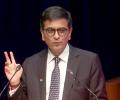
"The doctrinal error in the Krishna Iyer approach was, postulating a rigid economic theory, which advocates for greater State control over private resources, as the exclusive basis for constitutional governance," the CJI wrote in the 193-page judgment.

Former Chief Justice of India D Y Chandrachud has expressed concern about the influence of social media on the judiciary, stating that special interest groups are using it to sway court decisions and judges need to be vigilant. He highlighted the dangers of forming opinions based on short social media clips, emphasizing the nuanced nature of judicial decision-making. Chandrachud also defended the collegium system for judicial appointments and clarified that while there is no legal bar on judges entering politics after retirement, their decisions might be scrutinized differently due to their past roles.

Supreme Court Justice B V Nagarathna dissented against the collegium's recommendation to elevate Patna High Court Chief Justice Vipul Manubhai Pancholi to the Supreme Court, citing concerns about seniority, regional representation, and the circumstances of his earlier transfer.
"The boy came from a marginalised background, could not pay the admission fees of Rs 17,500. He would have lost his admission had we not granted relief then. This is what has sustained me as a judge all these years," the CJI said.

The Supreme Court on Monday took strong note of former Chief Justice of India Ranjan Gogoi being made a party to a PIL and seeking of an in-house inquiry against him for dismissing a plea earlier related to a service dispute.

Several opposition leaders and some lawyers of the Supreme Court reacted sharply to Modi attending the puja at the CJI's residence.

The litigant levelled allegations against the former CJI following which a bench comprising Justices Bela M Trivedi and Satish Chandra Sharma asked the security personnel to escort him out of the courtroom

The Supreme Court has questioned the practice of Governors withholding assent to bills indefinitely, stating that it renders the constitutional provision of 'as soon as possible' meaningless.

The Centre has argued before the Supreme Court that state governments cannot use writ jurisdiction to challenge the actions of the President and Governor regarding bills passed by state assemblies, particularly concerning fundamental rights violations. The President seeks the Supreme Court's opinion on whether states can file writ petitions under Article 32 and the scope of Article 361.
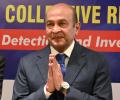
Lok Sabha Speaker Om Birla admitted a notice for the removal of High Court judge Justice Yashwant Varma and constituted a three-member committee to probe charges against him.
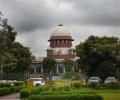
The Supreme Court has stayed the Calcutta High Court's decision that stalled the implementation of a revised list of Other Backward Classes (OBCs) in West Bengal, providing relief to the state government.

The Supreme Court has upheld the deletion of the 'waqf by user' provision in the amended waqf law, stating it is not arbitrary and addresses potential misuse.

In a video, Chandrachud and his wife Kalpana Das were seen welcoming Modi at their house.

Chief Justice of India Sanjiv Khanna has recused himself from hearing pleas related to the alleged illegal felling of hundreds of trees in the Delhi Ridge area. The decision comes after a previous bench, led by former CJI D Y Chandrachud, sought a personal affidavit from Delhi Lieutenant Governor V K Saxena in the case, which also sought contempt proceedings against certain DDA officials. CJI Khanna stated that his prior involvement with the Delhi LG while serving as the NALSA chairman would make it inappropriate for him to hear the plea. The bench has ordered the listing of the pleas before a different bench starting November 27.

The Supreme Court of India has dismissed a plea against the construction of a new passenger jetty and terminal at the Gateway of India in Mumbai, upholding a Bombay High Court verdict that allowed the project to proceed. The project aims to improve passenger travel between South Mumbai and other locations.

He will take oath on November 11, a day after incumbent Justice DY Chandrachud demits office on attaining the age of 65.
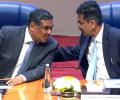
Chief Justice of India-designate Sanjiv Khanna on Friday lauded CJI D Y Chandrachud for his "monumental" contribution, saying he worked on a mission to improve the apex court and pursued his goal of making it "a sanctuary of inclusivity", which was accessible to all.

The Supreme Court refused to stay a provision barring the declaration of tribal lands as waqf properties, upholding key provisions of the Amended Waqf Act.

Chief Justice D Y Chandrachud, who is demitting office on November 10, Wednesday deferred by four weeks hearing on pleas challenging the immunity granted to husbands in cases of marital rape.
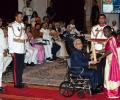
President Droupadi Murmu conferred the coveted Padma awards on 68 eminent personalities, including former Chief Justice of India Jagdish Singh Khehar, dancer Shobana Chandrakumar, actor Anant Nag, and Vice Chancellor of King George's Medical University Soniya Nityanand. The awards were given in various disciplines and fields, including art, social work, public affairs, science and engineering, trade and industry, medicine, literature and education, sports, and civil service. The Padma Vibhushan was awarded to Justice (retd) Khehar for public affairs, while nine individuals received the Padma Bhushan. The Padma Shri was awarded to leading immunologist and KGMU VC Nityanand, footballer Inivalappil Mani Vijayan, singer Ashwini Bhide Deshpande, actor Ashok Laxman Saraf, mask maker Reba Kanta Mahanta, and musician Ricky Gyan Kej, among others.

The CJI's remarks came amid mounting concerns in India over widespread incidents of attacks on the minority Hindu community in Bangladesh after prime minister Sheikh Hasina resigned and fled on August 5 following weeks of violent unrest.

The Supreme Court is scheduled to hear a plea on August 8 seeking directions to the Centre for the restoration of statehood to Jammu and Kashmir. The plea highlights concerns about the delay and its impact on democratic rights and development.

Speaking after laying the foundation stone of the Bombay high court's new complex on land allotted by the Maharashtra government in Mumbai's upscale Bandra area, he noted the mega project was a collaboration between the state and the judiciary to provide modern infrastructure to citizens.
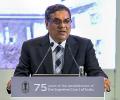
Justice Khanna was elevated as an additional judge of the Delhi high court in 2005 and was made a permanent judge in 2006. He was elevated as a judge of the Supreme Court on January 18, 2019.
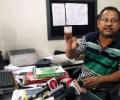
Supreme Court Justice M M Sundresh recused himself from hearing the bail plea of advocate Surendra Gadling, an accused in the Elgar Parishad-Maoist links case. The case has been adjourned multiple times.

Justice Sanjiv Khanna, who has been part of several landmark Supreme Court judgements such as scrapping the electoral bonds scheme and upholding abrogation of Article 370, will be sworn in as the 51st Chief Justice of India on Monday.

In a significant development, the Supreme Court on Thursday recalled its controversial May 2 verdict that had ordered liquidation of Bhushan Power & Steel Limited (BPSL) while setting aside a resolution plan of JSW Steel Limited for the ailing firm. A bench comprising Chief Justice B R Gavai and Justice Satish Chandra Sharma observed that the May 2 judgment, authored by Justice Bela M Trivedi, since retired, did not "correctly consider the legal position as has been laid down in the catena of judgments".

Outgoing Supreme Court Justice Sudhanshu Dhulia bids farewell, expressing his deep connection to the legal community and the country.
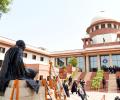
Calling itself the "custodian of the Constitution", the Supreme Court on Thursday asked if it could "sit idle" if a constitutional functionary like governor failed to discharge duties, as it reserved its verdict on the presidential reference on grant of assent to bills.
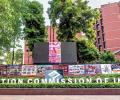
The Supreme Court on Monday granted protection from arrest to psephologist Sanjay Kumar in connection with two FIRs lodged by the Election Commission of India accusing him of spreading misinformation over Maharashtra's electoral rolls through posts on social media.

People get 'so fed up' with the matters of courts that they just want a settlement, Chief Justice of India D Y Chandrachud said on Saturday while highlighting the role of Lok Adalats as alternative dispute redressal mechanisms.

Chief Justice of India D Y Chandrachud on Thursday advised market regulator SEBI and the Securities Appellate Tribunal (SAT) to exercise caution amid a significant surge in equity markets and pitched for more tribunal benches to ensure that the "backbone is stable". Inaugurating the new SAT premises here, CJI Chandrachud pitched for authorities to consider opening up new benches of the SAT given the higher workloads because of higher quantum of transactions and newer regulations.

A two-judge bench of the top court had on August 11 directed authorities in Delhi-National Capital Region (NCR) to start picking up stray dogs from all localities "at the earliest" and relocate the animals to dog shelters.
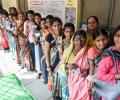
Former chief justices of India, who have conveyed their views to a parliamentary committee on the bill proposing simultaneous polls, have endorsed the constitutionality of the 'one nation, one election' concept but have raised concerns over its various aspects, including the power given to the Election Commission, and offered suggestions.

Chief Justice of India Justice B R Gavai on Friday praised Justice Bela M Trivedi for her career trajectory from the subordinate judiciary all the way up to the Supreme Court, where she became the eleventh woman judge to be appointed in its history.

Expressing concern over instances of 'unwarranted' confiscation of personal devices during raids, the CJI said they highlight the pressing need to strike a balance between investigative imperatives and individual privacy rights.

Shiv Sena-Uddhav Balasaheb Thackeray leader Sanjay Raut on Thursday demanded that Chief Justice India D Y Chandrachud recuse himself from the cases tied to the disqualification petitions concerning rebel Shiv Sena and Nationalist Congress Party MLAs.

The Supreme Court is scheduled to hear on Monday Allahabad high court judge Yashwant Varma's plea seeking invalidation of a report by an in-house inquiry panel which found him guilty of misconduct in the cash discovery row.
The Supreme Court questioned Justice Yashwant Varma regarding his plea to invalidate an in-house inquiry panel report that indicted him after a large amount of burnt cash was discovered at his official residence during his time as a Delhi High Court judge.
 © 2026 Rediff.com - Advertise with us - Disclaimer - Privacy Policy - Sitemap - Feedback - About us - Terms of use - Grievances