
The Supreme Court has questioned the NHAI regarding toll collection on a highway stretch in Kerala where commuters face extreme delays. The court is reviewing a High Court order suspending toll collection due to poor road conditions and severe traffic congestion.

An exasperated Justice Chandrachud asserted he will not allow any lawyer to "dictate" the procedure of the court.
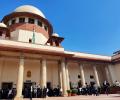
The Supreme Court addressed the issue of probe agencies summoning lawyers for providing legal advice to clients under investigation, emphasising that lawyers should not be summoned merely for offering legal advice but can be if they are assisting in the crime. The court is considering guidelines to prevent investigative overreach and protect lawyer-client privilege.

Union Parliamentary Affairs Minister Kiren Rijiju on Wednesday underlined the government's resolve to take all political parties on board in moving an impeachment motion against Justice Yashwant Varma, saying corruption in the judiciary cannot be approached through a 'political prism'.
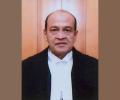
Officials aware of the procedure to appoint and remove Supreme Court and high court judges pointed out that while defending his case before lawmakers in any of the House, Justice Varma can announce that he is quitting and his verbal statement will be considered as his resignation.

Lok Sabha Speaker Om Birla is likely to announce the formation of an inquiry committee to probe the charges against Allahabad High Court Judge Yashwant Varma. A notice signed by 152 MPs was submitted to Birla on July 21.
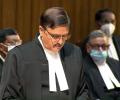
Justice Abhay S Oka, known for his unwavering commitment to liberty and constitutional values, bid farewell to the Supreme Court of India. In his final address, he stressed his dedication to upholding constitutional liberties, emphasizing that it was his "honest endeavor" to fulfill the dream of the Constitution's framers. He also expressed gratitude to the bar and his colleagues for their support and shared heartfelt memories from his time on the bench. Justice Oka's departure marks the end of a distinguished judicial career spanning over two decades, during which he served as a judge of the Bombay High Court, Chief Justice of the Karnataka High Court, and ultimately, as a Supreme Court justice.

The BJP lawmaker sparked a row when he said, "(the) Supreme Court is taking the country towards anarchy" and that "Chief Justice of India Sanjiv Khanna is responsible for the civil wars taking place in the country".
The Supreme Court is hearing arguments regarding a presidential reference on whether fixed timelines can be imposed on governors and the president for acting on bills passed by state legislatures. The court is considering objections to the maintainability of the reference under Article 143 of the Constitution.

The SC has sought a response from the Centre on a plea seeking the restoration of statehood to Jammu and Kashmir.

Raut claimed that by not deciding on the disqualification petitions, Chandrachud kept doors and windows open for defections.
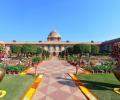
The Supreme Court has ruled that a Governor cannot send bills to the President for consideration if the state assembly has already cleared them for a second time. The court was questioning the Centre over the powers of the Governor when it comes to granting assent to bills.

Chandrachud said it should be ensured that courts provide safe and accommodating environment for all members of the society.

The Centre has opposed the imposition of fixed timelines on governors and the President for decisions on bills passed by state legislatures, arguing that such constraints were intentionally omitted by the Constitution's framers.

The Supreme Court of India dismissed a plea seeking the inclusion of Vinayak Damodar Savarkar's name in the Emblems and Names (Prevention of Improper Use) Act, 1950. The petitioner, appearing in person, argued for the inclusion based on his 30 years of research and claimed a need to establish facts about Savarkar in a legally verifiable manner. However, the court found no violation of fundamental rights and suggested the petitioner make a representation to the Union of India for curriculum inclusion. This dismissal follows the court's earlier reprimand of Congress leader Rahul Gandhi for his remarks on Savarkar at a rally in Maharashtra, although criminal proceedings against Gandhi were stayed.
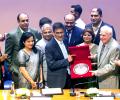
While that created a stir so did the decision on his penultimate day at work with the Supreme Court rechristening its summer vacation "partial court working days", an issue that has led to criticism that the apex court judges enjoyed long breaks.
The Supreme Court questioned Justice Yashwant Varma's conduct regarding an in-house inquiry panel report that found him guilty of misconduct in a cash discovery row. The court raised concerns about his delayed challenge to the inquiry and the implications of the panel's recommendations.

The Supreme Court of India has censured BJP MP Nishikant Dubey for his remarks against the judiciary, stating that his comments "tend to scandalize and lower the authority of the Supreme Court of India." The court dismissed a contempt petition against Dubey but issued a scathing order criticizing his remarks, which included accusations that the court was "taking the country towards anarchy" and that Chief Justice Sanjiv Khanna was "responsible for the civil wars taking place in the country." The court deemed Dubey's statements "highly irresponsible" and indicative of an attempt to "incite religious wars." The order highlighted the importance of maintaining public confidence in the judiciary and condemned attempts to undermine its authority.
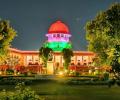
The Centre has told the Supreme Court that imposing fixed timelines on governors and the president to act on bills passed by a state Assembly would amount to one organ of the government assuming powers not vested in it by the Constitution and lead to a "constitutional disorder".

As soon as one of the pleas came up for hearing on Friday, Solicitor General Tushar Mehta, appearing for the Centre, objected and said there can't be an "endless" filing of pleas challenging the Act.

The CJI said there is an urgent need to emerge from the adjournment culture to a culture of professionalism.
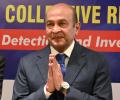
The Union government is considering an impeachment motion against Allahabad High Court judge Yashwant Varma, who was indicted by a Supreme Court-appointed probe panel after burnt cash was found at his residence. The government is likely to consult with opposition parties before moving forward with the motion, which would require a two-thirds majority vote in Parliament.

Amid a heated debate over the three new criminal laws, Chief Justice of India DY Chandrachud on Tuesday refused to comment on them, saying the issues arising from these statutes were pending before the Supreme Court.

'It is a crisis of BJP's own doing. This is an in-house fire.'

Salient features of the National Sports Governance Bill that promise to overhaul several aspects of sports governance and the grievance redressal system for athletes and administrators alike in the country.
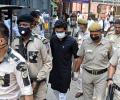
The Supreme Court of India questioned whether former JNU student Sharjeel Imam can be prosecuted in multiple states for sedition based on a single speech. The court is considering a plea to club multiple FIRs filed against Imam in Uttar Pradesh, Assam, Manipur, and Arunachal Pradesh for his alleged inflammatory remarks during protests against the Citizenship Amendment Act (CAA). The court is concerned about the potential for double jeopardy and has indicated that it may transfer the cases to Delhi.

'Day by day we expose how soulless we have become as a society. Every day is a disappointment.'
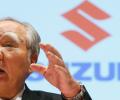
President Droupadi Murmu on Saturday approved 139 Padma awards including seven Padma Vibhushans, 19 Padma Bhushans and 113 Padma Shris.

Disagreeing with the Centre's submission that the petitions seeking legal validation of same-sex marriage reflected an 'urban elitist' view, Chief Justice of India D Y Chandrachud said on Tuesday queerness is not urban or elite, or restricted to upper classes and privileged communities.
Officials aware of the procedure to appoint and remove Supreme Court and high court judges pointed out that while defending his case before lawmakers in any of the House, Justice Varma can announce that he is quitting and his verbal statement will be considered as his resignation.
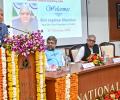
Vice President Jagdeep Dhankhar has questioned the Chief Justice of India's involvement in executive appointments, specifically citing the selection of the CBI director. He believes this practice undermines democratic principles and calls for revisiting the existing norms. Dhankhar also raised concerns about the "doctrine of basic structure", suggesting it has a debatable jurisprudential basis. He emphasized the importance of each institution operating within its constitutional boundaries and highlighted the need for coordinated autonomy. The vice president also discussed the need for a balanced approach to judicial review and the importance of judges focusing on judgments rather than other forms of expression. He stressed the need to revisit the current state of affairs to restore the judiciary's sublimity.

The Supreme Court of India began hearing a batch of petitions challenging the constitutional validity of the Waqf (Amendment) Act, 2025. The bench, led by Chief Justice Sanjiv Khanna, asked both sides to address whether the court should entertain the petitions or relegate them to the high court. The hearing is underway with senior advocate Kapil Sibal arguing for the petitioners. The act, which was passed by Parliament following heated debates, has been challenged by various parties including AIMIM leader Asaduddin Owaisi, All India Muslim Personal Law Board (AIMPLB), and Jamiat Ulama-i-Hind.
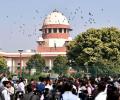
The Supreme Court on Monday agreed to hear a plea of Ashoka University's political science department head Ali Khan Mahmudabad challenging his arrest for social media posts related to Operation Sindoor.
A bench comprising Chief Justice B R Gavai and Justices Augustine George Masih and AS Chandurkar also directed that the offending video be immediately taken down and restrained the YouTube channel from republishing it or similar content.

The Congress party has accused the BJP of engaging in "damage control" after the party distanced itself from comments made by two of its MPs, Nishikant Dubey and Dinesh Sharma, criticizing the Supreme Court. Congress general secretary Jairam Ramesh stated that the BJP's clarification was merely an attempt to mitigate the damage caused by the MPs' remarks and that the party's actions were hypocritical, given the silence of the BJP president on similar comments made by other party members.
The Supreme Court has initiated a suo motu case regarding investigation agencies summoning lawyers and will examine if they can be put to notice. The action follows the Enforcement Directorate summoning senior lawyers, which was condemned by bar associations.

Chandrachud said there were several comments on the social media which alleged that the CJI is "so arrogant" that he got up in the midst an important argument in court.

A three-member panel led by the Chief Justice of India (CJI) Sanjiv Khanna has been formed to probe the discovery of "four to five semi-burnt sacks" of Indian currency notes found after a fire at the residence of Delhi High Court judge Yashwant Varma. The incident, which occurred on March 14, has triggered an in-house inquiry, with the findings determining the judge's fate. The panel, consisting of Chief Justices Sheel Nagu (Punjab and Haryana), G S Sandhawalia (Himachal Pradesh), and Karnataka High Court judge Anu Sivaraman, will conduct a "deeper probe" into the allegations. Justice Varma has denied any knowledge of the cash being stored in the storeroom. The inquiry follows the Delhi High Court Chief Justice Devendra Kumar Upadhyaya's report that recommended a deeper investigation. The top court's 2014 guidelines for in-house procedures for probing allegations against judges will be followed during the inquiry. The panel's findings could lead to either the removal of the judge, if the misconduct is deemed serious, or a reprimand. The inquiry will also determine if the fire was indeed a short-circuit as initially reported.

The Supreme Court of India has rejected a plea by a woman claiming to be the legal heir of the Mughal emperor Bahadur Shah Zafar-II, seeking possession of the Red Fort in Delhi. The court termed the plea as "misconceived" and "meritless", dismissing the petition against the Delhi High Court order. The petitioner, Sultana Begum, argued that her family was deprived of the Red Fort by the British East India Company after the first war of Independence in 1857. The court, however, dismissed the petition, citing the delay in filing the appeal and the lack of justification for the claim.
A Constitution bench comprising Chief Justice B R Gavai and Justices Surya Kant, Vikram Nath, P S Narasimha and A S Chandurkar, would fix the timelines on July 29 and commence hearing on the presidential reference in mid-August.
 © 2026 Rediff.com - Advertise with us - Disclaimer - Privacy Policy - Sitemap - Feedback - About us - Terms of use - Grievances