The lessons learned from the failure of Chandrayaan-2 contributed to the success of India's third lunar mission, former space scientist with the Indian Space Research Organisation (ISRO) Nambi Narayanan said, after the successful touchdown of the 'Vikram' lander on the lunar South Pole.

The next operation - reduction of orbit- will be done at 11 PM on Sunday, ISRO added.

'ISRO's style is a terrific example of being able to survive, acknowledge failures, and then most importantly of all, learn from them to ensure that subsequent missions are successful.'

Here is a glimpse of the journey of India's third lunar exploration venture has taken so far.

At least four babies, three boys and a girl, who were born in the Kendrapara district hospital here on Wednesday evening were named so by their overwhelmed parents.
Sachin Tendulkar, Sania, Mirza, Anil Kumble and Virat Kohli hailed Moon mission Chandrayaan-3's successful landing
This is the third time that Tamil Nadu has supplied the necessary soil to the Bengaluru headquartered space agency for performing the tests for its ambitious Moon missions.
Congratulate ISRO and the Chandrayaan-3 team on their magnificent achievement by sending an e-mail to news1995@rediffmail.com
'Perhaps the government should explain how the same scientific temper, which authored a precise landing for Chandrayaan-3, finds the periodic table and the theory of evolution not good enough for inclusion in the educational curriculum,' asserts Shyam G Menon.

India will become the fourth country to master the technology of soft-landing on the lunar surface after the US, China and the erstwhile Soviet Union.

Happy Bharatvasis are creating living portraits as tributes to India reaching the moon.

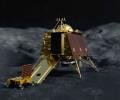
The spacecraft will now prepare for separation of the lander module -- comprising the lander and rover -- from the propulsion module.
New data from India's Chandrayaan-3 mission suggests that ice might be present at more locations on the Moon's surface than previously believed. The study, published in Communications Earth and Environment, analyzed temperature data collected by the ChaSTE probe onboard the Vikram lander. The researchers found that significant variations in surface temperatures can influence the formation of ice, with slopes angled away from the Sun potentially providing favorable conditions for ice accumulation. The findings have implications for future lunar exploration, suggesting that water-ice resources could be more accessible than previously thought.

The mission objectives of Chandrayaan-3 are to demonstrate a safe and soft landing on the lunar surface, to demonstrate rover roving on the Moon, and to conduct in-situ scientific experiments.

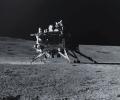
The Vikram lander was 100 kilometers away from LRO, near Manzinus crater in the Moon's south pole region, when LRO transmitted laser pulses toward it on December 12 last year.
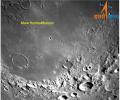
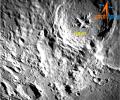
This camera that assists in locating a safe landing area -- without boulders or deep trenches -- during the descent is developed by Ahmedabad-based Space Applications Centre (SAC), a major research and development centre of ISRO.

The next firing is planned for Tuesday between 2 pm and 3 pm. it said.

India's lunar mission Chandrayaan-3 holds immense potential for gathering critical data and will significantly contribute to the understanding of the Moon, a former top National Aeronautics and Space Administration (NASA) official has said, describing India-United States space partnership further moving to the moon.

'ISRO Chairman Dr. Somanath's leadership truly created history and we extend our hearty congratulations to him and his team,' Venugopal said on X, formerly Twitter.

Besides the scientists at the Indian Space Research Organisation, officials at the European Space Agency are also involved in tracking the lander module of the Chandrayaan-3 mission which is minutes away from making a soft landing on the surface of the moon, a senior scientist said on Wednesday.

The Laser-Induced Breakdown Spectroscope instrument onboard 'Pragyan' rover of Chandrayaan-3 has 'unambiguously confirmed the presence of sulphur in the lunar surface near south pole, through first-ever in-situ measurements,' ISRO said on Tuesday.
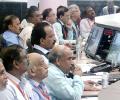
Leading scientists and experts said this monumental accomplishment not only marks India's indelible imprint on lunar exploration but also demonstrates the prowess of human collaboration, determination, and cutting-edge technology.

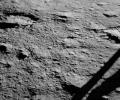
India created history on Wednesday when the lander module of Chandrayaan-3 touched down on the lunar south pole, propelling the country to an exclusive club of four and making it the first country to land on the uncharted surface.
The team led by researchers from the University of Hawai'i (UH) at Manoa in the US discovered that these electrons in Earth's plasma sheet are contributing to weathering processes -- breaking down or dissolving of rocks and minerals -- on the Moon's surface.
The Indian Space Research Organisation (ISRO) has successfully de-docked the SpaDeX satellites, a significant achievement that clears the path for future missions such as exploring the moon, human spaceflight, and building India's own space station. The de-docking, announced by Union Minister Jitendra Singh, follows a successful docking experiment conducted in January. The SpaDeX mission involved launching two satellites, SDX01 and SDX02, to demonstrate the docking technology in space.

From The New York Times to BBC and The Guardian to The Washington Post, the historic event in India's space programme on Wednesday made headlines across the globe.
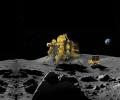
This eagerly anticipated event will be broadcast live on August 23, starting from 17:27 Hrs IST on multiple platforms, including the ISRO Website, its YouTube channel, ISRO's Facebook page, and DD National TV channel.
The cryogenic upper stage of the LVM3 M4 launch vehicle, which successfully injected the Chandrayaan-3 spacecraft into the intended orbit on July 14 this year, made an uncontrolled re-entry into the Earth's atmosphere, the ISRO said.

The entire mission operations of Chandrayaan-3, right from the launch till landing, "happened flawlessly" as per the timeline, the team that led India's third mission to the Moon said on Wednesday.

Former National Aeronautics and Space Administration (NASA) Official Mike Gold has said Chandrayaan-3's success is a triumph of Indian innovation, human capital and the capabilities that will take India even further.

ISRO chairman S Somanath on Monday said instead of a success-based design in Chandrayaan-2, the space agency opted for a failure-based design in Chandrayaan-3, focused on what all can fail and how to protect it and ensure a successful landing.

Rajasthan Sports Minister Ashok Chandna made the slip hours before the touchdown by Chandrayaan's lander on the lunar surface - an unmanned landing eagerly anticipated across the country.
A number of private companies have contributed to the development of ISRO's Chandrayaan-3 spacecraft which successfully landed near the south pole of the Moon on Wednesday evening.
A PSLV rocket carrying Earth observation satellite EOS-09 failed to launch from the Sriharikota spaceport early on Sunday.

Chandrayaan-3 is now in an orbit, which when closest to Earth is at 173 km and farthest from Earth is at 41,762 km, the space agency said.
As scientists at the Indian Space Research Organisation (ISRO) gear up for the much-awaited soft landing of the Chandrayaan-3 spacecraft on the Moon's surface, the space agency may postpone the touchdown to August 27 in the event that health parameters of the lander module are found to be "abnormal", a senior official has said.

'A person weighing 68 kilograms on the Earth would weigh only over 11 kg on the Moon'

Kareena Kapoor says that like any other Indian, she is also waiting 'with bated breath' for Chandrayaan 3 to land on the Moon's surface and she plans to watch the event with her children.

The initial assessment of the first-ever measurements of the near-surface lunar plasma environment over the south pole region by RAMBHA-LP payload onboard Chandrayaan-3 lander indicates that plasma there is relatively sparse, ISRO said on Thursday.
Mainstream American newspapers, many of which had been sceptical of India's space mission and sometimes even made fun of it through cartoons, noted the great Indian achievement.
 © 2026 Rediff.com - Investor Information - Advertise with us - Disclaimer - Privacy Policy - Sitemap - Feedback - About us - Terms of use - Grievances