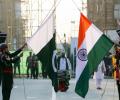
The UN Security Council will hold closed consultations on Monday on the situation between India and Pakistan after Islamabad sought an emergency meeting on the issue. Pakistan, which currently sits as a non-permanent member of the council, requested the meeting in light of rising tensions between the two countries following a terror attack in India. The meeting comes after India's foreign minister spoke with all council members except China and Pakistan, emphasizing the need to bring perpetrators of the attack to justice. The Pakistani envoy has argued that the situation in Jammu and Kashmir poses a threat to regional and international peace and security, justifying the need for a council discussion.

UN Secretary-General Antnio Guterres expressed concern over the heightened tensions between India and Pakistan, calling for maximum restraint and urging both countries to step back from the brink. Guterres offered his "good offices" to both governments in the service of peace and condemned the recent terror attack in Pahalgam, emphasizing the need to bring those responsible to justice. He also stressed that a military confrontation would be detrimental and could easily spin out of control. His remarks came hours before a closed consultation of the UN Security Council on the matter, requested by Pakistan. The UN Secretary-General highlighted the need for de-escalation, diplomacy, and a renewed commitment to peace.
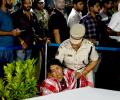
The ISI strategy has been to use its proxies to target Hindus in India. They want an outrage and counter-targeting of India's minorities. Further, even the whiff of it restores the Pakistan army's popularity, especially when it's in the dumps, like now, points out Shekhar Gupta.

'It is important India to stay focussed on its primary national objectives: Combating terrorism; not losing sight of other security and strategic concerns (on the Sino-Indian front for instance); ensuring a strong economy and registering growth which includes improving the lot of common people; and finally making certain that the social fabric remains intact and harmony among people is not jeopardised, at least any further,' asserts Nilanjan Mukhopadhyay.
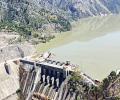
Pakistan has halted the construction of contentious canals in Punjab province after India suspended the Indus Waters Treaty following a deadly terrorist attack in Kashmir. The decision to suspend the canals project was made after Prime Minister Shehbaz Sharif met with PPP chairman Bilawal Bhutto-Zardari and agreed to address the concerns of Sindh province, where the project had sparked protests. The canals project, aimed at irrigating the desert region in Punjab, was seen as a threat to water resources in Sindh. Both sides have agreed to seek consensus on the issue in the Council of Common Interests (CCI), a high-powered inter-provincial body. Meanwhile, Pakistan has reiterated the importance of the Indus Water Treaty for its water security and economy, and condemned India's move to suspend it.
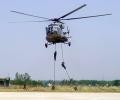
'Pakistan cannot sustain a war with India for more than four days. They are in such dire straits. At best they can sustain war for one week.'
'Unlike the surgical strikes and the Balakot air strikes across the LoC, we have gone further inside Pakistan and raised the bar of escalation.'

'Had Haji Pir and/or Skardu been taken, the message would have gone out not just to General Asim Munir and his cohort in the Pakistan army but to the Pakistani people that every terrorist incident in India would lead to substantial loss of territory in PoK.'
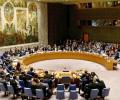
The United Nations Security Council held closed-door consultations on rising tensions between India and Pakistan, with envoys calling for restraint and dialogue. The consultations, requested by Pakistan, lasted for about an hour and a half. UN Secretary-General Antonio Guterres expressed concern over the tensions, urging both countries to avoid a military confrontation. India's former Permanent Representative to the UN, Syed Akbaruddin, said that no consequential outcome could be expected from the discussion.
'Whatever we do, the purpose will be to re-establish deterrence.'

'The Pakistanis called the US state department and said we agree with India on peace.' 'It was then that US President Donald Trump jumped in and took credit for the ceasefire.'

Azmi said during Aurangzeb's reign, India's border reached Afghanistan and Burma (Myanmar).

'The lesson Beijing would have learned is that there is, cost-benefit wise, no better option than to keep the Pakistan military supplied with its most advanced armaments, certain that in hostilities with India these would be used for maximum effect.'

'Even known names and social media handles went berserk by stating that Karachi has been attacked and an F-16 was shot down.'
'He is intrigued by the intractability of Kashmir issue. With his interest in dealmaking and peacebrokering, he sees it as an exciting challenge to tackle.'
'One good outcome of Operation Sindoor -- perhaps, its best outcome -- could be that India has resumed meaningful contact directly with Pakistan at the military-to-military level,' observes Ambassador M K Bhadrakumar.
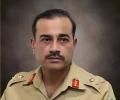
Pakistan's Chief of Army Staff Gen Syed Asim Munir visited Balochistan on Saturday amid clashes in the restive province in which 18 security personnel and 23 terrorists have been killed in the last 24 hours. The army chief was given a comprehensive brief on the prevailing security situation in the province and offered prayers at the funeral of the slain soldiers. He also visited the injured soldiers in the Combined Military Hospital Quetta. The military said the terrorists were killed in different areas of troubled Balochistan in the last 24 hours. Terror attacks have increased since the banned militant Tehreek-e-Taliban Pakistan group broke a fragile ceasefire agreement with the government.
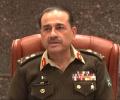
Aware of simmering dissensions within the top echelons of the army, Munir has moved slowly in reshuffling senior generals, observes Rana Banerji, who headed the Pakistan desk at RA&W, India's external intelligence agency.
'It was inspired by the Hamas attack and was like their attack -- well planned and well executed.'
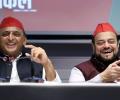
Samajwadi Party MLA Abu Asim Azmi, suspended from the Maharashtra assembly over his remarks praising Mughal emperor Aurangzeb, will be '100 per cent' put in jail, Chief Minister Minister Devendra Fadnavis said in the legislative council.

The Pahalgam massacre highlights the evolution of terrorism into a multi-domain challenge. India's response must similarly evolve -- from tactical retaliation to comprehensive strategic deterrence. To establish a credible and sustained deterrent, India must also carry out continuous kinetic operations, both overt and covert, suggest Sakshit Raina and Rahul Mishra. To establish a credible and sustained deterrent, India must also carry out continuous kinetic operations, both overt and covert, suggest Sakshit Raina & Rahul Mishra.
'I am worried that Pakistan will still feel compelled to take substantive military action beyond this apparent drone activity.' 'If so, the crisis could persist for a while more and dangerous days are still ahead.'
'Right now, we have no relationship with Pakistan. And the relationship with China is not great.'
'This strike has certainly enhanced your image.' 'Otherwise, people would have called you a damp squib, capable of doing nothing except talking big.'
'There's something called deterrence by punishment.' 'That means you hit in a manner calculated to raise costs and consequences for Pakistan, so that the next time it attempts a Pahalgam-like attack, it has to think ten times.'

'Fears in Washington began to intensify when it was realised that subsequent Pakistani and Indian attacks on major military facilities -- which were significant in terms of geographic scope and intensity -- could rapidly take both sides to where neither actually wanted to go.' 'The US objective was to stop the fighting as soon as possible. Everything else was secondary.'

Images from the ICC Champions League Group B match between Afghanistan and Australia in Lahore, on Friday.

Samajwadi Party MLA Abu Asim Azmi was on Wednesday suspended from the Maharashtra legislative assembly till the ongoing budget session ends on March 26, over his remarks eulogizing Mughal emperor Aurangzeb.
It is time we buried the mantra of 'peaceful and stable Pakistan is in our interest'. It is not, simply because Pakistan's existence -- that is synonymous with its army -- means peace has no chance, asserts Colonel Anil A Athale (Retd). It is time we buried the mantra of 'peaceful and stable Pakistan is in our interest' asserts Colonel Anil A Athale (Retd).

Samajwadi Party MLA Abu Asim Azmi's remarks praising Mughal emperor Aurangzeb sparked outrage in the Maharashtra legislature, leading to calls for his suspension and accusations of treason. The issue, which was politicized by both the ruling coalition and opposition parties, led to the adjournment of both Houses of the state legislature. Azmi later retracted his statements, saying they were twisted and that he had not made any derogatory remarks against Shivaji Maharaj or Sambhaji Maharaj. The BJP, however, seized the opportunity to slam the Congress and other opposition parties, accusing them of trying to "eradicate" Sanatan Dharma. The Mumbai police have initiated a probe into the matter, registering a case against Azmi for his remarks.

Asim Malik's shift to the important DG, ISI post comes as something of a surprise now, but it indicates the army chief's confidence in him, notes Rana Banerji, who headed the Pakistan desk at RA&W.
Terrorism and insurgency in J&K had subsided when India demolished East Pakistan -- for the simple reason that Pakistan understands power. We need to follow Chanakya's dictum of Saam, Daam, Dand, Bhed for strategising against Pakistan, asserts Lieutenant General Prakash Katoch (Retd). The ground truth is that unless we are prepared to acknowledge our shortcomings, including massive intelligence failures, punish those responsible and take corrective actions, we will continue in the same vein, asserts Lieutenant General Prakash Katoch (Retd).
'It could be the Pakistan army's commercial interest, tactical or strategic interest or one of their leaders.' 'Even if you send a message that we have attempted to kill one of the Pakistani generals, that itself will serve the purpose.'
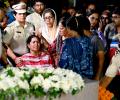
The dastardly dimensions of the attack are gradually sinking in even as the Government of India announced its immediate diplomatic and other retaliatory measures. It is generally expected to be followed up with punitive military action across the LoC, sooner than later, observes Mohammad Sayeed Malik, the distinguished commentator on Kashmir affairs.

A 26-year-old woman, who works in the health sector, was allegedly raped by a history-sheeter, Dattatray Gade (37), inside a stationary state transport bus at Swargate terminus in the early hours of Tuesday (February 25), according to the police.
A Mumbai court has granted anticipatory bail to Samajwadi Party MLA Abu Azmi in a case filed against him for his remarks praising Mughal ruler Aurangzeb. The court, however, cautioned Azmi to exercise restraint during interviews, warning that any irresponsible statement could spark riots. The case stems from Azmi's remarks during an interview where he praised Aurangzeb's rule and claimed that India's GDP during his reign accounted for 24 percent of the world's GDP. Azmi's lawyer argued that his client's statements were made spontaneously and without any malicious intent, while the prosecution opposed the bail plea, arguing that the remarks were made in a sensitive time following the release of a film based on the life of Chhatrapati Sambhaji Maharaj, a revered Maratha king who was captured by Aurangzeb. The court noted that the investigation was at a preliminary stage and that the investigating officer did not have the video recording of the interview when the case was filed. The court also expressed concern over the potential for Azmi's remarks to incite violence.

The outcome of the last group match between India and New Zealand on Sunday will determine if Australia or South Africa will face Rohit Sharma and Co in Dubai.

The full implications of the India's refusal to play Champions Trophy matches in Pakistan were laid bare on Sunday as Australia and South Africa waited to find out whether they will play their semi-finals in Lahore or Dubai this week.
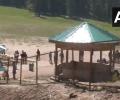
'If they aim to remain aligned with the public sentiment, as any democratic government should, then they must respond. Why else would the prime minister have cut short his visit to Saudi Arabia? And why would he have instructed the home minister himself to travel to Srinagar to assess the situation firsthand? This suggests that something is indeed being planned. I am quite certain of that, although the exact form it will take remains to be seen.'

Before the violence and rioting that erupted in Nagpur on Monday, March 17, over Mughal emperor Aurangzeb's tomb came provocative statements from various political leaders.
 © 2026 Rediff.com - Investor Information - Advertise with us - Disclaimer - Privacy Policy - Sitemap - Feedback - About us - Terms of use - Grievances