
After big win in Bihar, the BJP is likely to push harder in Tamil Nadu, where the DMK government and the uneasy BJP-AIADMK alliance are preparing for a tense election filled with seat-sharing fights, changing alliances, and the unpredictable entry of Vijay's TVK party, predicts N Sathiya Moorthy.
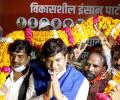
'Without our support Nitish Kumar wouldn't have become chief minister.' 'After the government was formed we became ministers, but our agenda remained the same: Amit Shah had promised reservation for Nishads.' 'He wouldn't listen, so we went to UP and contested 52 seats in the 2022 elections. He didn't like the idea of rebellion.' 'He saw that this man, coming from Bombay, is very sharp. He's made four MLAs now, tomorrow he'll make 40. A time will come when they will make it 125.' 'They bought our MLAs and ousted us from the government.'
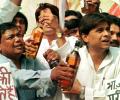
As the election nears, political positions on prohibition are shifting.

BJP strategists know it may not repeat its 2014 performance in its traditionally strong bases in the north and the west. This is where the success in the north east and east is so important.

'The people of Uttar Pradesh have already made up their mind to puncture the Samajwadi Party's cycle, kick away the Bahujan Samaj Party's elephant, and remove shadows of the already-vanished hand of the Congress.'
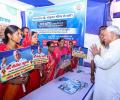
For nearly two decades, Nitish Kumar has cultivated women as a distinct constituency. 'To create a broader vote base, he thought it would be better to bring women to electoral politics.'

'He has emerged as a formidable leader who cannot be ignored anymore, who cannot be mocked.'

P Chidambaram and Rajeev Shukla of the Congress, Bharatiya Janata Party's Sumitra Valmiki and Kavita Patidar, former Congress leader Kapil Sibal, Rashtriya Janata Dal's Misa Bharti and Jayant Chaudhary of the Rashtriya Lok Dal were among the 41 winners declared elected unopposed to Rajya Sabha.

The BJP's strategy seem to be to wean away allies from the Congress, in Dravidian Tamil Nadu, and maybe later in UP, Bihar and elsewhere, though in slow doses, but without wooing them into a new alliance. The idea seems to be only to weaken the INDIA bloc from within -- and leaving it at that, notes N Sathiya Moorthy.

Polling for three parliamentary seats and 29 assembly constituencies were held on October 30, an exercise being seen as a barometer of the political mood in the country ahead of assembly elections in politically critical Uttar Pradesh as well as other states.
For the 2019 polls, the BJP chief deployed over 7,000 leaders to oversee the work of polling committees on the over 400 seats the BJP contested. These committees were asked to focus on 120 seats the party had lost in 2014, but believed it could win in 2019.

Mayawati was outmanoeuvred by the BJP in the race for the Rajya Sabha in Uttar Pradesh just days after she helped the Samajwadi Party snatch two Lok Sbaha seats from the saffron party in bypolls.

'He is a key fulcrum point in the pan-Indian creation of an effective Opposition to the BJP.'

Janata Dal-United President Sharad Yadav was on Thursday elected unopposed to the Rajya Sabha from Bihar, but in two other seats, the party's official candidates were facing stiff challenge from Independents backed by rebels and the Bharatiya Janata Party.

From the voter-level, traditionally anti-BJP, anti-Hindutva minorities and other secular voters would have an option, especially in the face of the mounting anti-incumbency against the ruling party -- as it happened in the 2001 assembly polls, points out N Sathiya Moorthy.
It is likely that the party's allies in Tamil Nadu and West Bengal, two of the five states going to the polls in April-May, might insist on allocating fewer seats than they did in 2016, reports Archis Mohan.
Counting of votes in all elections will be held on May 2.

From opposing the NPR and NRC to demanding special status for Bihar to staying out of the Union Cabinet on principle to showing the BJP who was boss in Bihar, Nitish Kumar has wasted no opportunity at cocking a snook at the BJP leadership. But how long can he continue, asks Gopal Krishna.
'The poor manner in which the RJD stitched its alliance and mismanaged its electioneering, now reveals that Tejashwi was more interested in enhancing his political stature by cutting down many senior leaders, by downsizing and shrinking RJD allies, by displaying arrogance and inaccessibility and by committing silly mistakes in candidate selection,' points out Mohammad Sajjad.

While the DMK fears that the Congress with its poor strike rate will pull it down in the 2021 state elections, like it did five years ago, the ruling AIADMK is worried that the BJP may ultimately do a Bihar on it, relegating it to second place in Tamil Nadu, says N Sathiya Moorthy.
Amit Malviya has been pilloried for allegedly threatening journalists, indulging in fake news and generally bringing a bad name to his party.
Indians are election junkies, and that includes all of us -- political parties, aspirants for seats, pollsters, pundits parsing straws in the wind, says Shreekant Sambrani

The BJP in the last few years lost a major ally like Telugu Desam Party but also gained a big regional partner like All India Anna Dravida Munnetra Kazhagam and several smaller allies in northeastern states.

'Delhi 2015 is a warning of an intensifying nightmare in the offing.'

The Congress president's election comes up early next year and party workers fear Sonia may pass on her mantle to Rahul. If that happens or if she continues to remain at the helm but Rahul calls the shots, there could be large scale desertions of workers and leaders worried about their future.

'At this moment, the Trinamool has an edge.'
Exit polls often go wrong in India because pollsters don't sample voters in the poorest parts of the country or the core support bases of different political parties, explains Professor Atanu Biswas of the Indian Statistical Institute, Kolkata.
'Never before in Bengal had a single party been re-elected with two-thirds of the assembly,' notes Trinamool Congress MP Derek O'Brien.

JD-U leaders believe Prashant Kishor's entry would benefit its case for contesting a larger number of seats in Bihar in next year's general election.

'The Bihar verdict has shown that the people of Bihar don't desire to go back to the mandir-masjid rhetoric.' 'Jobs, wages and development are the aspiration of the people of Bihar and we hope the next government will keep that in mind.'

'Modi is still immensely popular and, therefore, he can sustain any number of policy failures.' 'Modi himself has worn multiple faces so it would be naive to think that the Modi of 2021 will be the same Modi that will be campaigning for re-election in 2024.'

Stalin, like his father M Karunanidhi did in 2004, may play the king-maker in a way -- not the king, unless the 2024 post-poll circumstances throws up a situation where he alone becomes acceptable to the rest, observes N Sathiya Moorthy.

For the first time in seven years the prime minister finds himself at his most vulnerable, observes Virendra Kapoor.

'Modi had not discussed demonetization with me prior to his announcement on 8 November 2016. 'I learnt of it along with the rest of the country. 'I was not surprised when he did not discuss the issue with me prior to making the public announcement. 'It fitted in with his style of making dramatic announcements.' A fascinating excerpt from Pranab Mukherjee's The Presidential Years: 2012-2017.
The Mamata Banerjee-led party, which has often been mocked by opponents for not having a well-defined ideological plank, seems to have finally found its calling in Bengali sub-nationalism, as a section of top party leaders feel only an 'inclusive message of regionalism, which the Bengalis can identify with, will counter the aggressive nationalism and Hindutva practised by the saffron camp'.
It looks as if competing political parties in Tamil Nadu have not grasped the full impact and import of a sizable section of voters possibly staying away from voting -- voters, supposedly with a predictable polling pattern -- owing to the Covid second wave and more so, how it could affect the outcome in individual constituencies and even booths, says N Sathiya Moorthy.
After Bihar elections, Rahul Gandhi's go-it-alone strategy seems to have taken a back seat.

'Consider this image of today's youth in Bihar -- armed with a bike, a smartphone and possibly some illegal arms too, imbibing incessant stream of images from the Internet and television.' 'Some of them would turn into gau bhakts, some would listen with interest the exploits of Salafism, dig deep into the Internet to come out with images which cry vociferously that their respective religions are in danger.'
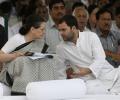
The leadership styles of the two Gandhis being different, the party appears to be pulling in different ways. While Sonia Gandhi, the longest-serving Congress president, seems more predisposed to holding the government accountable on issues of probity, the younger Gandhi is more keen on taking up battles that ensure immediate victories.

From Narendra Modi's victory in 2014 to the Nitish-Lalu triumph in 2015 and delivering Assam to the BJP in 2016, young and very professional strategists have startled politicians and the media.
 © 2026 Rediff.com - Investor Information - Advertise with us - Disclaimer - Privacy Policy - Sitemap - Feedback - About us - Terms of use - Grievances