
Pakistan Prime Minister Shehbaz Sharif announced that Pakistan would host the signing ceremony of a peace agreement between the US and Iran in Switzerland on June 19, calling it a "historic milestone" that ends a 107-day conflict and promises global economic stability.

A peace deal between the US and Iran, set to be signed in Geneva, faces significant hurdles over the release of Iran's USD 12 billion in frozen assets, with conflicting reports from both sides on the conditions for their release.

Trump further alleged that Iran was behind the attacks on three vessels carrying Indian seafarers near the Hormuz Strait, which resulted in the deaths of three, despite the US Central Command having confirmed that the strikes were carried out by American naval forces, calling the incident "totally unacceptable."

Author of over 100 books, he served as the secretary general of Lok Sabha from 1983 to 1990.

Earlier, Israeli Prime Minister Benjamin Netanyahu also declared that Iran would never be allowed to acquire nuclear weapons, regardless of any agreement.

Much will depend on how the protagonists use the current interlude to work proactively for the beginning of a durable settlement or, on the contrary, prepare for a new round of escalation, points out Ambassador M K Bhadrakumar.

US Vice President JD Vance on Friday dismissed reports suggesting that Iran would receive financial incentives merely for signing the peace deal between Washington and Tehran aimed at ending the hostilities in West Asia, calling such claims "fake information".

The urgency for a resolution is underscored by the military situation, as joint operations by Israel and the US have consistently been "targeting Iran's missile systems, launch sites and other critical infrastructure" since the onset of the conflict.
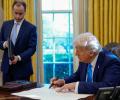
White House Press Secretary Karoline Leavitt noted that progress has been made in the Geneva talks with Iranian authorities, but the two nations stand 'far apart' on certain issues.

...is a way out, notes Prem Panicker in his must read blog on the Iran War. What the indefinite extension produces is a prolonged condition of not-war-not-peace, in which oil markets cannot stabilise, Asian refineries cannot plan, European governments cannot stop subsidising consumption they cannot afford, and the next flashpoint -- a seized tanker, a miscalculated drone strike, a Truth Social post that claims too much -- is one news cycle away.

Saudi Arabia and the UAE are actively pushing Trump to take the war to its bitter finish and 'erase' Iran's presence in the geopolitics of the region. Simply put, the two most powerful Sunni Arab oligarchies are on the same page as Israel. Such interference increases the risk of a breakdown in dialogue between the US and Iran, points out Ambassador M K Bhadrakumar.

Both sides have now revealed a preference for escalation over strategic defeat, and each new provocation narrows the space for the next pause. The Touska seizure, Iran's refusal to negotiate under blockade, Israel's strikes on Iranian oil infrastructure -- all of these add up to an increasingly untenable situation. This makes the wild card -- Trump and his motormouth -- more consequential than ever, notes Prem Panicker in his must read blog on the Iran War.
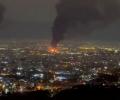
To be sure, Trump is furious, as the trajectory of the war is in a state of Zugzwang, as chess players call it. Trump and Netanyahu stare at two choices -- retreat in humiliation and concede Tehran's demands -- recognition of its rights, reparations, and binding security guarantees -- or perish in a quagmire, points out Ambassador M K Bhadrakumar.
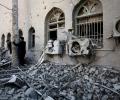
The logic of war plus the gathering storms in US politics as the midterms loom large leave him with no real alternative but to negotiate, points out Ambassador M K Bhadrakumar.

For weeks, the war skirted the edge of catastrophe without tipping over. Missiles flew, there was much destruction, commanders were assassinated, cities across the Gulf and even in Israel struggled to absorb the shock. But one line held: Energy infrastructure, the arteries of the global economy, remained largely untouched. That is no longer true. Prem Panicker continues his must read daily blog on the Gulf War.

Iran launched retaliatory military strikes targeting Israel and American military bases across the region, including in Qatar, the United Arab Emirates, Kuwait, Bahrain and Jordan.

'Was the five-day pause ever meant to hold, or was it simply another instrument of signaling, of positioning, of buying time in a war where even the pauses are tactical?' asks Prem Panicker in his must read daily blog on the Gulf War.

The United States, which entered this war in expectation of a short, sharp win along the Venezuela model, is now preparing for deeper involvement in a conflict it does not fully control, without the allies it typically relies on, against an adversary that is not behaving as expected, in a global environment that is already absorbing economic shock. Prem Panicker continues his must read daily blog on the Gulf War.
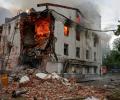
Ukrainian President Volodymyr Zelenskyy on Sunday said that a "dignified end" to the war was possible given that the US was demonstrating a constructive approach.

Alliances fight wars effectively only when they share an endgame. If Israel acted without US knowledge, then the military alliance is operating without real coordination at the level of strategic targeting. Neither picture is reassuring in a war that is no longer regional in its consequences. Prem Panicker continues his must read daily blog on the Gulf War.

'To suddenly give the impression of taking a position that is hostile to Iran, or, at least, not friendly to Iran, is not a good thing.'

When everyone has footage and no one can verify it, the loudest voice wins, notes Prem Panicker who begins a daily blog on the War in the Middle East.
United States President Donald Trump has opened a two-week window for diplomacy with Iran before deciding on military action, aiming to restart stalled negotiations amid Israel's bombing campaign, CNN reported.
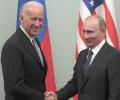
Earlier this month, the White House said that US President Joe Biden believed that his meeting with his Russian counterpart Vladimir Putin will be a good step forward in the US-Russia relationship to de-escalate tensions and have stable relations.
Of Trump's reciprocal tariffs and trade deals
'Trump's desire to withdraw the US from some arenas on the global stage will result in ceding space to China.'

Prime Minister Manmohan Singh is leaving for a nine-day long tour on November 21.Dr Singh will take a break in Geneva before reaching Washington on the evening of November 22. He, along with his wife Gursharan Kaur, will stay at the luxurious and heritage Hotel Willard Inter Continental. The hotel is located at 1401, Pennsylvania Avenue, just two blocks away from the White House.

'The touchstone is reciprocity which will be applied to friends and foes alike.' 'It will be a bitter pill to swallow.'

Times have changed, situations have changed, but the basic nature of superpower geo-politics remains the same and so also India's diplomacy -- call it non-alignment, strategic autonomy or neutrality; it all depends on the time scale, notes Rup Narayan Das.
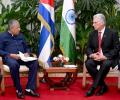
The warmth and respect for India were evident wherever I went and noticed how most Latin Americans have Indian gurus either directly or online and yoga was very much in vogue, observes Ambassador T P Sreenivasan.

The Geneva agreement is a signal, which at least Saudi Arabia and Israel are so reading, that normalisation of relations between US and Iran is not merely about the nuclear fuel cycle, says K C Singh.

The finance minister continues to be backed by the same policy team in charting out the broad strategy as in the few earlier Budgets.

Reagan, who denounced the then USSR as the 'evil empire', was won over by the charm of the Soviet Union's final leader, Mikhail Sergeyevich Gorbachev.

Every twist and turn in KMC's civil service career is attributed to serendipity, an aptitude for making desirable discoveries by accident. He plays down his capabilities, which took him to the top of the civil service as the Cabinet Secretary or his misfortune in losing a daughter in her prime and suggests that his career was indeed serendipitous, observes Ambassador T P Sreenivasan.
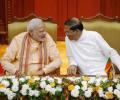
'What we have heard from the Sri Lankans is their desire to have a foreign policy that allows Sri Lanka to best advance its own interests rather than a foreign policy that relied solely on one relationship.' 'We think this is an attitude that makes a lot of sense. India and Sri Lanka have many areas of shared interests, and it's certainly welcomed by us to see that deepening of those ties.'

Known to be having extensive expertise in dealing with India's neighbourhood as well as the US, China and Europe, the 1988-batch Indian Foreign Service (IFS) officer pipped nearly half-a-dozen others in the race for the coveted post including Indian High Commissioner to UK Gaitri Issar Kumar (1986-batch IFS) and Ruchira Kamboj (1987 batch IFS).

The opposition party also said that it would like to remind the BJP that Hindu Mahasabha president Syama Prasad Mookerjee aligned with Jinnah's Muslim League to form the government in Bengal during the British rule.
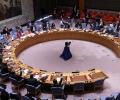
India has abstained on yet another resolution involving Ukraine, this time a motion sponsored by Russia at the United Nations Security Council (UNSC) that sought to establish a commission to investigate claims by Moscow that the United States and Ukraine are carrying out 'military biological activities' in laboratories in Ukraine in violation of the biological weapons convention.
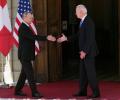
The summit probably fulfilled the expectations on both sides, but the bar of expectations was intentionally kept low, observes Ambassador M K Bhadrakumar.
Russian Foreign Minister Sergey Lavrov on Wednesday warned that a third World War, should it break out, will be "nuclear and devastating", amid spiralling tensions with the West over Moscow's ongoing massive military operation against Ukraine.
