
The US special representative for Afghanistan and Pakistan James Dobbins is stepping down, Secretary of State John Kerry today said amid a political crisis in the war-torn country.
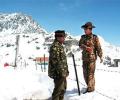
Ten days later, with the Indian Army in full control of the area where the incident took place, New Delhi has signalled a face-saver for Beijing.
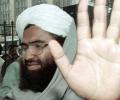
This is the second time that China has defended the decision to put a technical hold on India's bid to ban Azhar, the mastermind of the January 2 Pathankot terrorist attack.

UN chief Ban Ki-moon and the Security Council have strongly condemned the attack on a UN base in South Sudan that killed 22 people, including two Indian peacekeepers, and asked the government there to swiftly investigate the "criminal act".

United States Secretary of State John Kerry has held wide-ranging talks with visiting Foreign Secretary Sujatha Singh on key issues, including the regional situation with respect to Afghanistan, Pakistan and Bangladesh.

'China has refused to act upon the threat posed by Pakistan using terrorism as an instrument of its foreign policy.' says Rajeev Sharma.

China on Sunday said the border dispute with India has been "contained" and the Indian elephant and Chinese dragon should "do more" to strengthen the bilateral cooperation to facilitate its settlement.
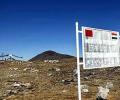
The move was aimed at 'reaffirming China's claim over the state'. China claims the state as 'South Tibet'.

China on Monday said Defence Minister A K Antony's visit Beijing has given both countries an opportunity to enhance their "strategic cooperative partnership" and jointly maintain peace and tranquillity in the border areas through increased military-to-military coordination.

Chinese Vice Foreign Minister Liu Zhenmin "called in" India's envoy in Beijing Ashok Kantha to lodge a protest on Modi's visit on Friday

Continuing his fast-paced diplomacy, Indian Prime Minister Narendra Modi spoke to China's Premier Li Keqiang on Thursday. During the phone call, Li conveyed his government's desire to establish a robust partnership with the new government in India.

A day after the National Investigation Agency filed a chargesheet against Jaish-e-Mohammed chief Masood Azhar in the Pathankot attack, India took on Pakistan at the United Nations and called on the hostile neighbour to leave behind its ways of terrorism, with the warning saying that, "what you sow will bear fruit".

China has sharply reacted to India's plans to construct a road network along the McMohan line in Arunachal Pradesh and expressed hope that India will not take any action which may complicate the situation before a final settlement is reached to end the boundary dispute.
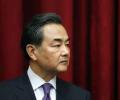
Carrying a message of "peaceful cooperation" from his President for the new Prime Minister, Chinese Foreign Minister Wang Yi on Monday exuded confidence that both the countries have the capabilities to deal properly with the contentious issues such as boundary dispute.
.jpg)
Congress has questioned Prime Minister Narendra Modi's "absence" in Delhi and his engagement in state election campaigns at a time when unabated ceasefire violations continued from across the border.

The UN Security Council has declared the Ebola outbreak in West Africa a threat to peace and security, with UN chief Ban Ki-moon deciding to deploy an "unprecedented" emergency health mission to combat the outbreak that has impacted the lives of millions.

Jaishankar's talks with Yang and later in the Strategic Dialogue were expected to cover the key India-China differences like China blocking India's bid to join the NSG and UN ban on Azhar.

India provides an intrinsic and important link between the developing and the developed world, and maintains a distinct relationship with the United States and China on individual basis, says External Affairs Minister Salman Khurshid.

With India's political wheel turning full circle this year, National Security Advisor Ajit Doval will negotiate from an expanding diplomatic space, writes Ajai Shukla

Influential world leaders on Thursday braced for a showdown at the G20 summit over an imminent US-led action against Syria, as United States President Barack Obama's plan to launch military strikes cleared the first hurdle with a key Senate committee narrowly approving it.

'China knows the best way of twisting the knife in its dealings with India: By launching a major incursion into Indian territory,' says Rajeev Sharma.
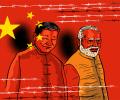
'As China rises and India grows to reclaim their earlier positions on the world stage as two of the largest economies and most important countries, there will indeed be some contention between these two powers.' 'There will also be plenty of space and room for cooperation amongst the two of us.' 'As our economic size increases to match the fact that we are the two most populous nations on earth, it will be all the more important for us to keep the interests of our peoples as well as those of the rest of the world in mind.' 'We shall have to grow together rather than as separate and disparate entities,' points out Ambassador Gautam Bambawale -- who served as India's ambassador to China -- in the 7th annual lecture of the Indian Association of Foreign Affairs Correspondents on March 1, 2019.

The advance of the Al-Qaeda splinter group the Islamic State in Iraq and Syria and its allies towards Baghdad appears to have been "stalled" but the "grave" situation in Iraq needs to be dealt with militarily as well as politically, a top UN official has said.

After Modi became the prime minister, the Indo-US relationship has seen an upward trajectory, he said.
India and China decided to seek a fair and rational solution to their border dispute on Saturday as they focused on the proposed border defence cooperation agreement to avert incursions like the one witnessed in Leh region last month.
Describing the boundary talks with China as "positive", National Security Adviser Ajit Doval on Friday said India has inalienable positions and the government will protect vital national interests.
'After more than 20 years of understanding, nothing much seems to have been achieved. What the two countries have been trying to do is to manage the recurrence of border incursions. The two sides must address the disease, and not the symptom of the disease,' says Rup Narayan Das.
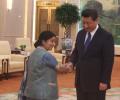
Chinese President Xi Jinping on Monday received External Affairs Minister Sushma Swaraj
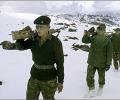
Virtually defending the latest incursion by the People's Liberation Army in the Chumar sector in Ladakh, China on Thursday said its troops were patrolling on its side of the Line of Actual Control and asserted that "status quo" should not be changed pending a final settlement.

The start of Indian lobbying in the US can be traced back to Pakistan's anti-India lobbying. Policy wonk Ashok Sharma documents this journey and its catalytic role in transforming the US-India relationship.

India strongly condemned the 'barbaric' terror attack by the Taliban on a school in Pakistan that killed 141 people, mostly children, as United Nations chief Ban Ki-moon and the Security Council called for perpetrators of the blood-curdling attack to be brought to justice.

Prime Minister Narendra Modi and Chinese President Xi Jinping on Thursday began summit-level talks.
China has asserted that it had never waged a war to occupy 'an inch of land of other countries', days after Bharatiya Janata Party's prime ministerial candidate Narendra Modi slammed the Communist giant for its "expansionist mindset".
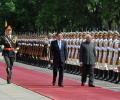
'Prime Minister Narendra Modi appears to have gone beyond the cautious approach usually advocated by the tightly-knit 'China group' in the ministry of external affairs in dealing with Beijing.'
'Prime Minister Narendra Modi appears to have gone beyond the cautious approach usually advocated by the tightly-knit 'China group' in the ministry of external affairs in dealing with Beijing.'

The United Nations has expressed concern over the killing and maiming of children who continue to be recruited and used as human shields by Maoists in India and over the threat of sexual violence against girls within Naxalite ranks.

A proposed nuclear deal aims to stop Pakistan from building small tactical nuclear weapons that could fall into terrorist hands.

''There is the perennial worry in the Indian mind regarding the US 'hyphenating' India and Pakistan. Frankly, this is a completely nonsensical hypothesis. The US has always 'hyphenated' India and Pakistan and it couldn't have been otherwise,' says Ambassador M K Bhadrakumar.

'The Panchsheel Agreement is unique in the annals of international relations as it stands out as a bizarre illustration of a prime minister trading his country's crucial national interests solely to buffer his personal international image,' feels R N Ravi.

Nevertheless, border dispute will feature prominently on Modi's agenda but the matter won't be discussed at length. Nayanima Basu reports
 © 2026 Rediff.com - Investor Information - Advertise with us - Disclaimer - Privacy Policy - Sitemap - Feedback - About us - Terms of use - Grievances