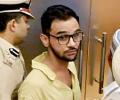
The Supreme Court has refused to grant bail to activists Umar Khalid and Sharjeel Imam in the 2020 Delhi riots conspiracy matter, citing a prima facie case against them under the UAPA. However, bail was granted to other activists in the same case.

Activist Sharjeel Imam has moved the Supreme Court challenging a Delhi High Court order denying him bail in a case linked to the 2020 Delhi riots. The High Court had denied bail to several individuals, emphasizing that conspiratorial violence under the guise of protests cannot be allowed.
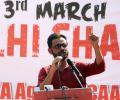
Student activist Umar Khalid has petitioned the Supreme Court for a review of the verdict denying him bail in connection with the 2020 Delhi riots conspiracy case, arguing that there were errors in the initial decision.
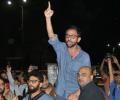
The Supreme Court on Friday adjourned to September 22 the hearing on bail pleas of activists Umar Khalid, Sharjeel Imam, Gulfisha Fatima and Meeran Haider in the Unlawful Activities (Prevention) Act (UAPA) case related to the alleged conspiracy behind the February 2020 riots in Delhi.
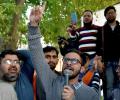
The prosecution had opposed the bail pleas saying it was not a case of spontaneous riots but a case where riots were "planned well in advance" with a "sinister motive" and "well-thought-out conspiracy".
The Supreme Court on Monday sought the Delhi police's response on the bail pleas of activists Umar Khalid, Sharjeel Imam, Gulfisha Fatima and Meeran Haider in the UAPA case related to the alleged conspiracy behind the February 2020 riots in Delhi.
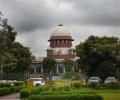
The Supreme Court denied bail to activists Umar Khalid and Sharjeel Imam in the 2020 Delhi riots conspiracy case, citing prosecution material suggesting their involvement in planning and strategic direction. The court granted bail to other activists but emphasized the seriousness of the allegations against Khalid and Imam.

Justice Manoj Kumar Ohri noted the prosecutor appearing in the case hadn't appeared on the last four to five occasions.
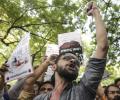
The Supreme Court has denied bail to Umar Khalid in the 2020 Delhi riots conspiracy case, citing a prima facie case against him under the UAPA. Other activists were granted bail. Khalid's father expressed disappointment, while a friend shared Khalid's reaction.

'Because, if someone remains an undertrial prisoner for five or seven years and is finally proven innocent, how will you compensate for the time lost?'

A violent clash broke out between two groups of students at Jawaharlal Nehru University (JNU) campus on Friday during a 'Visarjan Shobha Yatra' organised on the occasion of Vijayadashami, following the nine-day Navratri celebrations.
The Supreme Court of India has ruled that an 'act of terror' under the Unlawful Activities (Prevention) Act (UAPA) includes planning, coordination, and mobilization, not just the final execution of the act. The court emphasized that the intent and effect of the act are crucial, not solely the instrumentality used.

Sharjeel Imam will, however, stay behind bars as he has not been granted relief in the case involving alleged larger conspiracy behind the 2020 North East Delhi riots which left more than 50 people dead and hundreds of others injured.
The Supreme Court has directed lawyers for the accused in the February 2020 Delhi riots to restrict their oral arguments to 15 minutes, emphasizing the need for a time schedule. The court also addressed bail pleas from activists like Sharjeel Imam and Umar Khalid, while the Delhi Police maintained the riots were a pre-planned attack.

'If the trial is not going on, if the charges have not been framed, it is obvious that he must be given bail. But he has been denied again.'
Delhi Police strongly opposes bail pleas of activists Umar Khalid, Sharjeel Imam, and others in the February 2020 riots case, claiming it was a pre-planned attack on the nation's sovereignty and an attempt to divide society on communal lines.
Jawaharlal Nehru University (JNU) has sought a first information report (FIR) after students allegedly raised 'provocative' slogans against Prime Minister Narendra Modi and Union home minister Amit Shah inside the university campus during an event on Monday night, varsity officials said.

The Delhi police vehemently opposed the bail pleas of activists Umar Khalid, Sharjeel Imam and others in the February 2020 riots case, saying it had become a trend now for doctors and engineers to engage in anti-national activities. The police cited inflammatory speeches and violent protests as reasons for opposing bail.

Police in Mumbai have registered a case against students of the Tata Institute of Social Sciences for allegedly holding an unapproved event to mark the death anniversary of former DU professor G N Saibaba and raising slogans in support of Sharjeel Imam and Umar Khalid.

Imam is accused of making inflammatory speeches against the government on the Citizenship (Amendment) Act and the National Register of Citizens,
"Due to personal reasons, the undersigned hereby recuses from hearing the matter. Accordingly, let the present matter be put up before the principal district and sessions judge, southeast district, Saket court, for February 13 at 12 pm with a request to transfer the matter," the judge said in an order passed on Friday.

"Charges are being framed under sections 124 (sedition), 153A (promoting enmity between different groups on grounds of religion), 153B (imputations, assertions prejudicial to national integration), 505 (Statements conducing to public mischief) of Indian Penal Code, and Section 13 (punishment for unlawful activities) of UAPA," Additional Sessions Judge Amitabh Rawat ordered.
The application alleged that the assistant superintendent of jail recently had entered his cell along with eight-ten people in the garb of a search, assaulted him and called him a terrorist and anti-national.
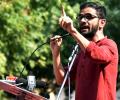
Activist Umar Khalid seeks bail in the UAPA case related to the 2020 Delhi riots, claiming lack of evidence and denying conspiracy charges. Other activists also argue for bail, citing delays and insufficient evidence.

The court also listed for hearing on November 18 bail pleas by other co-accused in the matter, including Khalid Saifi and Meeran Haider.
Imam is accused of offenses relating to sedition, promoting enmity between different groups on grounds of religion, race, place of birth, imputations prejudicial to national integration, and public mischief under the Indian Penal Code, and indulging in unlawful activities under the UAPA.
Chief metropolitan magistrate Dinesh Kumar admitted him on bail on furnishing Rs 25,000 bond with one surety of like amount.
Activist Umar Khalid has appealed to the Supreme Court against the Delhi High Court's decision to deny him bail in a case under the Unlawful Activities (Prevention) Act (UAPA) related to the alleged conspiracy behind the February 2020 Delhi riots.

Five teams of the Crime Branch have been deployed to locate Imam, a resident of Bihar, they said.
He had been involved in organising the protests at Shaheen Bagh but came into limelight after a video clip went viral wherein he could be heard making some disturbing comments while addressing a gathering at Aligarh Muslim University, following which he was booked under the sedition charge in the UP town.

He was slapped with a sedition case after a video of his purported speech went viral on social media where he was heard speaking about "cutting off" Assam and the northeast from the rest of India.
A Delhi court on Friday granted bail to former JNU student Sharjeel Imam in a sedition case in which he was accused of instigating the Jamia riots in New Delhi in 2019.

The high court said prima facie charges of rioting and unlawful assembly are made out against nine of the 11 accused, including Imam, Tanha and Zargar.

Sharjeel Imam's speech at the Aligarh Muslim University neither gave the call for anyone to bear arms nor incited any violence as a result of it, the Allahabad High Court has said granting him bail in a sedition case.
'One does not understand why you should launch your attack against the Constitution, against Gandhiji, against the Left and Congress regimes at a moment when the Hindutva regime needs such attacks against them.' 'By doing so, don't you think you are playing into the hands of Hindutva forces?', Mohammad Sajjad, who teaches history at Aligarh Muslim University, asks Sharjeel Imam who was arrested on charges of sedition on Tuesday, January 28.
A Delhi court on Friday denied bail to Jawaharlal Nehru University student Sharjeel Imam in connection with allegedly giving an inflammatory speech and inciting violence in 2019, saying that the speech was on communal lines and its content 'tend to have a debilitating effect on the peace and harmony.'
"He is accused of delivering seditious speeches and inciting a particular section of community to indulge in unlawful activities, detrimental to sovereignty and integrity of the nation," the chargesheet said. "In the garb of protesting against the Citizenship Amendment Act, he exhorted people of a particular community to block the highways leading to the major cities and resort to 'Chakka Jam', thereby disrupting normal life," it said.
Imam has been booked under Section 13 (unlawful activities) of the Act in the case, said his counsel advocate Mishika Singh. The police had earlier charged Imam with sedition, alleging his speech promoted enmity between people that led to riots.
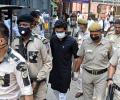
The Supreme Court of India questioned whether former JNU student Sharjeel Imam can be prosecuted in multiple states for sedition based on a single speech. The court is considering a plea to club multiple FIRs filed against Imam in Uttar Pradesh, Assam, Manipur, and Arunachal Pradesh for his alleged inflammatory remarks during protests against the Citizenship Amendment Act (CAA). The court is concerned about the potential for double jeopardy and has indicated that it may transfer the cases to Delhi.

The police said it has attached CCTV footage, call detail records and statements of over 100 witnesses as evidence in the charge-sheet placed before Chief Metropolitan Magistrate Gurmohina Kaur. The court had on Monday sent Imam, arrested on sedition charge last month, to one-day custody of the Delhi police in the violence case.
 © 2026 Rediff.com - Advertise with us - Disclaimer - Privacy Policy - Sitemap - Feedback - About us - Terms of use - Grievances