
In its supplementary charge sheet, the police said 'serious riots had broken out in consequence to the protest march organised by Jamia students' against the amended citizenship law on December 15 last year.

The Delhi high court on Tuesday said it will hear on May 26 a plea by JNU student Sharjeel Imam, who has been arrested in a case related to alleged inflammatory speeches made by him during the protests against the Citizenship Amendment Act and the National Register of Citizens in 2019, seeking interim bail.

The court further observed that Imam, also a former JNU student, and Khalid were stated to be 'co-conspirators' in the case and it would thus hear both the two bail applications together.

The anti-CAA activist was slapped with a sedition case after his alleged speeches went viral on social media where he was heard speaking about "cutting off" Assam and the northeast from India. Earlier, he had been booked on similar charges by Aligarh police in Uttar Pradesh for a speech he delivered on the AMU campus.
The police can now name them in their supplementary charge sheet, an official said. In a late evening statement, the government said that this is a purely procedural matter, adding that the elected government has no role to play in this.
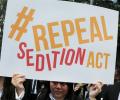
According to a National Crime Records Bureau report, a total of 356 cases of sedition -- as defined under section 124A of the IPC -- were registered and 548 people arrested between 2015 and 2020, out of which only six were convicted.
The matters were listed before a division bench headed by Justice Prathiba M Singh after a change in the roster of judges dealing with such cases.
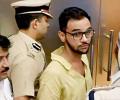
Khalid is currently in judicial custody in connection with a larger conspiracy case related to the 2020 North East Delhi violence.
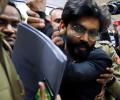
Imam in his fresh bail plea stated that since the apex court has put sedition (Sec 124-A) in abeyance, his case has improved for grant of bail.

The 11 people were discharged on February 4 by the trial court, which said they were made 'scapegoats' by police and that dissent has to be encouraged, not stifled.
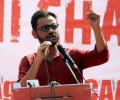
Former JNU student Umar Khalid on Wednesday withdrew his bail plea from the Supreme Court in a case lodged under anti-terror law UAPA over his alleged involvement in the conspiracy behind the northeast Delhi riots of February 2020.
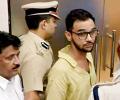
Former Jawaharlal Nehru University student and activist Umar Khalid has completed four years in jail after being arrested in connection with the 2020 northeast Delhi communal riots.

A court in Delhi on Saturday discharged 11 people, including student activists Imam and Asif Iqbal Tanha, who participated in anti-CAA protests, in the 2019 Jamia Nagar violence case.

The Supreme Court on Wednesday adjourned till January 10 the hearing on the bail plea of former Jawaharlal Nehru University (JNU) student Umar Khalid in a case lodged under anti-terror law Unlawful Activities (Prevention) Act (UAPA) over his alleged involvement in the conspiracy behind the northeast Delhi riots of February 2020.

The Supreme Court on Tuesday adjourned for a week the hearing on a plea filed by former Jawaharlal Nehru University student Umar Khalid seeking bail in a case lodged under anti-terror law Unlawful Activities (Prevention) Act (UAPA) over his alleged involvement in the conspiracy behind the northeast Delhi riots of February 2020.

Kalita pleaded that she needed the videos and chats to prove her innocence, but the Delhi police counsel contended that her petitions were not maintainable.
On Monday, another accused Meeran Haider also applied to the restoration of inmate daily phone call facilities.
Khalid's petition challenging the October 18 last year order of the Delhi High Court, which had rejected his bail plea in the matter, came up for hearing before a bench of Justices A S Bopanna and Prashant Kumar Mishra.
During the proceedings, counsel for Imam said, "From the impugned speech, there is nothing which per se causes any kind of religious animosity. We cannot lose sight of the context. What Sharjeel Imam says, in relation to CAA-NRC, is that in much as it affects one community directly, what kind of support is to be elicited from the majority community."
The court said the legal proceedings against the 11 accused were initiated in a 'perfunctory and cavalier fashion' and 'allowing them to undergo the rigmarole of a long-drawn trial does not augur well for the criminal justice system of the country'.
The Delhi high court on Tuesday refused to grant bail to former Jawaharlal Nehru University student Umar Khalid in a Unlawful Activities (Prevention) Act (UAPA) case related to alleged conspiracy behind the riots here in February 2020.

Addressing a rally in Rithala in northwest Delhi, Shah said Kejriwal and Congress leader Rahul Gandhi were against the construction of Ram temple, the scrapping of provisions of Article 370 and were not bothered about the country's image and soldiers.
A police official said Chudawala was at the forefront in raising the slogan 'Sharjeel tere sapno ko hum manzil tak pahuchaege (Sharjeel, We will realise your dreams)." A complaint in this regard was lodged by former Bharatiya Janata Party MP Kirit Somaiya on February 2.
The high court's observation came while hearing the bail plea of Khalid who has challenged a trial court's March 24 order dismissing his bail application in the case.

A Delhi high court bench headed by Justice Mukta Gupta disposed of Imam's appeal for stay and requested the lower court to conclude on a "short date" the examination of the witnesses on which there is no dispute between the parties.

The Bombay high court has granted anticipatory bail to a 22-year-old student of the Tata Institute of Social Sciences (TISS), who was charged with sedition last year for allegedly shouting slogans in support of jailed JNU student Sharjeel Imam at an LGBTQ event in the city.
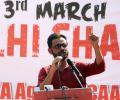
A bench of Justices Siddharth Mridul and Rajnish Bhatnagar was hearing Khalid's plea challenging a trial court's order which had on March 24 dismissed his bail application in the case.

The anti-Citizenship (Amendment) Act protest was secular but the charge sheet in the Delhi riots conspiracy case was communal and the police fabricated a story to suit its narrative, former Jawaharlal Nehru University student leader Umar Khalid told a court in New Delhi on Tuesday calling it a 'naked form of false implication.'
A Delhi court on Thursday denied bail to former JNU student Umar Khalid in a case of larger conspiracy in connection with Delhi riots during February 2020.

"The very fact that Pandit Jawaharlal Nehru believed that democracy has made revolution superfluous after independence and how it meant the complete opposite of a bloodless change," it said.
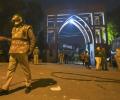
Sharjeel Usmani, the son of Assistant Professor Tariq Usmani of the AMU's Department of Geography, was picked by the Uttar Pradesh's anti-terrorist squad (ATS) sleuths from his uncle's house in Azamgarh on Wednesday and was subsequently produced in a court in Aligarh which remanded him in judicial custody, they said.
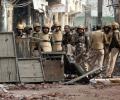
It stated that by a 'sustained and well-oiled' campaign, they created an acute sense of fear and insecurity in the minds of the minority community.
In this conspiracy, firearms, petrol bombs, acid bottles and stones were collected at numerous homes, police claimed.
Arguing his bail plea in the riots conspiracy case before additional sessions Judge Amitabh Rawat, his lawyer referred to the supplementary charge sheet filed in the case and said that the police wished to paint every accused with the same brush while adding tadka (flavour) to it.
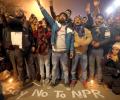
Those who withdrew called off the blockade on the Sarita Vihar-Kalindi Kunj road and alleged "politicisation" of their "peaceful protest".
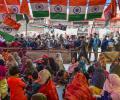
The chargesheet in which 15 persons have been named as being part of a 'premeditated conspiracy' in the north east Delhi riots, said the tone and nature of the communication of the members of Jamia Co-ordination Committee (JCC) changed from the evening of February 24 and they started talking about relief, rehabilitation and care of the victims while 'simultaneously unleashing concerted disinformation campaign blaming the state, police and the ruling political party for the loss of lives and property caused by their terrorist and unlawful act'.

Despite repeated appeals from the police and the varsity authorities, the protesters refused to end their agitation. Police said the protesters did not have permission to march towards Parliament.
 © 2026 Rediff.com - Investor Information - Advertise with us - Disclaimer - Privacy Policy - Sitemap - Feedback - About us - Terms of use - Grievances