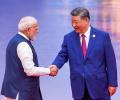
India's dual pursuit of a robust strategic partnership with Washington and a pragmatic, tension-management policy with Beijing represents the essence of modern multi-alignment. By embracing economic pragmatism, learning to compartmentalize political differences, and engaging in continuous dialogue, India can secure its borders, grow its economy, and contribute to a stable, multipolar Asian century, points out Ambassador Rajasekhar.

INOX Air Products has commissioned a new ultra-high purity liquid oxygen facility in Hosur, Tamil Nadu, to support India's growing semiconductor and solar manufacturing sectors, reducing reliance on imports.

Investors should do thorough due diligence when selecting a platform.

Analysts predict that developments in West Asia, their impact on crude oil prices, and the trading activity of foreign institutional investors (FIIs) will be crucial factors influencing the Indian stock market this week.

Addressing the nation on 79th Independence Day, Modi said the time has come to undertake reforms in GST as the indirect tax regime has completed 8 years.

US President Donald Trump received a red carpet welcome in Beijing for talks with Chinese President Xi Jinping on trade, the Iran war, and other key issues. The visit underscores the importance both nations place on their relationship amid ongoing tensions.

Nvidia CEO Jensen Huang has publicly endorsed Marvell Technology as a potential 'trillion-dollar company,' citing its crucial role in developing advanced connectivity solutions for next-generation artificial intelligence infrastructure. This endorsement, made at Computex 2026, follows a significant Nvidia investment in Marvell and highlights the industry's shift towards optical interconnects to meet the demands of large-scale AI systems.

Indian equity benchmark indices Sensex and Nifty experienced a significant tumble in early trade, with the Sensex tanking nearly 700 points, driven by uncertainty surrounding US-Iran negotiations, a fresh spike in crude oil prices, and persistent foreign fund outflows.
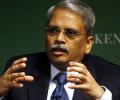
Infosys co-founder Kris Gopalakrishnan urges Indian startups to focus on deep technology and advanced manufacturing to ensure strategic autonomy.

US President Donald Trump met with Chinese President Xi Jinping in Beijing to discuss trade, technology, Taiwan, and the Iran war. Xi Jinping said that 2026 will be a 'historic, landmark year' for China-US relations.

The GraphIN 2026 conference in Kochi brings together global experts to discuss advancements in graphene and two-dimensional materials, highlighting India's growing role in electronics and semiconductor manufacturing.

JPMorgan has downgraded Indian equities to 'neutral' from 'overweight', citing elevated valuations, rising earnings risks, and limited exposure to next-generation technology like AI. The brokerage believes other emerging markets offer more attractive risk/reward propositions despite India's strong structural growth story.

Mahindra & Mahindra (M&M) is implementing a comprehensive, multi-layered strategy to fortify its supply chains against geopolitical volatility, logistical challenges, and regulatory risks, drawing lessons from recent global disruptions.

Compared with a year ago, the effective cost of studying abroad for Indian students has increased by roughly 10%-12% due to currency depreciation and rising living costs.

India's first trillion-dollar company will be built on technology it owns, not just operates, predicts Ajay Kumar.

Donald Trump says several issues were settled during the final day of talks with Xi Jinping covering trade, tariffs, and diplomacy.
Nasscom President Rajesh Nambiar highlights India's growing importance as a technology partner due to geopolitical uncertainties and the need for resilient supply chains.
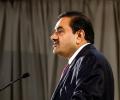
Gautam Adani, chairman of Adani group, emphasised that energy and intelligence are inseparable national priorities, asserting that India must build its own capabilities in these sectors rather than relying on external sources, especially in the context of global conflicts and shifting supply chains.

Finance Minister Nirmala Sitharaman on Sunday proposed Rs 10,000 crore investment in the biopharma sector over the next five years, a move which would give a boost to the country's pharmaceuticals industry.

India's leading passenger vehicle manufacturers are significantly increasing investments and factory capacities, alongside planning major product launches for FY27, driven by strong confidence in sustained domestic demand growth despite global geopolitical tensions and supply chain risks.
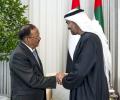
India is the only significant power that all parties trust, or at least do not distrust, notes former defence secretary Ajay Kumar.

Prime Minister Narendra Modi has begun a six-day tour of the UAE, the Netherlands, Sweden, Norway and Italy to strengthen bilateral relations amid geopolitical challenges. The trip will focus on energy security, trade, and technological cooperation.
Nayagam PP, career counsellor and founder of EduJobs360, explains how traditional engineering choices are being replaced with flexible, future-ready career paths that align with industry requirements.

Prime Minister Narendra Modi will visit the UAE, the Netherlands, Sweden, Norway and Italy to deepen India's bilateral ties amid geopolitical changes.

Gautam Adani emphasised the importance of energy security and digital infrastructure in shaping geopolitical power, urging India to develop sovereign capabilities across the AI value chain.

Tata Projects on Tuesday said the construction of the US-based chip company Micron Technology's semiconductor assembly and test facility at Sanand near Ahmedabad is going on in full swing. The facility is coming up in nearly 50 acres of area at Sanand industrial area and the construction began in July last year.

Andhra Pradesh is set to launch India's first indigenously built, open-access quantum computers, marking a significant step towards building a sovereign quantum hardware ecosystem. The initiative aims to position the state as a global hub for quantum technology and enable applications in various sectors.

Semiconductor makers need thousands of engineers and technicians, and though India has one of the largest pool of engineers in the world, they do not have experience in the semiconductor manufacturing space.
This is the time for India to plan forward fully, with the goal of Atmanirbharata, and energy security. The Persian Gulf is no longer a reliable source, points out Rajeev Srinivasan.

India's fiscal deficit is projected to reach 4.5 per cent of GDP for the current fiscal year, exceeding the budgeted target, as the government's policy responses to the West Asia conflict are expected to strain public finances, according to research firm BMI.

If TVK MLAs and ministers are perceived as clean, or demonstrably cleaner than their predecessors, the credibility dividend will be enormous. The voter will feel rewarded, points out Ramesh Menon.

Maharashtra Chief Minister Devendra Fadnavis on Tuesday claimed India's neighbours wanted to "break up" Assam by taking advantage of the unrest in the state earlier, but their "dreams were shattered" as the Narendra Modi government brought peace to the region.
At the D Y Patil International University's Foundation Day, experts advised students to embrace AI wisely, highlighting its potential and the importance of critical thinking in the digital age.
The deferral of Natarajan Chandrasekaran's re-appointment as Chairman of Tata Sons has sparked questions regarding a previous unanimous resolution by Tata Trusts and potential internal disagreements.

The government is closely watching the fast-paced developments at the salt-to-semiconductor conglomerate.

The US President had hosted Modi for an official working visit in Washington, DC, on February 13 last year.

HDFC Bank, India's largest private-sector lender, has revised its FY27 growth trajectory, stepping back from earlier guidance to align with a more measured 12 per cent year-on-year expansion, citing geopolitical uncertainties.

Apple CEO Tim Cook's strategic pivot, from initial rejections to local partnerships and leveraging government policies like PLI, transformed India into a major iPhone manufacturing and export hub, now accounting for one in every four iPhones assembled globally.

Finance Minister Nirmala Sitharaman on Sunday proposed to increase the outlay on electronics manufacturing to Rs 40,000 crore in the 2026-27 fiscal year.

What items did Finance Minister Nirmala Sitharaman make costlier?
