
If these reports are true, it means that it possesses something much more powerful than it has tested in the past. North Korea has run nuclear tests in the pasts, but this announcement has sent panic waves internationally.

'Once the military starts to draw up plans for using nuclear weapons, then nuclear weapons could be used earlier in a crisis than otherwise.'

It is said that Vajpayee, who was also fluent in English, was the force behind uplifting Hindi to the international platform by using the language at the UN each time he delivered a speech.
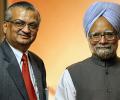
'Dr Singh, visibly relieved, said, 'Yesterday night I couldn't sleep. I stayed awake, praying throughout. You have saved the country'.' A fascinating excerpt from former atomic energy chief Dr Anil Kakodkar's memoir Fire And Fury: Transforming India's Strategic Identity.
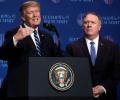
'Traditionally, the US tried to tamp down tensions whenever a crisis situation arose and deputed officials from Washington to travel to Delhi to counsel restraint.' 'This time around, no US envoy flew down to Delhi -- not even when tensions spiked and a flashpoint was reached last week,' points out Ambassador M K Bhadrakumar.

The strategy, President Donald Trump said, is tailored and flexible to address the wide array of threats in the 21st century.

'The bottom line is that at least now we should take an honest look at this business of NSG membership (or Masood Azhar for that matter.),' says Ambassador M K Bhadrakumar.
United States president-elect Donald Trump's tweet for strengthening and expansion of country's nuclear arsenal is indicating a major policy change as against the Obama Administration which had pushed for reduction and ultimately elimination of nuclear weapons.
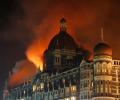
India would have responded differently to "Pakistan-sponsored" Mumbai terror attacks had there been a different "mix of people" at the helm, according to former foreign secretary and national security advisor Shivshankar Menon.
'We must look at the entire question of military preparedness anew, taking into account the new realities,' says Vice Admiral Premvir Das (retd).

It is unconscionable to choose between Sardar Patel, who united India physically, and Indira Gandhi, who gave meaning, content and pride to the unity of the nation and became a martyr at the altar of national unity, says Ambassador T P Sreenivasan.

Leaders of the two countries, however, did discuss on Pakistan's nuclear safety and security which is an ongoing discussion.

He was the army commander who planned Operation Bluestar. As army chief he planned Operation Brasstacks which rattled the Pakistan army. General K Sundarji was brilliant, ambitious and controversial, remembers Rahul Bedi.
Saudi Arabia has invested in Pakistani nuclear weapons projects and believes it could acquire atomic bombs "at will", the BBC reported on Thursday.
'Given Chinese sensitivity to anything to do with Tibet -- and the fact that in the 1950s it was the Tibet issue which led to the deterioration of India-China relations and the border war in 1962 -- India should be particularly careful in not triggering a Chinese reaction which it may not be able to handle,' says former foreign secretary Shyam Saran.

'India must close the missile technology gap with both China and Pakistan as early as possible, or else the credibility of India's nuclear deterrence will remain suspect,' says Brigadier Gurmeet Kanwal (retd).

Sanctions against North Korea following its H-bomb test could have serious repercussions and may prove disastrous for all the players involved, says Debalina Ghoshal.

To imagine that no one contributed to global peace to deserve the prize in 2017 is to be extremely cynical about peacemakers around the globe.

The implications of the interim deal between Iran and the world's big powers go far beyond the nuclear programme, says Nitin Pai

'China might soon have to seriously consider whether it prefers an Indo-US hyphenation to a Sino-Indian one.'

Immediate NSG membership will not help India realise its nuclear ambitions any faster. It could have easily left the process take its own course, instead of running a high-stakes campaign to get in, says B S Raghavan.
Every demand of the armed forces remains essentially anchored to 1964 and its fulfilment or otherwise largely a function of money availability
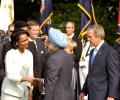
The night before Dr Singh was to meet President Bush, he said he could not sign the agreement.

While trying to persuade North Korea to give up its provocative actions, engaging China is the first hurdle that world leaders will have to deal with, says Rajaram Panda.

The Nobel Prize for Malala may have caused deep divisions across the globe and disturbed the peace, while the award to OPCW, though not without critics, may have served the cause of peace by eliminating a weapon of mass destruction from the face of the earth, says Ambassador T P Sreenivasan.
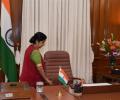
Sushma Swaraj, like Clinton, has a strong political base in her own party and is likely to have her imprint on foreign policy, says Ambassador T P Sreenivasan.
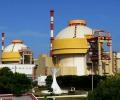
'Decisions on nuclear power have so far been taken by a small select group, primarily interested in profiteering from their actions, stating 'secrecy' as necessary from the national security point.' 'This argument is false, because we are dealing with the 'civilian' nuclear power sector, which is open even to the IAEA,' says Dr A Gopalakrishnan, former chairman of the Atomic Energy Regulatory Board.

The Mars mission is overwhelmingly irrelevant to space science and won't advance the frontiers of knowledge. It will divert attention from the real technological challenges facing the Indian space programme, and will further distort our science and technology priorities, says Praful Bidwai.

'Diplomatic engagement will continue even as India keeps all its options open with respect to discretely targeting the Pakistani military and its terrorist proxies.'
 © 2026 Rediff.com - Investor Information - Advertise with us - Disclaimer - Privacy Policy - Sitemap - Feedback - About us - Terms of use - Grievances