
Mukherjee extended an invitation to Xi to visit India which he accepted.

Talking about the threat of terrorism, he said "As diverse and pluralistic societies, we both face threats from fundamentalist terrorism. Yet, we do not seem to be able to cooperate as effectively we should in some critical international forums dealing with this subject."

"Both India and China are victims of terrorism and the region was suffering from the menace. The prime minister said no country is immune from terrorism and on this issue, we cannot afford to have any differences," MEA spokesperson Vikas Swarup told reporters after the meeting.

As Xi is due to arrive in Goa on Saturday to take part in the BRICS Summit, Chinese foreign ministry spokesperson Geng Shuang said the relations between India and China made "great headway" despite some "disputes" but there was no change in in Beijing's stand on the issues of NSG and Azhar.

'The boycott has not achieved success. Sales figures for Chinese products on the top three Indian online retailers in the first week of October hit a new record. Amazingly, the Chinese mobile phone company Xiaomi sold half a million phones in just three days on the Flipkart, Amazon India, Snapdeal and Tata CLiQ platforms.'

The $10.5 billion arms and equipment deal helped to arrest the recent drift in the 'special and privileged' strategic partnership, observes Brigadier Gurmeet Kanwal (retd).

India and China on Friday agreed to seek a "political" solution to the border dispute at the earliest as Prime Minister Narendra Modi asked Beijing to "reconsider its approach on some issues" and announced CBMs like e-visa for Chinese tourists and operationalisation of hotline between two militaries.

Prime Minister Narendra Modi and Chinese President Xi Jinping on Thursday began summit-level talks.

Chinese foreign ministry spokesperson, Hua Chunying said China-Pakistan cooperation is in accordance with the 48-member nuclear club, which supervises global nuclear commerce.

India and China met and spoke a lot this year, but failed to produce any meaningful results.

A new draft proposal circulated among Nuclear Suppliers Group member states early this month could pave the way for India to become a member of the elite club, but this is unlikely to happen before the end of the Barack Obama presidency next month.
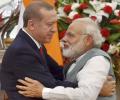
Turkish President Recep Tayyip Erdogan's has been trying to mollycoddle India with sweet nothings while having a very close relationship with Pakistan.

Rebuffed by the Obama administration on its effort to seek US intervention on Kashmir, Pakistan has said that it has never made such a "demand" and just presented its wish list to Americans on the issue.

'Modi's abject capitulation will play out badly in his core constituency.' 'The bulk of our strategic community is under the impression that India under Modi has already become a superpower.' 'They don't even want to look at the country's emaciated limbs or its asthmatic problems,' says Ambassador M K Bhadrakumar.

Trump's diatribe against India in his speech on the Paris Agreement is hard to explain, especially when a Modi-Trump meeting is supposedly on the cards, says Ambassador T P Sreenivasan.

'China's deep involvement in the stability and economic and political success of Pakistan actually produces some elements of congruence with India's core interest in a stable and productive relationship with Pakistan.' 'It is not far-fetched for us to pursue that congruence and with ingenuity work out with China a formula that also satisfies our formal position on PoK,' argues Ambassador Kishan S Rana.

'There is no holistic picture of our own goals and objectives.' 'For some inexplicable reason, the decision makers find it best to listen to their inner souls in dealing with these issues rather devising a carefully thought-out, structured plan,' says Vice Admiral Premvir Das (retd).

Sujatha Singh stands for the right values and quite simply, she's a "good person" who understands complex economic issues thoroughly, say her friends.

The two countries also signed three other agreements -- to enhance aviation links, to jointly work in the area of energy efficiency and promotion of parliamentary cooperation.

The American efforts to make India a security partner have enhanced India's importance to Chinese decision makers and new recognition of India's importance and achievements are reflected in a much more positive reporting about India in the State-controlled media, says Walter Andersen.

India on Thursday secured Mexico's backing in its bid to become member of the Nuclear Suppliers Group as it aggressively scouted for support ahead of a crucial meeting of the 48-nation nuclear trading bloc in Vienna.
The camaraderie between Modi and Obama has taken the India-US relationship to unprecedented and transformative levels.
'Given the present force levels, India cannot fight and win.' 'India can't hope to terminate the conflict on India's terms and impose the nation's will upon the adversaries,' says Brigadier Gurmeet Kanwal (retd).
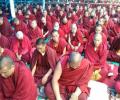
'Given Chinese sensitivity to anything to do with Tibet -- and the fact that in the 1950s it was the Tibet issue which led to the deterioration of India-China relations and the border war in 1962 -- India should be particularly careful in not triggering a Chinese reaction which it may not be able to handle,' says former foreign secretary Shyam Saran.

The two countries also asked all nations to stop cross-border movement of terrorists and asserted that a decisive collective response from the international community without 'double standards and selectivity' was required to combat the threat of terrorism.

"We are committed to building a new India. We have to do this as early as possible," he said.

'This novel format of diplomacy -- the informal summit -- will not only facilitate bilateral communication and reduce miscalculations at the very top level of the two governments, but possibly open the space for China and India to speak in one voice on various issues of mutual concern,' note Feng Renjie and Ding Kun Lei

There are many reasons for Japan to turn a deaf ear to its anti-nuclear lobby and concentrate on its geo-strategic imperatives to sign the nuclear deal with India, says Debalina Ghoshal.

Addressing the media jointly with Modi after hour-long talks at the White House, Obama said it was natural for India and the US, two biggest democracies, to 'deepen and broaden' partnership.

A proposed nuclear deal aims to stop Pakistan from building small tactical nuclear weapons that could fall into terrorist hands.

'We have never had a policy regarding Pakistani artistes working in India.' 'We welcome them with open arms and that remains the official policy of the Indian government, including the current dispensation.'

'The success or otherwise of Modi's foreign policy will largely depend on the equation he is likely to strike with Donald Trump.'

'While China expressed reservations on the Indian role in the South China Sea, Beijing threw to the winds Indian concerns on Kashmir by announcing $46 billion in investments Pakistan occupied Kashmir,' says Srikanth Kondapalli.
The expulsion is likely to cloud India-China ties as Narendra Modi visits China for the G-20 Leaders Summit on September 4-5 and Xi Jinping is scheduled to be in Goa for the BRICS meeting on October 15-16.

'There will be some issues of contention, especially on H1B visa and on trade policy.'
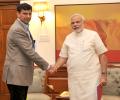
The government's critics say that the Prime Minister failed to rein in vicious and unprecedented personal attacks on the central bank chief by the likes of Rajya Sabha MP Subramanian Swamy.

India on Monday got the backing of Switzerland in its bid to become a member of the Nuclear Suppliers Group.

'An ardent advocate of nuclear disarmament, Obama may even be secretly heaving a sigh of relief that the NSG is unlikely to reach unanimity of opinion on India's candidature,' says Ambassador M K Bhadrakumar.

Modi is likely to seek support of Switzerland and Mexico for India's membership of the 48-member Nuclear Suppliers Group as both these countries are key members of the elite group. The issue is likely to figure during Modi's meeting with Obama in Washington.

The strategic pacts were inked after the summit between Prime Minister Narendra Modi and his Japanese counterpart Shinzo Abe during which they also discussed international and regional issues of mutual importance including UN security reforms.
 © 2026 Rediff.com - Investor Information - Advertise with us - Disclaimer - Privacy Policy - Sitemap - Feedback - About us - Terms of use - Grievances