
A US nonprofit policy think tank, the Federation of American Scientists (FAS), estimates India's nuclear arsenal at 190 warheads, including those for new missiles under production. The report highlights India's ongoing modernisation of its nuclear capabilities and adherence to a no-first-use doctrine, while also noting uncertainties in warhead designs and plutonium reserves.

India is increasingly focusing on long-range weapons capable of reaching targets across China.
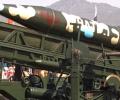
Pakistan is believed to have 140-150 nuclear warheads this year, 10 more than last year. In contrast, India is said to have 130-140 nuclear warheads, according to the annual nuclear forces data by Stockholm International Peace Research Institute.

The spectre of Pakistan's nuclear weapons falling into the hands of terrorist organisations has once again come to the fore. Western commentators are calling for plans to secure or destroy the nuclear warheads in the event of a meltdown. It would be in India's interest to provide the maximum possible assistance for such a move, says Brigadier Gurmeet Kanwal (retd)
Expanding its nuclear arsenal at a rapid pace, Pakistan is now aiming to develop smaller and lighter atomic warheads more suitable for use on missiles, the bulletin of the Atomic Scientist has said.
Among Pakistan's neighbouring countries, India will be particularly vulnerable if Islamist terrorists and their Al Qaeda and Taliban brothers ever lay their hands on Pakistan's nuclear warheads as it is one of the nations that the Al Qaeda has named as an enemy. Being a contiguous land neighbour, it is also easier to target even if sophisticated delivery systems like ballistic missiles are not available
British scientists are secretly working on the design of a revamped nuclear warhead at the Atomic Weapons Establishment at Aldermaston in Berkshire.

The nine nuclear-armed states -- the United States, Russia, the United Kingdom, France, China, India, Pakistan, Israel and the Democratic People's Republic of Korea (North Korea) -- together possessed an estimated 13,080 nuclear weapons at the start of 2021.
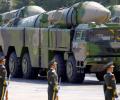
China is expanding its nuclear force and is likely to have a stockpile of about 1,500 warheads by 2035, up from the current estimated number of 400, the Pentagon has said in a report that notes that Beijing aims to expand its national power through both domestic and foreign policy initiatives.

Russia moves forward with the plan as part of the plan to deploy tactical nuclear bombs in the country bordering Ukraine.
India is not converting all its weapons-grade plutonium into war heads, two top American nuclear scientists have claimed, estimating that it currently has 80 to 100 nuclear warheads for its emerging triad of air, land, and sea-based nuclear-capable delivery vehicles.

Donald Trump has ruled out using nuclear weapons or ground troops against Iran, despite the US military developing strike options including the "mother of all bombs" (MOAB) for Iranian energy and nuclear facilities. Trump clarified the MOAB is not nuclear and expressed confidence in non-nuclear options. He also discussed nuclear disarmament talks with Russia and China and his determination to prevent Iran from acquiring nuclear weapons, even as questions arise about MOAB's effectiveness against deeply buried targets.

A new report from the Stockholm International Peace Research Institute (SIPRI) indicates that India has expanded its nuclear arsenal and is developing long-range weapons capable of reaching targets across China, while also maintaining focus on its rivalry with Pakistan.

The United States military has developed fresh strike options against Iran that include the potential use of the GBU-43/B Massive Ordnance Air Blast (MOAB), widely known as the "mother of all bombs", to target energy infrastructure and nuclear sites, CNN reported, citing multiple US officials familiar with military planning discussions.

"We estimate that Pakistan now has a nuclear weapons stockpile of 130-140 warheads. This stockpile exceeds the projection made by the US Defense Intelligence Agency in 1999 that Pakistan by 2020 would have 60-80 warheads," said the report released last month.

Nearly all of the nine nuclear-armed States, including India and Pakistan, continued intensive nuclear modernisation programmes in 2024, upgrading existing weapons and adding newer versions, according to a report by a global think-tank.

Iran has conveyed seven conditions to the United States through Qatari mediators for starting negotiations to end the ongoing war, while warning that Tehran is prepared for a "decisive war" if Washington rejects its demands.

Pakistan has criticised India's recent remarks on Pakistan-occupied Kashmir (PoK) protests, asserting it is addressing issues democratically. Pakistan also warned India against blocking water, calling it an "act of war," and commented on India's nuclear capabilities and its own military strikes in Afghanistan.

The move is meant to enhance the operational capability of the armed forces, reduce import dependence and increase domestic value addition.

Successful interceptor, anti-ship, MIRV and hypersonic technology tests have strengthened India's position among a select group of advanced missile powers.

Pakistan and China are among the countries which are testing nuclear weapons, United States President Donald Trump has said to justify his administration's plans to resume testing of the US's own nuclear assets after a gap of over three decades.

China on Monday successfully test-fired a long-range strategic missile from one of its nuclear-powered submarines in the Pacific Ocean, drawing sharp reactions from Japan and Australia.

India successfully test-fired nuclear-capable short range ballistic missiles Prithvi-II and Agni-I from an integrated test range off the Odisha coast, demonstrating its strategic deterrence capability. The test-firing of the missiles, conducted by the elite Strategic Forces Command, validated all operational and technical parameters.
Pakistan's atomic weapons stockpile has jumped to an estimated 70-90 warheads from a previous figure of 60 and it is also developing two new types of nuclear-capable cruise missiles, according to a top American scientist.

Three milestones in three days signal India's growing mastery in next-generation strategic technologies spanning nuclear deterrence, hypersonic propulsion and precision stand-off strike capability.
Iran is poised to produce its first nuclear warhead and will be able to do so within a year of an order from its Supreme Leader Ayatollah Ali Khamenei, a media report said on Monday. Quoting Western intelligence sources, The Times daily claimed that Iran has perfected the technology to create and detonate a nuclear warhead and is merely awaiting the green signal from its Supreme Leader.

Pakistan's atomic arsenal probably consists of between 90 to 110 nuclear warheads, a latest Congressional report has said, informing the American lawmakers that Islamabad is interested in concluding a nuclear cooperation deal with the US, which would require their approval.

India successfully test-fired the 'Agni 5' intermediate range ballistic missile, capable of reaching targets up to 5,000 km, validating its operational and technical parameters.
The new warhead, due to be operational in five years' time, will be used to replace Trident missiles on submarines.

'Pakistan's is the only military-controlled nuclear weapons programme in the world.' 'As people get radicalised, the risk of a brigadier or pilot taking matters into their own hands is a real concern.'

'DRDO has been directed to license missile technologies to the private sector.'
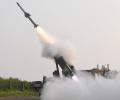
'China is in the middle of a substantial expansion of its nuclear weapon arsenal, which satellite images indicate includes the construction of over 300 new missile silos,' SIPRI's statement noted.
Pakistan on Tuesday test-fired a newly developed short-range surface-to-surface missile capable of carrying a nuclear warhead, the military said. The Hatf-9 missile, with a range of 60 km, can "carry nuclear warheads of appropriate yield with high accuracy," the military said in a statement. The "multi-tube ballistic missile" system had been developed to add "deterrence value to Pakistan's strategic weapons development programme at shorter ranges," it said.
United States President Barack Obama and his Russian counterpart Dmitry Medvedev on Monday signed a landmark deal in Moscow committing the two Cold War rivals to a new, legally binding arms-control treaty and resume military cooperation, as they promised to "reset" their damaged bilateral ties.

The report put India's 'stored' nuclear warheads at 172 in January this year while the number for Pakistan was 170.

The IRGC had announced earlier that it was carrying out an intense wave of attacks on US and Israeli positons throughout the region since dawn, using missiles as well as drones.
In a statement on behalf of the EU, Britain offered new negotiations meant to defuse tensions over Iran's insistence that it must be in full control of uranium enrichment-- a possible pathway to nuclear arms.

A seismic tremor recorded in an area around North Korea's known nuclear site on Friday is suspected to be a nuclear test, says South Korea.
A United States university students' project has stumbled upon figures that China's could have 3,000 nuclear warheads, many times larger than the well established estimates of arms-control experts, sounding alarm bells in Pentagon.

The question is no longer whether the war will expand. It has. The next few days will tell us whether the war stabilises around Hormuz or whether the Strait itself becomes the trigger for a far larger rupture. What to watch for over the next 48 hours is simple: Any move by the US toward direct naval control of the Strait; any credible Iranian attempt to disrupt or mine shipping lanes and, critically, whether energy infrastructure in the Gulf continues to be targeted.If those lines are crossed in tandem, the war will no longer be containable within the region.
