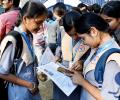
As per the updated policy, class 10 and class 12 students can appear for an improvement exam in the same academic year to enhance their scores if they are not satisfied with their performance.

The clarification by board comes after it received a few requests stating that, because of some reasons, Class 10 students will not be able to appear in the first board exam, hence should be allowed to appear in second board exam.

The Indian Navy has been recognized as the best marching contingent among the armed forces at the Republic Day Parade. Maharashtra won for states/UTs, and the Culture Ministry for ministries/departments.

'It interferes in administrative matters of institutions, robbing them of their independence in day-to-day affairs and appointments.'
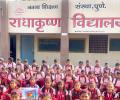
'There'll be extended periods where things aren't working in your favour. But if you believe in the cause profoundly, then you simply persevere.'

In the academic year 2024-2025, the IB had 258 authorised schools in India, up from 183 schools in 2019.

The Kerala government will review the implementation of the Centre's PM SHRI scheme in the state following controversies and concerns. A cabinet sub-committee has been formed to study the scheme, and further proceedings are on hold pending the committee's report.

Can change happen? Not unless the changemakers themselves want it since they benefit the most from the status quo, warns Biswajit Dasgupta.

According to CBSE officials, an expert committee will be formed and a content development agency may be engaged to ensure updated textbooks are ready for the next academic session.

With the rise of digital classrooms, students are often asked to create videos, prepare slideshows or use online research to complete assignments. 'We are glad that children are not spending hours copying notes in the name of homework but even now parents end up doing or supporting a major portion of the homework.'

The Rajya Sabha MP said the National Entrance-cum-Eligibility Test has prevented access to medical education for so many children and the strength to change that rule of exam could emerge only from education.

The Central Board of Secondary Education has approved the norms for conducting board exams twice a year for Class-10, a move recommended in the new National Education Policy.
At the Mumbai campus the institute will offer both UG and graduate degrees, most of its courses will focus on science, technology, engineering and mathematics.
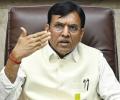
Cabinet approves Khelo Bharat Niti, says it will bring India into top-5 of world sports

The foreign degree no longer sells itself, families are doing the math, and for many, the numbers just don't add up.
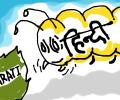
'I don't know whether the top Gujarati leaders of Indian politics (Prime Minister Narendra Modi and Union Home Minister Amit Shah) in Delhi realise that the narrative of HindiHinduHindustan will eventually destroy their own language too.'

President Droupadi Murmu's address to the nation on the eve of the 79th Independence Day.

The governor's comments rekindle the debate over the historical account of the marriage between Amer ruler Bharmal's daughter and Akbar in 1569.
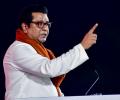
Maharashtra Navnirman Sena chief Raj Thackeray on Wednesday asked what was the need to "impose" Hindi on students and appealed to schools in Maharashtra to foil the government's "hidden agenda to deliberately create a language divide".

At least six major UK universities have announced plans to set up campuses or liaison offices in India.
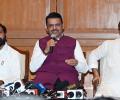
Facing mounting opposition to the introduction of Hindi language in Maharashtra schools from classes 1 to 5, the state cabinet on Sunday decided to withdraw two GRs (government orders) on the implementation of the three-language policy.
Fadnavis questioned the people's perception of Indian languages and English.
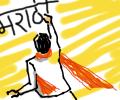
'Maharashtrians are facing a dual battle -- numerical battle with North Indians and financial battle with Gujaratis and Marwaris.' 'This has created anxiety about survival and ownership over Mumbai and Maharashtra.'
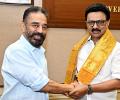
Where does Kamal Haasan stand on the issue of imposition of Hindi in the south? "I stand with Punjab. I stand with Karnataka. I stand with Andhra," is his quick reply.
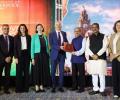
Initially, we will look to take a small batch of a few hundred students, with a plan to increase this to 5,000 students in the next five years, and eventually 10,000 by 2036.'

An amended government order issued on Tuesday said Hindi will "generally" be the third language, instead of being mandatory, but gave an option to opt out if 20 students per grade in a school express the desire to study any Indian language other than Hindi.
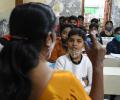
The Maharashtra government has reversed its decision to make Hindi a mandatory third language in schools after facing widespread opposition. The move comes after the state's language consultation committee urged the Chief Minister to revoke the decision. The government will now issue a revised order making Hindi learning voluntary. The decision had been met with criticism from various quarters, including opposition parties and the Maharashtra Navnirman Sena, which had called for a protest against the move.
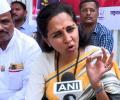
NCP (SP) leader Supriya Sule has criticized the Maharashtra government's decision to make Hindi a mandatory third language in schools, stating that it will not tolerate any undermining of the Marathi language. Sule also criticized the state's implementation of the National Education Policy (NEP) 2020, expressing concerns about its potential impact on students and teachers. She also questioned the appointment of a retired bureaucrat as the chief economic advisor to the chief minister and criticized the state's performance in areas like fiscal deficit management and the Jal Jeevan Mission.
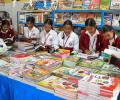
The National Council of Educational Research and Training (NCERT) has removed all references to the Mughals and Delhi Sultanate from its class 7 textbooks. The new textbooks, released this week, have been designed in line with the new National Education Policy (NEP) and the National Curriculum Framework for School Education (NCFSE) 2023, which emphasize incorporating Indian traditions, philosophies, knowledge systems, and local context into school education. The textbooks now include new chapters on ancient Indian dynasties, sacred geography, and government initiatives like Make in India and Beti Bachao, Beti Padhao. The revamp has been met with criticism from opposition parties who equate it with "saffronisation."
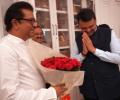
Maharashtra Navnirman Sena (MNS) president Raj Thackeray has slammed the state government's decision to make Hindi a mandatory third language in schools from Classes 1 to 5, calling it an attempt to "Hindi-fy" the state. Thackeray has vowed to oppose the decision vehemently and ensure it is not implemented. The move is part of the new curriculum implementation under the National Education Policy (NEP) 2020, which mandates a three-language formula for classes 1 to 5. Thackeray argues that Hindi is not a national language but a state language and its imposition undermines the principle of linguistic regionalization. He also questioned why Hindi is being forced on Maharashtra but not in southern states. The Opposition Congress has also criticized the move, calling it an imposition of Hindi and a threat to Marathi sentiment. The state government, however, defended its decision, stating that Hindi is a means of communication in the entire country and that Marathi is already compulsory.
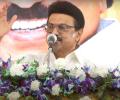
"Permitting students to discontinue studies is akin to asking them not to study," Stalin said, addressing an event organised by the Parents-Teachers Association in Cuddalore.

The DMK government in Tamil Nadu has sparked controversy by replacing the Indian Rupee symbol with a Tamil letter in the logo for its 2025-26 budget. The move has drawn criticism from the state BJP, which accused the ruling party of being "stupid." The development comes amidst the ongoing language row between the Centre and Tamil Nadu, with the latter alleging Hindi imposition by the Union government.

'Why should children, who are already burdened with so many subjects, be over-burdened with three languages?'

Tamil Nadu Chief Minister M K Stalin has reiterated the state's opposition to Hindi imposition by the Centre, calling it a 'mask' for Sanskrit. He also claimed that the National Education Policy (NEP) is being used to promote Sanskrit in many states, and that the Centre is trying to do away with languages like Tamil and impose Sanskrit. Stalin's statement comes amid growing concerns over the alleged imposition of Hindi in non-Hindi speaking states.
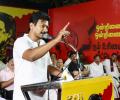
'The vast majority of BJP supporters in Tamil Nadu can't speak any language other than Tamil.' 'When rural Tamil Nadu can't speak any other language than Tamil, how are they going to convince them that they have to learn Hindi?'

A parliamentary panel has criticized the Indian government for withholding funds from states that have not agreed to implement the PM SHRI schools scheme, calling the reasoning behind the decision "not factual or justified." The panel has recommended the immediate release of pending funds to states like Kerala, Tamil Nadu, and West Bengal, which have been significantly impacted by the delays.

Whether or not today's protest against NEP escalates into a full-fledged struggle across the state remained in the hands of the Prime Minister Narendra Modi-led BJP government, he said.
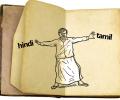
The three-language formula proposed in the National Education Policy 2020, is at the centre of the political row between the Dravida Munnetra Kazhagam-led Tamil Nadu government and the central government.
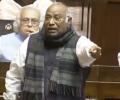
The Rajya Sabha witnessed an uproar on Tuesday over an unparliamentary remark by Leader of Opposition Mallikarjun Kharge, who apologized to the Chair while clarifying that it was meant for the government that was "trying to create a regional divide" in the country. The controversy stemmed from a statement by Education Minister Dharmendra Pradhan, who slammed the Tamil Nadu government for its stand on the three-language policy under the National Education Policy (NEP). Kharge's use of a Hindi expression, deemed unparliamentary, sparked outrage from the treasury benches. He subsequently apologized for the remark, stating it was directed at the government's policies and not the Chair.
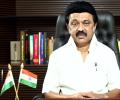
Tamil Nadu Chief Minister and DMK president M K Stalin announced that his party will file a case in the Supreme Court against the Waqf Bill passed in the Lok Sabha. The opposition AIADMK expressed solidarity with the DMK's stance, while the BJP members staged a walkout from the Assembly in protest. The CM argued that the amendment was passed at the behest of a few allies despite opposition from majority parties and that it is an attack on the Constitution and religious harmony. The DMK claims the bill threatens the autonomy of the Waqf Board and the Muslim minority population.
 © 2026 Rediff.com - Investor Information - Advertise with us - Disclaimer - Privacy Policy - Sitemap - Feedback - About us - Terms of use - Grievances