
While demand for hair care products is increasing in both rural and urban markets, urban consumers have proven to be more extravagant, reports T E Narasimhan.

The role of AI spans coaching, performance, learning, engagement and career growth.

India indulges in the most sophisticated marketing campaigns but has poorest branding, says Shombit Sengupta, Founder, Shining Consulting.

Marico's chief executive officer (Consumer Products Business) Saugata Gupta, too, affirmed that his company was being cautious in dealings with such retailers. FMCG companies work on tight credit cycles. On the other hand, modern trade retailers such as Aditya Birla Group's More, RPG's Spencer, Mukesh Ambani group's Reliance Fresh, Subhiksha and Vishal have been expanding aggressively over the last couple of years.

What is driving the digital-first approach of traditional, legacy brands? Apart from the growing adoption of the internet in the country, brands are drawn to the agility of the medium.
Nearly all FMCG companies like Marico, HUL, ITC and the rest have been indicating that the operating environment has been challenging, with drop in consumption, especially in rural areas, severe crunch in market liquidity conditions, and disruptions and floods in several parts of the country. To overcome this, they are boosting their direct reach in the countryside.

Some analysts see more upside in FMCG stocks given the performance gap between the sector and the market.
Listed entities demerge businesses from lubricants and skincare to textiles, tea and information technology.

Despite near-term headwinds of rising input costs and the possibility of lower demand for products as Covid dented rural & urban India, and impacts both production & consumption, analysts remain bullish on stocks of fast moving consumer goods (FMCG) companies and expect the index to relatively outperform its peers in the second half of fiscal 2021-22 (FY22). In the past one year, prices of key commodities such as groundnut oil, mustard oil, Vanaspati, soya oil, sunflower oil and palm oil have shot up in the range of 20 per cent to 60 per cent, data show. The FMCG sector macros in this backdrop, according to analysts, have further deteriorated because of weakness in consumer demand and likely margin pressure due to elevated crude oil, palm oil and global food prices.

The Board of Control for Cricket in India (BCCI) has pegged the base price for the combined IPL media rights at Rs 32,890 crore, nearly double the Rs 16,347 that Star Disney paid five years ago. Experts say that at these levels, there does not seem to be any profit-and-loss logic at play. It is more about what premium broadcasting companies are ready to spend for market share dominance. They point out that due to competition, they expect the final price to hit Rs 40,000-50,000 crore.

Ajit Mishra, vice president, research, Religare Broking, answers your queries.

Higher prices are burdening household budgets and threatening the margins of leading manufacturers.
However, the government's draft policy on e-commerce companies has forced consumer companies to also adapt to the changes. For Dabur India, e-commerce channel continues to be a key driver of growth in urban India. The contribution of online sales to its entire portfolio is at six per cent compared to 1.5 per cent before the pandemic.

'Kerala isn't as dependent on agriculture like Bihar or Odisha or even other southern states.' 'Economic losses would not be too intense, unlike other states.' 'The floods could, at best, impact India Inc's earnings for a quarter or two.'

Sanjiv Mehta, chairman of the country's largest consumer goods company, HUL, believes that the second wave of the Covid-19 pandemic between April and June this year has been a mere pause in India's consumption story, and that it will not change the country's overall growth trajectory. India is poised for growth, especially in the fast-moving consumer goods (FMCG) sector, Mehta told shareholders at the company's annual general meeting on Tuesday. The signs of recovery are becoming evident with many states lifting lockdown restrictions in recent weeks.

The iconic British brand acquired by Unilever in 2009 from American major Sara Lee, is attempting to get a new image with actors Sidharth Malhotra and Varun Dhawan.
With a revival in demand and consumption, FMCG companies are looking forward to 2022 with positivity and hopes of sustaining a healthy growth trend across both rural and urban markets while gearing up to cater to the ever-increasing digitally active consumers and tackle the challenge of higher commodity prices. Health and wellness and convenience are going to remain key trends and FMCG companies are strengthening their core brands, driving premiumisation across their portfolios with targeted innovations as consumers are gravitating towards trusted brands looking for quality, purity and hygiene, in continuation of the trend that started since the pandemic last year. FMCG makers are accelerating digitalisation and are investing in building capability in e-commerce and Direct-to-Consumer channels, identifying it as a key vector of their growth as the threat of a possible third wave is still not away.

Marico Chairman Harsh Mariwala shares his career lessons and success mantras.

First it was called content-led commerce. Then it came to be known as influencer-led commerce. And its latest iteration is creator economy. This evolution of the terminology for online personas impacting buying decisions -- through blogs, memes, bite-sized videos, and podcasts -- has happened over the past five to seven years.
Amway surged by converting a multitude into sales agents.

Ajit Mishra, vice president, research, Religare Broking, answers your queries.

Two-day event saw participation of venture capitalists, private equity funds, angel investors, etc.
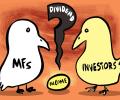
The combined dividend payout by early-bird companies -- those that have declared their results for FY21 -- is up 8.9 per cent, lower than the 21.9 per cent rise in in FY20 but ahead of the underlying growth in India Inc business last year. Combined net sales of these early birds were down 1.8 per cent last financial year while net profit was up 27.3 per cent in FY21. Some top companies that have stepped up dividend payout in FY21 include Hindustan Unilever, Indus Towers, Tata Steel, Ultratech Cement, Larsen & Toubro, Dabur, Asian Paints, and UPL. In contrast, banks have skipped dividends under an RBI diktat while companies such as Marico, TCS, Maruti Suzuki, and Godrej Consumer are paying lower dividends for FY21.
Second quarter numbers hint at a rocky road ahead with a slowdown in discretionary categories set to continue.

In terms of stock selection, India continues to benefit from two phenomena - the big getting bigger and availability of quality stocks in relative abundance compared with its Asian peers.

FMCG stocks have underperformed the market, falling 2.2 per cent so far in 2014.

The new packaging norms, which will kick in on November 1, will push up the product prices.

The report analysed product launches of 2011, their success over three years, and reported 31 of the 14,509 products introduced that year were received well by consumers.

FCMG companies which have plants i Npal may take a hit on revenues.

Sebamed's campaign for its cleansing bar of the same name, released across print, television, digital and outdoor, has also named Santoor, a popular soap brand from Wipro Consumer Care.
FMCG and retail giants are making good use of technology to reach out to rural India.

A break-up of business shows that 75% of a firm's turnover is led by volume growth, while 25% is price-led. Companies such as Britannia, Nestl, Dabur, Marico, Kellogg, Parle Products, and Hindustan Unilever have increasingly focused on smaller packs of their key products, aimed at improving sales.

To be an effective entrepreneur, management students need to have holistic experience, says Harsh C Mariwala, Chairman & Managing Director, Marico Limited.

The most consistent wealth creators since 2008 are all consumer-facing companies, says Devangshu Datta.

According to data compiled by media research agency TAM, the rate of growth of advertising on television in terms of the number of hours was half during the January-June period this year in comparison with the corresponding period last year.

Now, a new dawn breaks for Sangeeta Pendurkar, 43, who takes charge mid-month as managing director at Kellogg India.

Ajit Mishra, vice president, research, Religare Broking, answers your queries.
Even as large fast moving consumer goods companies like Hindustan Unilever and ITC struggle with their volume growth, mid-tier FMCG companies like Godrej Consumer Products, Marico, Dabur and Nestle have reported strong spurts in volumes as they focus on inorganic growth and rural markets, according to industry experts.

Apart from the growing adoption of the internet in the country, brands are drawn to the agility of the medium, its targeted and data driven approach and the increasing cost of offline channels for sales and distribution.
