The Supreme Court declined to examine a plea challenging a PMLA provision, stating the issue lies in the law's abuse, not the law itself. The court allowed the petitioner to approach the High Court if procedures weren't followed.

The Delhi High Court has stayed the release of the movie 'Udaipur Files' amid concerns that it could promote communal disharmony. The court has directed petitioners to approach the central government with their grievances, and the stay will remain in effect until the government decides on the matter.

The Supreme Court has stated it will intervene if there is mass exclusion in the special intensive revision of electoral rolls in Bihar, emphasizing the Election Commission's role as a constitutional authority.
The Supreme Court questioned Justice Yashwant Varma regarding his plea to invalidate an in-house inquiry panel report that indicted him after a large amount of burnt cash was discovered at his official residence during his time as a Delhi High Court judge.
Expressing surprise over political parties not coming forward in filing objections related to 65 lakh excluded voters, the top court directed the chief electoral officer of Bihar to implead them in the court proceedings.

A two-judge bench of the top court had on August 11 directed authorities in Delhi-National Capital Region (NCR) to start picking up stray dogs from all localities "at the earliest" and relocate the animals to dog shelters.

The Supreme Court dismissed Allahabad High Court judge Yashwant Varma's plea seeking invalidation of a report that found him guilty of misconduct in the cash discovery row.

Jagdeep Dhankhar's sudden resignation as Vice President has led to speculation about underlying political tensions and disagreements with the ruling alliance.

The opposition has raised questions regarding Jagdeep Dhankhar's sudden resignation as the vice president, with concerns about the reasons behind his decision and its timing.

The Supreme Court has questioned the line of investigation adopted by the Haryana SIT in the case of an Ashoka University professor booked for social media posts, stating that it "misdirected itself."
The Supreme Court would likely hear on Wednesday a plea of Ashoka University's faculty Ali Khan Mahmudabad against his arrest for his social media posts over Operation Sindoor.
The Supreme Court has agreed to hear petitions challenging the Election Commission's decision to revise electoral rolls in Bihar. The hearing is scheduled for July 10.

The plea claimed the blocking was effected by the intermediary pursuant to an undisclosed direction allegedly issued by the Centre citing vague grounds of "national security" and "public order".
A bench of Justices Surya Kant and N Kotiswar Singh deferred the hearing on Shah's plea after his counsel and senior advocate Maninder Singh made a request.

Several opposition MPs, who had previously criticized former Rajya Sabha chairman Jagdeep Dhankhar, are now praising him following his sudden resignation, with some even requesting him to reconsider.

The Centre on Wednesday told the Supreme Court that nobody can claim right over government land and it is legally empowered to reclaim properties which are declared waqf by using the waqf by user principle.
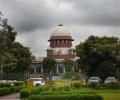
The Supreme Court of India has sought responses from the Centre and others on a petition challenging the blocking of the YouTube channel '4PM'. The petitioner, Sanjay Sharma, the Editor of the channel, alleges that the blocking order, issued by an intermediary based on an undisclosed direction from the Centre, violates his right to free speech and the public's right to information. The plea argues that the blocking was based on vague grounds of 'national security' and 'public order' without any opportunity to be heard. The court has issued notices to the Centre and others seeking their responses on the petition.
A bench of Justices Sudhanshu Dhulia and Joymalya Bagchi, however, questioned the timing of the exercise, besides offering its prima facie view that Aadhaar card, voter ID card and ration cards could be considered during the SIR in Bihar.

The Rajya Sabha secretariat has verified the signatures of 44 of the 55 MPs who had signed a notice to bring a motion for the removal of Allahabad high court Judge Shekhar Yadav over his 'hate speech' even as Kapil Sibal and nine others were yet to verify their signatures.
The Supreme Court of India has extended the interim bail of Ashoka University professor Ali Khan Mahmudabad, who was arrested for contentious social media posts on Operation Sindoor. The court, however, restrained him from posting anything online with respect to the cases against him, stating that there was no impediment on his right to speech and expression. The court directed the Special Investigation Team (SIT) to furnish the investigation report on the next date of hearing.
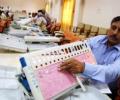
BJP's prime ministerial candidate Narendra Modi is predicted to win both seats -- Varanasi and Vadodara. Kejriwal is places at number 2 in Varanasi, says the ABP News-Nielsen exit poll. Senior BJP leader L K Advani is likely to win the Gandhinagar Lok Sabha for the sixth time.
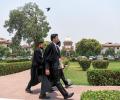
The Supreme Court of India has reserved its interim orders on three key issues related to the Waqf (Amendment) Act, 2025, including the power to denotify waqf properties, the composition of waqf boards, and the provision regarding government land. The court heard arguments from both the petitioners, who challenged the validity of the amended law, and the Centre, which defended the Act as a secular concept. The petitioners sought interim orders to prevent the implementation of certain provisions while the court considers the legal challenges.

Rejecting Bharatiya Janata Party's charge that he was shielding Tarun Tejpal, Union Minister Kapil Sibal on Thursday said law must take its course in the sexual assault case against the Tehelka editor and if he is guilty, he should be punished.
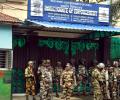
The Supreme Court has announced it will decide in April whether to reconsider its 2022 verdict upholding the Enforcement Directorate's powers to arrest and attach property under the Prevention of Money Laundering Act (PMLA). The court is hearing a batch of pleas seeking a review of the July 2022 verdict, which upheld the ED's powers of arrest and attachment of property involved in money laundering, search and seizure under the PMLA. The verdict came on a batch of over 200 petitions filed by individuals and other entities questioning various provisions of the PMLA.

'It was a disaster on his part to give an oral remark which allowed ascertainment of the religious character of places of worship.' 'This disrupted the social harmony of the country.'

Sources close to the top BJP leadership tell me that Tharoor has already had secret meetings with the BJP's top brass and is waiting patiently to make his next move, reports Ramesh Menon.

Accusing Union Ministers Beni Prasad Verma and Kapil Sibal of vitiating the election campaign, the Bharatiya Janata Party on Tuesday approached the Election Commission seeking strong action against them for making "baseless" allegations against its leaders.

Issuing notice to the ED on the plea filed by the Tamil Nadu government and Tamil Nadu State Marketing Corporation (TASMAC), a bench comprising Chief Justice B R Gavai and Justice Augustine George Masih told Additional Solicitor General S V Raju, appearing for the anti-money laundering probe agency, that "Your ED is crossing all the limits."
The bench, which examined the online post by the professor, who heads the political science department in the Sonipat-based Ashoka University, questioned his choice of words, saying they were used deliberately to humiliate, insult, or put others in discomfort. "The choice of words are deliberately made to insult, humiliate or cause discomfort to others. The professor, who is a learned person cannot lack a dictionary... he could have conveyed the very same feelings in a simple language without hurting others. He should have shown respect for the sentiments of others. He could have used a simple and neutral kind of language, respecting others," Justice Kant said.
A court in Sonipat on Tuesday remanded in judicial custody till May 27 Ali Khan Mahmudabad, the head of Ashoka University's political science department who was arrested for his social media posts related to Operation Sindoor, his lawyer said.

The Supreme Court of India on Tuesday questioned the issue of using "spyware against terrorists" and stated that any report touching upon the country's "security and sovereignty" won't be made public. The court indicated it might address individual concerns regarding privacy breaches, but the report of the technical committee would not be a document for public discussion. The court will examine the extent to which the report can be shared publicly. The court's statement came during a hearing on a petition related to the alleged use of Pegasus spyware for surveillance. The court also emphasized that "having spyware is not wrong, against whom you are using is the question" and that the security of the nation cannot be compromised. The hearing has been adjourned to July 30.
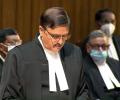
Justice Abhay S Oka, known for his unwavering commitment to liberty and constitutional values, bid farewell to the Supreme Court of India. In his final address, he stressed his dedication to upholding constitutional liberties, emphasizing that it was his "honest endeavor" to fulfill the dream of the Constitution's framers. He also expressed gratitude to the bar and his colleagues for their support and shared heartfelt memories from his time on the bench. Justice Oka's departure marks the end of a distinguished judicial career spanning over two decades, during which he served as a judge of the Bombay High Court, Chief Justice of the Karnataka High Court, and ultimately, as a Supreme Court justice.
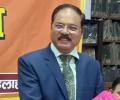
Members of several opposition parties in India have initiated proceedings to impeach Allahabad High Court Judge Shekhar Kumar Yadav for his alleged controversial remarks at a recent event. The impeachment motion, signed by 55 opposition MPs, cites the judge's speech at a Vishva Hindu Parishad (VHP) function, where he allegedly made provocative statements on a uniform civil code and the law working according to the majority. The Supreme Court has taken note of the controversy and sought details from the Allahabad High Court.

The Gujarat High Court dismissed a plea filed by journalist Mahesh Langa seeking the quashing of an FIR registered against him for allegedly stealing "highly sensitive and confidential documents" belonging to the Gujarat Maritime Board (GMB). The court found that prima facie, Langa's involvement in the crime was evident from the evidence collected during the investigation. The court further stated that the investigation is at a nascent stage and it would be inappropriate to exercise its inherent powers in favor of the petitioner at this stage.

Chief Justice of India Justice B R Gavai on Friday praised Justice Bela M Trivedi for her career trajectory from the subordinate judiciary all the way up to the Supreme Court, where she became the eleventh woman judge to be appointed in its history.
Hours after, however, firing from the Pakistani side was reported in Akhnoor sector in Jammu and Kashmir. Drones were also seen in the Pir Panjal area.

The Supreme Court of India has asked DMK leader V Senthil Balaji to choose between his ministerial post in Tamil Nadu and his freedom. The court expressed concern over Balaji's reinstatement as a minister despite being granted bail in a money laundering case related to the "cash-for-job" scam. The court fears that Balaji's presence as a minister could influence witnesses in the case. The court has given Balaji until April 28 to make a decision.
He also rejected all charges of alleged cheating and siphoning off money by Congress in the matter.
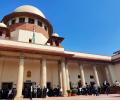
The Supreme Court on Monday agreed to consider listing for urgent hearing the petitions challenging the constitutional validity of the Waqf (Amendment) Act, 2025.
Underscoring the 'presumption of constitutionality in favour of law', the Supreme Court on Tuesday said petitioners challenging the waqf law needed a 'strong and glaring' case for interim relief.
