
A mysterious shooting incident at a ISRO facility in the early hours near Bangalore threw up conflicting versions with a CISF guard claiming that two unidentified persons shot at him while the police raised serious doubts.

Since Pakistan has 'opted out' of the project, it is now being called South Asian satellite.

Out of its 47 operational satellites, India currently has six to eight satellites which are used entirely for military purposes.
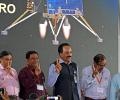
While the historic success of Chandrayaan-3 is celebrated by Indians across the world, two untrumpeted engineering colleges in Kerala are basking in the glory of the key role played by some of their alumni in the crucial Moon mission.

The feat is the second one for the Indian Space Research Organisation scientists in using the indigenously made cryogenic stage after the January 5, 2014 launch of GSLV-D5.

The ISRO lost communication with the satellite when it attempted to ignite the engine in a third and final move to its desired location.

The initial assessment of the first-ever measurements of the near-surface lunar plasma environment over the south pole region by RAMBHA-LP payload onboard Chandrayaan-3 lander indicates that plasma there is relatively sparse, ISRO said on Thursday.
This is the third time that Tamil Nadu has supplied the necessary soil to the Bengaluru headquartered space agency for performing the tests for its ambitious Moon missions.

India performed yet another space feat on Wednesday when the Indian Space Research Organisation launched a record 104 satellites into orbit from Sriharikota, Andhra Pradesh, something no other country has done before.

The primary goal of HysIS, whose mission life is five years, is to study the earth's surface in visible near infrared and shortwave infrared regions of the electromagnetic spectrum.

Indian Space Research Organisation's plan to soft land Chandrayaan-2's Vikram module on the Lunar surface did not go as per script in the early hours of Saturday, with the lander losing communication with ground stations during its final descent.

"Chandrayaan-2 is not the end of story. Our plans on Aditya L1 solar mission, human spaceflight programme are on track. A large number of advance satellite launches are planned in the coming months. SSLV will make its maiden flight sometimes in December or January. Testing of 200 ton semi-cryo engine is expected to begin shortly. Work is on to provide NAVIC signals on mobile phones, which will open the path to develop large number of applications for societal needs," he added.

ISRO said on Saturday the Aditya-L1 spacecraft has travelled beyond a distance of 9.2 lakh km from Earth, successfully escaping the sphere of Earth's influence.
On Thursday, scientists sent the 1,380 kg spacecraft to its next destination -- highly elliptical orbit of 300 km perigee and 1.6 lakh km apogee respectively. This will be followed by three more orbit-transfer exercises.
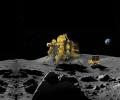
This eagerly anticipated event will be broadcast live on August 23, starting from 17:27 Hrs IST on multiple platforms, including the ISRO Website, its YouTube channel, ISRO's Facebook page, and DD National TV channel.

The United Nations General Assembly, heeding to a call by Prime Minister Modi, had made a declaration in December 2014 to observe June 21 every year as IDY.

'ISRO's style is a terrific example of being able to survive, acknowledge failures, and then most importantly of all, learn from them to ensure that subsequent missions are successful.'
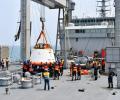
Nerves gave way to smiles at the spaceport in Sriharikota as delays and an anomaly-triggered 'hold' forced Indian Space Research Organisation (ISRO) scientists to revise the launch schedule of a test vehicle carrying payloads related to the country's ambitious human space flight mission, Gaganyaan which soared into skies after initial hiccups.

ISRO chief's comments came after NASA said that it had found the remains of the Vikram lander by its Lunar Reconnaissance Orbiter and credited the discovery to Chennai-based amateur astronomer and engineer Shanmuga Subramanium.

ISRO needs next generation launchers and new facilities to manufacture and launch them.

Chandrayaan-3 is now in an orbit, which when closest to Earth is at 173 km and farthest from Earth is at 41,762 km, the space agency said.

ISRO launched 12 Indian, 22 foreign satellites and successfully flight-tested India's first winged-body aerospace vehicle.
The ISRO said that 90 to 95 per cent of the mission objectives have been accomplished, notwithstanding the loss of communication with the lander.

Recently, the government relaxed foreign direct investment (FDI) norms for the space sector by allowing 100 per cent FDI in manufacture of components, systems or sub-systems for satellites, ground segments, and user segments. It also permitted 74 per cent FDI in satellite manufacturing and operation as well as satellite data products and 49 per cent in development of launch vehicles and spaceports. Following this, stocks of related companies saw an uptick on the bourses.

GSLV-MK III, which uses a homegrown cryogenic engine, has to do at least two more launches before it begins commercial operations, report Raghu Krishnan and T E Narasimhan.

The Supreme Court on Wednesday rapped the Haryana and Punjab governments over non-prosecution of violators found guilty of stubble burning and summoned the state chief secretaries to appear before it on October 23 and submit. an explanation.
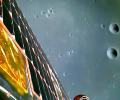
Taking to X (formerly Twitter), ISRO said, "Chandrayaan-3 Mission. Chandrayaan-3 Rover to MOX, ISTRAC, Moon walk begins!"

The space agency had earlier announced that the launch is tentatively scheduled at 09:28 hrs IST on November 25, subject to weather conditions.

The website of Indian Space Research Organisation's commercial arm Antrix Corporation Limited was reportedly hacked on Sunday and the space agency said efforts are on to set it right.
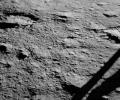
The lessons learned from the failure of Chandrayaan-2 contributed to the success of India's third lunar mission, former space scientist with the Indian Space Research Organisation (ISRO) Nambi Narayanan said, after the successful touchdown of the 'Vikram' lander on the lunar South Pole.

A mysterious flying object has reportedly been sighted by shepherds over Indian Space Research Organisation's Mahendragiri centre and neighbouring forest areas.

Only three countries (United States, Russia and China) have successfully landed spacecraft on the airless lunar surface.

India's ambitious third Moon mission's spacecraft Chandrayaan-3 after the launch on July 14, had entered into lunar orbit or the Moon's orbit on August 5.
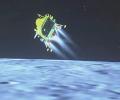
After Chandrayaan-3 touched down on the Moon, the Congress on Wednesday said it is a collective success of every Indian and ISRO's achievement reflects a saga of continuity and is truly fantastic.

It also carries equipment for meteorological data relay and satellite based search and rescue services being provided by earlier INSAT satellites.

The first Trajectory Correction Manoeuvre of India's maiden mission to Mars was on Wednesday carried out successfully by Indian Space Research Organisation scientists on the spacecraft, which is presently travelling some 2.9 million km away from Earth.
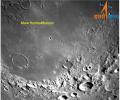
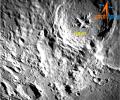
This camera that assists in locating a safe landing area -- without boulders or deep trenches -- during the descent is developed by Ahmedabad-based Space Applications Centre (SAC), a major research and development centre of ISRO.

Indian Space Research Organisation has built a supercomputer, which is to be India's fastest in terms of theoretical peak performance of 220 TeraFLOPS (220 Trillion Floating Point Operations per second).

Former National Aeronautics and Space Administration (NASA) Official Mike Gold has said Chandrayaan-3's success is a triumph of Indian innovation, human capital and the capabilities that will take India even further.

Scientists also expressed the hope that any technical problem will be sorted out by ISRO, and the mission will be launched successfully.
