
'Surely, Syrian President Bashar al-Assad will not be able to pay or compensate the Russians for deployment and use of Russian men and equipment,' says Brigadier S K Chatterji (retd).
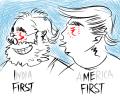
'Even in this age of self-willed and authoritarian leaders and spontaneous gestures, a script is still written,' notes Ambassador B S Prakash, imagining the 'talking points' are for the India-US summit on June 26.

'In the past the US has been reluctant to name Pakistan directly in an US-India joint statement.'
The US has taken the first step to open channels of communications with a leader it had so far refused to engage with, at least openly.

'Progress demands regular senior-level attention from American leaders.' 'A leaders' summit is great, but we need sustained engagement to continue to forge new agreements and find new areas of cooperation.'
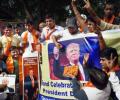
'India can rely on him to fight terrorism in all its forms, including Pakistan-sponsored outfits.'

India is committed to getting back to a sustainable growth path of 8 to 9 per cent, Prime Minister Manmohan Singh has said, adding that such a target is achievable because the fundamentals of the Indian economy remain strong.
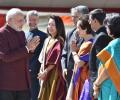
S Jaishankar turned out to be a chip of the old block and that too, in modern parlance, a fully loaded chip. The father laid down the precepts of Indian strategy and diplomacy and the son put them into practice. T P Sreenivasan on India's new foreign secretary.
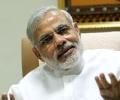
Wisner said during a discussion organised by Asia Society here yesterday on the Indian elections.
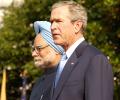
'If we could break through this symbolic barrier of sanctions and a dysfunctional relationship, we could do anything.'

Prime Minister Narendra Modi on Friday said his government has carried out major reforms -- including labour reforms and reforms in insurance and defence sectors -- 'in less than 100 days' and stopped reversals Indian economy had been facing.

The February 13 meeting between Nancy Powell, who quit as United States ambassador to India on Monday, and Narendra Modi, the Bharatiya Janata Party's prime ministerial candidate, was frosty enough to convince the Roosevelt House (the official address of the US embassy in New Delhi) and the White House in Washington DC that much had to be done before US diplomats could aspire to any significant access to a Modi-led government in India.
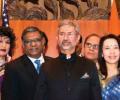
'Every index of the US-India relationship is pointing north. The time has come for us to set much more ambitious goals for ourselves,' says India's new Ambassador to the United States Dr S Jaishankar.
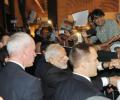
'You can see the essential contours of his new Pakistan strategy. Rather than keep engaging with or humouring them, he'd rather work on taking their four biggest supporters -- the US, China, the UAE and later Saudi Arabia -- away from them.' 'In his calculation,' says Shekhar Gupta, 'with the total support of all four of these, Pakistan will be forced to moderate its policies.'

Days before Narendra Modi arrives in the US to speak at the UN, meet Barack Obama, gupshup with the likes of Nadella, Pichai, Zuckerberg, and address desis in Silicon Valley, his ministers will help set the commercial and strategic tone for the prime minister's visit.
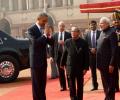
'We are no longer striving for a strategic partnership. We have arrived at one.'

'Implementation of the US-India Defence Technology and Trade Initiative is as much a test for the Modi government to direct its bureaucratic processes, as it is of US commitment,' says Lieutenant General Anil Chait (retd).
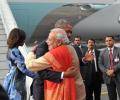
'A three generation US-Pakistan relationship is not likely to be snapped any time soon. All this presents an irritant to an India that wishes to concentrate on economic development,' says Colonel Anil A Athale (retd).

Indian diplomat Devyani Khobragade, whose arrest soured India-US relations, was on Friday re-indicted on visa fraud charges, a couple of days after a US court dismissed an earlier indictment.
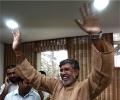
'Today, when Kailash Satyarthi is being honoured with the most prestigious global award, reports appear to the effect that many millions of Indian children are in 'slavery'. This is hardly the reputation that India should have when we are basking in the glory of 'Mangalyan',' says T P Sreenivasan.
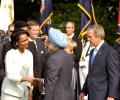
The night before Dr Singh was to meet President Bush, he said he could not sign the agreement.

'Modi and Obama both had agendas that went beyond the nuclear deal. The threat from the chilly Himalayas had to be tackled in the warm waters of the Indian Ocean.'

I still believe that it is a good thing that think tanks are mushrooming in Delhi. They provide a platform for discussion, even if they shed more heat than light. With Parliament almost incapable of serious debate, informed discussion and civilised discourse, where does this nation get its intellectual churn, asks Mohan Guruswamy.

'Your constant reiteration on the lack of religious freedom in India has sown doubts about the kind of information that you are being fed and based on which you seem to be making adverse references to India and its tradition of religious tolerance.'

Obama's decision to visit India must be a result of his judgement that Modi is a man of action, feels Ambassador T P Sreenivasan.

The spell that Prime Minister Narendra Modi cast over US lawmakers nearly two months during his visit to the United States has still not worn off, as was manifest by the gushing nostalgia of the Modi magic by both Democratic and Republican party representatives at the Congressional Diwali celebration on Capitol Hill on Wednesday.

'If the dimensions of the strategic partnership worked out by India and the US seem like a grand alliance targeted at you-know-who, China had better realise that it has fathered it,' says B S Raghavan, a long time observer of China.
.jpg)
To no one's surprise, the first question directed at Indian Ambassador to the United States Dr S Jaishankar -- at the end of his first public address since he assumed his duties in December -- was about the controversial Devyani Khobragade episode.

'To expect that he has a magic wand to resolve all differences and announce breakthroughs in all issues during his first visit to the US is to be unrealistic,' says Ambassador T P Sreenivasan.
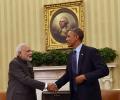
Furthering Indo-US cooperation on terrorism, Prime Minister Narendra Modi and President Barack Obama on Tuesday agreed to make "joint and concerted efforts" to dismantle safe havens for terror and criminal networks like Lashkar-e-Tayib, Jaish-e-Mohammad, Dawood-company, Al Qaeda and the Haqqani network.

'India may be new to world politics and her military strength insignificant in comparison with that of the giants of our epoch.' 'But India is old in thought and experience and has travelled through trackless centuries in the adventure of life.' 'Throughout her long history she has stood for peace and every prayer that an Indian raises, ends with an invocation to peace.' Jawaharlal Nehru's memorable speech to the United States Congress.

As India gears up to honour its pravasis on January 9 to mark their contribution in the nation's development, rediff.com presents perspectives from eminent writers on the Diaspora. Kicking off the series is Ambassador T P Sreenivasan, who points out that the change of the Diaspora policy put in place by Rajiv Gandhi following the military coup in Fiji and his decision to stand by them, was the one defining moment in India's dealings with its overseas family.

'It is in the interest of both sides that the visit of the US President is seen as being successful. Both sides have invested considerable political capital in it. This rapid exchange of visits and the decisions taken have to be justified, beyond the symbolism, which is no doubt important in itself. This opportunity to impart a fresh momentum to ties should not be missed,' says former foreign secretary Kanwal Sibal.
The West has always preferred a timid, half intelligent and a dependent India rather than a decisively independent and self-reliant one. A pliable Indian leadership suits the West best, says Tarun Vijay.

'Just how strong were the ties between the world's largest and oldest democracies that an incident involving a diplomat and a maid led to anger threatening the relationship itself? Or had the relationship been weakening in the past few years, masked by the empty symbolism of State dinners, asks Devesh Kapur.

In perhaps the first major conference on the United States-India strategic partnership in the aftermath of the Khobragade controversy that plunged the bilateral relationship in a downward spiral and is now in the process of being resurrected, the undeniable consensus among the panelists and participants was that much ballyhooed strategic convergence between Washington and New Delhi has dissipated.
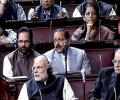
It is not in the Lok Sabha, where the BJP has a clear majority, but the Rajya Sabha that the Opposition has ganged up to checkmate Prime Minister Narendra Modi's ambitious plans.
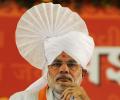
The second and final part of former cabinet secretary Naresh Chandra's interview to Sheela Bhatt.
 © 2026 Rediff.com - Investor Information - Advertise with us - Disclaimer - Privacy Policy - Sitemap - Feedback - About us - Terms of use - Grievances