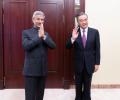
'We stress that the boundary issue shall not be linked with the overall bilateral relations. That is an important experience we have gathered through many years' effort to keep the ties moving forward

A deft hand on India-China relations, Bambawale earlier handled the China desk at the MEA.

China is acutely conscious of the need for the next Dalai Lama to be under its control. It was for this reason that China recently stressed their claim on Arunachal Pradesh. There were rumours that the next Dalai Lama may be found in Tawang. If that happens, India-China relations will become tense and there may be demands for the child to be handed over to the Chinese, points out Ambassador T P Sreenivasan.

Outgoing Indian envoy to China Vikram Misri on Monday had a virtual farewell call on Chinese Foreign Minister Wang Yi during which he said that "certain challenges" had overpowered the vast opportunities in the bilateral ties last year and hoped that with continued communication the two sides would be able to resolve the current difficulties.

India-China relations have always attracted Parliament's attention and there have always been useful and productive and constructive discussions how to engage with China, notes Rup Narayan Das.
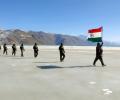
India has told China not to "shift goalposts" and "confuse" managing the border affairs and restoring peace at the frontiers with the larger issue of the resolution of the boundary question, which is dealt with by different designated mechanisms.

'If the Chinese were keen to mend fences with India, they would merely have to withdraw their troops in Eastern Ladakh.' 'They have not done so and they have not said that they will do so.'
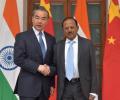
The two sides have already held 21 rounds of talks under the framework of SR dialogue which was set up to find an early solution to the border dispute.

'When you look at the border -- from Ladakh to Arunachal -- which is called the Sino-Indian border, but in effect it is actually the Indo-Tibet border.' 'Since the borders are still not secure, it has resulted in transgressions in Galwan, Dokalam etc.'

The US has been, historically, a sleeping partner in India-China relations. Today, any attempt by the Modi government to make a bilateral move to improve relations with Beijing could upset Biden's apple cart, notes Ambassador M K Bhadrakumar.


In the first highest level face-to-face contact between the two sides after border tension erupted in eastern Ladakh in early May, Singh and Wei met for two hours and 20 minutes in Moscow on Friday evening on the sidelines of a meeting of the defence ministers of the Shanghai Cooperation Organisation.
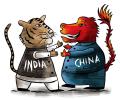
India and China achieved a major milestone this year when their bilateral trade crossed the landmark figure of $100 billion but it did not generate any fanfare in both capitals as the two Asian giants are going through a "particularly bad patch" in their relations due to a set of actions by Beijing in violation of agreements that led to the military standoff in eastern Ladakh. Starting with a modest $1.83 billion in 2001, the bilateral trade crossed $100 billion-mark in the first 11 months this year, a significant milestone for which the two countries carried out campaigns to boost trade and build it as a major stakeholder to improve the relations between two nations, whose ties otherwise remained frosty over the festering boundary dispute and strategic rivalry. According to last month's data from China's General Administration of Customs (GAC), the India-China bilateral trade totalled $114.263 billion, up 46.4 per cent year-on-year from January to November 2021.
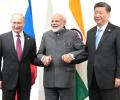
Asserting that both Prime Minister Narendra Modi and Chinese President Xi Jinping are 'responsible' leaders, Russian President Vladimir Putin on Saturday said they both are capable of solving issues between the two countries, and that it was important that no 'extra-regional power' should interfere in the process.

'Some observers say India and China are bound to be strategic adversaries. I find such determinism misplaced,' says National Security Advisor Shiv Shankar Menon.
During their hour-long in-person meeting on the sidelines of a Shanghai Cooperation Organisation (SCO) conclave in Dushanbe on Wednesday, External Affairs Minister S Jaishankar also told his Chinese counterpart and State Councilor Wang Yi that any unilateral change in the status quo along the Line of Actual Control (LAC) was 'not acceptable' to India and that the overall ties can only develop after full restoration of peace and tranquillity in eastern Ladakh.

'Vijay Gokhale's appointment as foreign secretary can be regarded as a certain 'adjustment' that could make a difference to the poor climate of India-China relations,' says Ambassdor M K Bhadrakumar.

'Keeping Kashmir out of the informal summit does not mean that they have given up their strategic interest.'
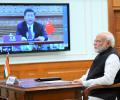
'If Asia does become a Chinese dominated space, it will not only be because India failed to get its economic act together but also because it did not stand up for its democratic credentials,' warns Shyam Saran, the former foreign secretary.

According to the latest reports, the death toll in the deadly coronavirus has climbed to 25 with confirmed cases rising sharply to 830, mostly in Hubei province. Beijing has reported 26 cases so far.

India, Jaishankar said, is a "prisoner of its past image" and must get over it.

'Modi's recent decisions to improve India-China relations, adjust India's neighbourhood policies and to rebalance India's ties with the major powers are linked to his political agenda.' 'Of course, the good part is that this agenda is also in the national interest,' says Ambassador M K Bhadrakumar.

'It is not a matter of fixing the military problem up there in the Himalayas and the retreat of the two militaries.' 'India has to find a way to correct the racist and very patronising views of India in the Chinese mind.'

'If you behave like a nail, the adversary will behave like a hammer.'
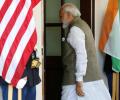
'In the next three decades up to 2050 there will be three important players at the world level.' 'India, US and China will be playing a very important role globally as the largest economies in the world.' 'These three countries will have to interact with each other much more closely because what they do and what they decide will impact the entire world.'

According to official sources, the primary objective of Wei's visit is to deliberate with Indian defence establishment on implementation of decisions taken by Modi and Xi in their informal summit in Wuhan in April.

The elephant in the room will permeate the conversations, predicts Rup Narayan Das.
'By not even acknowledging China's occupation of Indian territory Modi signalled to Beijing that he was not prepared to used forceful means to vacate the Chinese occupation, and that his government was reconciled to this loss of territory and accepted the fait accompli engineered by the PLA.'
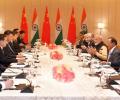
China had been trying hard to enter the Indian market, without opening its own to Indian products. There is an economic crisis in India-China relations that the Chennai Connect barely scratched the surface, points out Srikanth Kondapalli.

Most Indian IT firms work as system integrators for Huawei and though the exposure is very less as of now, the potential is more due to 5G roll out. As pressure to keep the Chinese firm out of the 5G network grows, other global firms, including Japan's NEC, South Korea's Samsung, Finland's Nokia and Sweden's Ericssion are increasing their investments to grab more market share in the telecom sector.
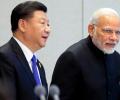
It is apparent that an easing of tensions at the border and a disengagement of troops is on the cards, observes Ambassador M K Bhadrakumar.

'If our troops on the frontlines were sleeping for two hours, they can perhaps now sleep for 2.5 hours because when the adversary is right in front, then you can't even blink your eyes, you have to be absolutely alert.'
'We should not minimise the seriousness of Chinese encroachments because their perception is different.' 'Nor should we fall into the trap of accepting so-called 'buffer zones' in areas of overlapping claims. We cannot have buffer zones in our own territory,' asserts Ambassador Shyam Saran, a former foreign secretary.
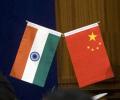
In the past year, Beijing has hosted at least 70 delegations from India as part of its outreach to the Indian business community, youth leaders and Sangh Parivar affiliates
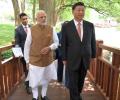
'India's preference today seems to be to exploit the deepening chill in relations with China to breathe new life into its meandering partnership with the US,' argues Ambassador M K Bhadrakumar.

"Terrorism is an enemy of the basic human rights: of life, peace and prosperity," Swaraj said.

India has told China that disengagement at all friction points is necessary to contemplate de-escalation of troops in eastern Ladakh even as the foreign ministers of the two countries agreed to establish a hotline for "timely" communication and exchange of views.

'How and if India retaliates will go a long way toward determining the trajectory of this crisis.'
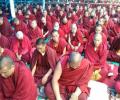
'Given Chinese sensitivity to anything to do with Tibet -- and the fact that in the 1950s it was the Tibet issue which led to the deterioration of India-China relations and the border war in 1962 -- India should be particularly careful in not triggering a Chinese reaction which it may not be able to handle,' says former foreign secretary Shyam Saran.

The USS John Paul Jones acted like a dog marking the lamp post, observes Ambassador M K Bhadrakumar.
 © 2026 Rediff.com - Advertise with us - Disclaimer - Privacy Policy - Sitemap - Feedback - About us - Terms of use - Grievances