
The Supreme Court on Friday refused to entertain a fresh plea challenging constitutional validity of the Waqf (Amendment) Act, 2025.

Karnataka has commenced a survey for the sub-classification of Scheduled Castes (SCs) in the state, which will continue until May 17. The exercise, led by a one-man commission headed by retired High Court Judge Justice H N Nagamohan Das, aims to gather empirical data on 101 castes within the SC list and provide clear recommendations on sub-quotas. The survey will be conducted in three phases, with designated camps for those who miss the first phase and online registration for those residing outside their towns. The Supreme Court's August 1, 2024, verdict upholding the constitutionality of sub-classification within SCs provided the legal basis for this initiative. The commission aims to address discrepancies in the status of certain SC castes and provide a comprehensive report within 60 days.

Opposition parties in India, including the Congress, Left parties, Samajwadi Party, Bahujan Samaj Party, Trinamool Congress, Dravida Munnetra Kazhagam, Rashtriya Janata Dal, Shiv Sena (UBT), and NCP (SP), have unanimously hailed the armed forces' "Operation Sindoor", a retaliatory strike against terrorist infrastructure in Pakistan and Pakistan-occupied Kashmir (PoK). The operation, which involved missile and drone strikes, was conducted in response to the April 22 Pahalgam terror attack. Despite political differences, all parties expressed support for the government and the armed forces, stressing the importance of national unity and integrity in the face of terrorism. While emphasizing the need for diplomatic avenues to prevent further escalation, some parties also called for caution in attributing political credit for the strikes.
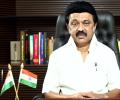
Tamil Nadu Chief Minister and DMK president M K Stalin announced that his party will file a case in the Supreme Court against the Waqf Bill passed in the Lok Sabha. The opposition AIADMK expressed solidarity with the DMK's stance, while the BJP members staged a walkout from the Assembly in protest. The CM argued that the amendment was passed at the behest of a few allies despite opposition from majority parties and that it is an attack on the Constitution and religious harmony. The DMK claims the bill threatens the autonomy of the Waqf Board and the Muslim minority population.

'It will split people and create caste clashes. Unity of people will be affected for the time being.'

The opposition party, however, said the four eminent Congress MPs and leaders who have been included at the instance of the Modi government will, of course, go with the delegations and make their contributions.
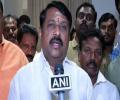
BJP legislator Nainar Nagendran will become the next state chief of the BJP in Tamil Nadu, succeeding K Annamalai, who is set for a national role. Union Home Minister Amit Shah, who is in the city to review the party's functioning, praised Annamalai's work. Nagendran, the lone contestant, is the current state vice president and was formerly with the AIADMK. He is expected to be officially announced as the new state president soon.

Issuing notice to the ED on the plea filed by the Tamil Nadu government and Tamil Nadu State Marketing Corporation (TASMAC), a bench comprising Chief Justice B R Gavai and Justice Augustine George Masih told Additional Solicitor General S V Raju, appearing for the anti-money laundering probe agency, that "Your ED is crossing all the limits."

Kamal has a crisp pen when it comes to writing short and yet powerful film dialogues. But while speaking ex tempore -- and that has been his style -- he looks every bit a confused man, observes N Sathiya Moorthy.
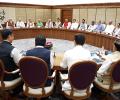
The diplomatic exercise aimed at presenting India's stance against Pakistan on terror comes in the wake of Operation Sindoor -- the Indian offensive against terror camps in Pakistan and Pakistan-occupied Kashmir following the April 22 terror attack in Pahalgam in which 26 people, mostly tourists, were killed.
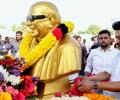
This article traces the history of the DMK's fight for state autonomy, beginning with C.N. Annadurai's advocacy in the 1960s and culminating in M. Karunanidhi's resolution in the Tamil Nadu Assembly in 1974. The article highlights the key figures involved, the arguments presented, and the impact of the Rajamannar Committee Report.

The Congress on Sunday said it was not stopping anyone from being part of diplomatic delegations to be sent to various countries following Operation Sindoor and that its leaders who have been named at the instance of the government must listen to their conscience and contribute to the exercise.

The Supreme Court of India has ruled that Tamil Nadu Governor R.N. Ravi can no longer serve as chancellor of state-run universities, a decision welcomed by the ruling DMK party. The court's judgment stems from a long-standing dispute between the state government and the governor over the assent of 10 bills passed by the Tamil Nadu Assembly. The DMK alleges that the governor had obstructed the smooth functioning of universities by delaying appointments and other critical matters. The judgment paves the way for the Tamil Nadu government to appoint new chancellors for its universities, effectively removing the governor's influence in higher education.

The government will send seven all-party delegations to key partner countries, including members of the United Nations Security Council, later this month to convey India's message of zero tolerance against terrorism following the Pahalgam terror attack and Operation Sindoor.

The Madras High Court has directed the Tamil Nadu police to file a case against state Forest Minister K Ponmudy, following his recent controversial remarks about Shaivism and Vaishnavism. The court warned the police that if they do not register an FIR against the DMK leader, it will initiate suo motu contempt proceedings.

Tamil Nadu Chief Minister M K Stalin has announced that the state's Assembly resolution seeking NEET exemption, which was sent for Presidential assent, has been declined by the Centre. Stalin termed the rejection as a "dark chapter in federalism" and accused the Centre of disregarding the will of the Tamil Nadu people. He also announced an all-political party meeting on April 9 to discuss the issue further.
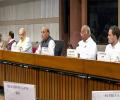
The delegations led by Baijayant Panda, Ravi Shankar Prasad (both Bharatiya Janata Party), Sanjay Kumar Jha (Janata Dal-United), Shrikant Shinde (Shiv Sena), Shashi Tharoor (Congress), Kanimozhi (Dravida Munnetra Kazhagam) and Supriya Sule (Nationalist Congress Party-Sharad Pawar) will visit a total of 32 countries and the EU headquarters in Brussels, Belgium.
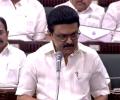
Tamil Nadu Chief Minister M K Stalin has announced the formation of a panel headed by a retired Supreme Court judge to study the relationship between the Union and state governments and ensure state autonomy. The panel, which will submit its interim report in January 2026 and its final report in two years, will examine the transfer of subjects from the State List to the Concurrent List, citing the National Eligibility-cum-Entrance Test (NEET) as an example of a subject outside state purview.
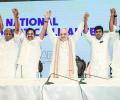
Union Home Minister Amit Shah on Friday said that the All India Anna Dravida Munnetra Kazhagam, Bharatiya Janata Party and all the alliance parties will contest the upcoming Vidhan Sabha elections in Tamil Nadu together under the National Democratic Alliance. The significant political development comes ahead of the TN Assembly election to be held in 2026,

Several petitions were filed in the apex court challenging the Act, contending that it was discriminatory towards the Muslim community and violated their fundamental rights.
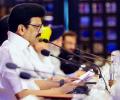
Tamil Nadu Chief Minister M K Stalin on Thursday slammed his Uttar Pradesh counterpart Yogi Adityanath over the language row, calling his remarks "political black comedy." Stalin said his state was not opposing a language, but its "imposition and chauvinism." He also claimed that Tamil Nadu's voice on the two language policy and fair delimitation "is echoing nationwideand the BJP is clearly rattled." Stalin was reacting to Yogi's reported allegations that the DMK government was indulging in divisive tactics by using language issue. BJP state president K Annamalai hit back at Stalin, claiming the DMK leader owns private schools that teach three languages but opposes the same policy for government school students in Tamil Nadu.
Defence Minister Rajnath Singh told an all-party meeting that at least 100 terrorists were killed in the Indian strikes on terror sites in Pakistan and Pakistan-occupied Kashmir under 'Operation Sindoor'. Leaders from various parties showed maturity and extended all support to the government and armed forces.
Senior DMK leader and Tamil Nadu Minister K Ponmudy has faced criticism, including from his own party, for his purported remarks on Shaivism and Vaishnavism. A video of the minister making the remarks has gone viral, leading to calls for his resignation. The BJP has slammed the minister and demanded his sacking, while DMK MP Kanimozhi also condemned the remarks. This incident follows an earlier controversy where Ponmudy linked north Indians with selling pani puri.
Pattali Makkal Katchi (PMK) founder Dr S Ramadoss has announced taking up the complete reins of the party, relegating his president son Anbumani to the role of working president. The move, announced ahead of Union Home Minister Amit Shah's visit to Chennai, comes in anticipation of the 2026 Assembly election.
The Enforcement Directorate (ED) conducted searches at multiple locations in Tamil Nadu on Thursday as part of a money laundering probe linked to alleged irregularities in the Tamil Nadu State Marketing Corporation (TASMAC), including the purported role of its minister Senthil Balaji. The raids covered the offices of TASMAC, its employees, corporate offices of distilleries and plants, as well as "key associates" linked to Balaji, but not the minister's premises. The ED is looking into liquor sale transactions and the role of alleged middlemen in connection with TASMAC. Balaji, the minister for electricity, is also in charge of TASMAC, which holds a monopoly over liquor trade in the state. The agency is also investigating Balaji's role in an earlier money laundering case linked to the "cash for jobs scam" in the state transport department. He was arrested in that case but is currently out on bail.
Tamil Nadu Chief Minister M K Stalin has welcomed the Supreme Court's ruling that state governors must give assent to bills passed by state assemblies, calling it a 'historic' victory for all state governments in India. The court's decision came after the Governor of Tamil Nadu, R N Ravi, withheld assent to several bills passed by the state legislature. The court found that the governor's actions were in violation of the Indian Constitution, which mandates that governors must act on the advice of the council of ministers. The ruling is seen as a significant step towards strengthening the federal structure of India.
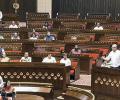
Opposition parties in India's Rajya Sabha, including the Congress and the TMC, walked out of the chamber after their demand for a discussion on the Election Commission's alleged lapses in issuing duplicate voter ID cards and delimitation was disallowed. The Deputy Chairman, Harivansh, rejected the notices under Rule 267, citing non-compliance with previous rulings. While TMC and Congress MPs focused on the duplicate voter ID issue, Tamil parties expressed concerns about the impact of delimitation on southern states. Despite raising slogans and pressing for a discussion, the opposition staged a walkout after their notices were rejected and their statements deemed not part of the official record.
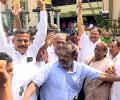
The ruling DMK in Tamil Nadu has won the Erode East bypoll with a massive margin, defeating actor-politician Seeman's NTK. The victory is seen as a boost for the DMK ahead of next year's Assembly elections. DMK candidate V C Chandhirakumar trounced Naam Tamilar Katchi's (NTK) M K Seethalakshmi by a margin of 91,558 votes, leading to the NTK forfeiting its deposit. Chief Minister and DMK president Stalin attributed the win to the DMK government's good governance, while AIADMK chief Edappadi K Palaniswami termed it a "fake" victory. The bypoll was necessitated due to the death of Congress MLA EVKS Elangovan last year.
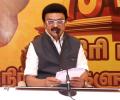
Tamil Nadu Chief Minister M.K. Stalin has condemned the alliance between the AIADMK and BJP, calling it a move driven by "hunger for power" and against the ideals of protecting state rights. He accused the alliance of being formed based on corruption and said it is doomed to fail. Stalin also criticized Union Home Minister Amit Shah for failing to address key issues like NEET and Hindi imposition, claiming that the BJP's agenda is to eradicate Tamil language and undermine Tamil Nadu's rights.
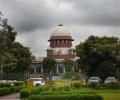
A bench comprising justices J B Pardiwala and R Mahadevan on April 8 gave a huge relief to the Dravida Munnetra Kazhagam-led Tamil Nadu government and cleared 10 state bills which were stalled and reserved by Governor R N Ravi for President's consideration, and also set a timeline for all governors to act on the bills passed by state assemblies.
The Centre on Thursday assured the Supreme Court that it will neither denotify Waqf properties, including "Waqf by user", nor make any appointments to the central Waqf council and boards till May 5.
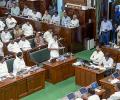
The Tamil Nadu Assembly passed a resolution on Thursday condemning the Centre's proposed Waqf Amendment Bill 2024, calling for its recall. Chief Minister M K Stalin argued that the amendment interferes with religious affairs and would negatively impact the Muslim minority. The resolution was unanimously passed by the Assembly, with support from all parties, including the opposition AIADMK and PMK. The BJP, however, walked out in protest, accusing the ruling DMK of engaging in divisive politics. The bill aims to streamline the Waqf Board's work and ensure efficient management of Waqf properties but has been criticized for potentially encroaching on religious freedom and autonomy. The Tamil Nadu government claims that the amendment would lead to government control over the Waqf Board and its properties, impacting its autonomy and potentially allowing for government acquisition of Muslim-owned lands.

Over the medium and long term, the BJP hopes to devour the AIADMK, they having identified the party as 'ideologically not as sound as the DMK', predicts N Sathiya Moorthy.

'If delimitation is not handled well by the Centre, the southern states are certainly going to challenge it.'

In more than one way, it's a setback for the DMK and Chief Minister Stalin in political terms. The electoral fall-out, if any, will have to wait until the next summer, only when assembly elections are due in the state, explains N Sathiya Moorthy.
The Supreme Court of India will likely hear a batch of petitions challenging the constitutional validity of the Waqf (Amendment) Act, 2025 on April 15. The Act, which came into force on April 8, has been met with widespread criticism from various stakeholders, including politicians, the All India Muslim Personal Law Board (AIMPLB), and Jamiat Ulama-i-Hind. They argue that the law is discriminatory and violates the fundamental rights guaranteed under Articles 25 and 26 of the Constitution. The petitions allege that the amendments give the government more control over the administration of Waqf, effectively sidelining the Muslim minority from managing their own religious endowments.
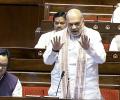
Union Home Minister Amit Shah informed the Lok Sabha that the situation in Manipur is largely under control, with no deaths reported in the last four months. However, he acknowledged that the situation cannot be considered satisfactory as displaced people are still living in relief camps. Shah attributed the violence to a high court decision regarding a reservation-related dispute, emphasizing that it was not terrorism-related but ethnic violence between two communities. He highlighted government efforts to establish peace, including discussions with both the Meitei and Kuki communities and a rehabilitation package for the displaced. While the opposition supported the resolution confirming the imposition of President's rule, they urged for a swift return to peace and normalcy in the state.

Unless Governor Ravi or the Union of India moves in appeal, seeking a hearing by a constitutional Bench, this is where it all will have to end, observes N Sathiya Moorthy.

A three-judge Supreme Court bench will hear petitions challenging the constitutional validity of the Waqf (Amendment) Act, 2025, on April 16. The petitions, including those by politicians and the All India Muslim Personal Law Board (AIMPLB) and Jamiat Ulama-i-Hind, were filed in the top court challenging the validity of the newly-enacted law. The Centre has filed a caveat in the apex court, seeking a hearing before any order is passed.
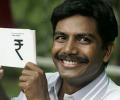
IIT Guwahati Professor D Udaya Kumar, who designed the Indian rupee symbol, has refused to comment on the controversy surrounding the Tamil Nadu government's new rupee logo for the state budget. Kumar's father was a DMK MLA, but the professor insists it's a coincidence and he has no opinion on the state government's decision to use a Tamil letter for the rupee symbol in its budget logo.
 © 2026 Rediff.com - Investor Information - Advertise with us - Disclaimer - Privacy Policy - Sitemap - Feedback - About us - Terms of use - Grievances