
BRICS nations have successfully reached a consensus on a joint statement following extensive negotiations, with India playing a crucial role in bridging differences, particularly among West Asian members like Iran, Saudi Arabia, and the UAE, despite regional conflicts and geopolitical tensions.

India and China have agreed to advance discussions on an "Early and Substantial Harvest" of boundary delimitation and border management during the 25th round of Special Representatives talks between National Security Advisor Ajit Doval and Chinese Foreign Minister Wang Yi in Beijing. Both sides reached an eight-point consensus, committing to the 2005 Agreement on Political Parameters and Guiding Principles for Settlement. Key outcomes include enhancing border management, improving understanding of the Line of Actual Control, establishing new meeting points and hotlines, and continuing cooperation on trans-border rivers and pilgrimage.

Rashtriya Swayamsevak Sangh chief Mohan Bhagwat on Thursday said protest is a legitimate form of dialogue in a democracy and should be aimed at building consensus rather than creating divisions.

Pakistan and the European Union have agreed to enhance their cooperation in combating terrorism across all forms. This commitment was solidified during the 10th Pakistan-EU Bilateral Counterterrorism Dialogue in Islamabad, where both sides condemned terrorism and discussed evolving threats, including those in cyberspace. They also expressed concern over the security situation in Afghanistan and pledged to work together in multilateral forums.

'The political leadership is very clear that we have to move towards the integration of the three services into theatre commands.'

Talks between the Union home ministry and Ladakh leaders ended without a breakthrough in Leh, with the two sides expressing differences over a draft proposal on constitutional safeguards and a legislature for the Union Territory.

Jio Platforms (JPL) is preparing a capex-light strategy to commercially launch 6G services in the early 2030s through software upgrades, rather than fresh infrastructure investments, according to Akash Ambani, managing director of JPL.

Ericsson CEO Andres Vicente emphasised the critical need for technology alignment and ecosystem collaboration to ensure security in the age of Artificial Intelligence. Speaking on Wednesday, he highlighted that AI's benefits in productivity and innovation cannot be forgone, making shared security concerns across interconnected tech layers paramount. Ericsson is actively working with partners through the Trusted Tech Alliance to establish common AI-era security understandings.

The Reserve Bank of India (RBI) has increased its GDP growth forecast for the current fiscal year (FY27) by 40 basis points to 7.1 per cent, acknowledging the resilience of domestic economic activity despite global headwinds and geopolitical tensions.

Indian banks are projected to achieve healthy profit growth in the second quarter of financial year 2027 (Q2FY27), driven by lower credit costs, robust advance growth, and fee income. However, net interest margins (NIMs) are expected to face pressure due to significant mobilisation of foreign currency non-resident (bank) FCNR(B) deposits.

'The larger lesson for India Inc is that promoter oversight and professional management are not inherently contradictory. The difficulty arises when the boundaries between the two are unclear.'

'Existing borrowers who have surplus cash should make partial loan prepayments to offset the impact of rising EMIs and reduce the overall interest burden.'

Former Bombay High Court judge Justice R C Chavan has resigned from the Maharashtra government's Uniform Civil Code panel, citing profound concerns.

'When the House adjourned, they were not yet getting 360. They were short of that, maybe by six or seven or ten.' 'So they wanted to break more parties and get their support, and they were engaged in that.'

Bahujan Samaj Party supremo Mayawati has reappointed her nephew Akash Anand as the party's national convenor, reversing an earlier decision to remove him. This move comes after Anand's expression of desire to return and considering party members' views, with Mayawati emphasizing the decision was made in the interest of the party and the movement.

Chinese President Xi Jinping is set to visit the United States from September 23 to 25 for summit talks with US President Donald Trump, with discussions expected to cover critical economic and trade issues, including AI, and the recently signed US sanctions law targeting countries buying Russian oil and gas.
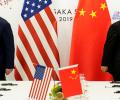
Top US and Chinese officials, including Vice Premier He Lifeng and Treasury Secretary Scott Bessent, held "candid, in-depth and constructive" talks in New York on economic and trade issues, with a specific focus on artificial intelligence. These discussions precede Chinese President Xi Jinping's anticipated visit to Washington and occur amidst new US sanctions targeting countries purchasing Russian oil and gas, and the US unveiling an "AI Force."

The protest site at Antarwali Sarati village in Maharashtra's Jalna district, which served as the epicentre for the Maratha reservation agitation led by Manoj Jarange, has been dismantled after 1,123 days. Local residents and the sarpanch decided to remove the tent and stage to facilitate daily activities and traffic movement, marking the end of a significant chapter in the three-year-long demand for OBC quota for the Maratha community.

Chinese Foreign Minister Wang Yi stated that President Xi Jinping and Prime Minister Narendra Modi reached a crucial consensus during the BRICS summit, agreeing that China and India should be partners, not rivals. The leaders pledged to maintain peace and tranquility in border areas, deepen cooperation, and support each other in multilateral forums, aiming to strengthen the Global South and promote a multipolar world order.

The successful hosting of the 18th BRICS summit in New Delhi has provided a significant boost to the BJP, offering a timely opportunity to strengthen its narrative against the opposition ahead of crucial assembly elections next year. BJP sources highlight the BRICS grouping's strong condemnation of the Pahalgam terror attack and the consensus declaration as major diplomatic victories for the Modi government, countering criticisms of its foreign policy. The party plans to leverage these outcomes during its month-long Seva Sankalp campaign to connect with various sections of society.
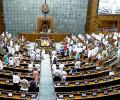
India's Monsoon session of Parliament remains formally unprorogued 40 days after adjournment, setting a new record. This unusual delay fuels speculation that the government intends to introduce a key legislation, possibly an amendment to the women's reservation law, without convening a new session. The proposed amendment aims for a 50 per cent seat expansion to address concerns over delimitation.

Congress MP Sukhdeo Bhagat on Saturday demanded punishment for Chief Election Commissioner Gyanesh Kumar amid an ongoing political row over the SIR exercise, declaring that "Kala Pani" is the appropriate punishment for Kumar based on the magnitude of his position and the alleged gravity of his misconduct.

India is hosting the BRICS summit, leveraging the platform to address global trade tensions and champion the developmental priorities of the Global South, including food, energy, and supply chain security. The summit, attended by leaders like President Xi Jinping and Vladimir Putin, will focus on resilience, innovation, cooperation, and sustainability, with India aiming to strengthen intra-BRICS collaboration and discuss global matters. The expanded BRICS grouping represents a significant portion of the world's population and GDP, making its discussions crucial for global economic stability.

The BRICS grouping adopted a consensus joint declaration in New Delhi, successfully navigating differences on the West Asia conflict but notably omitting any direct mention of US strikes on Iran or Iranian military attacks on Gulf Arab nations. The declaration also criticised Israel's actions in Gaza and called for a concerted approach against terrorism.

Xi's bilateral meeting with Modi was substantial and readouts from both sides gave indications of rapprochement, if not a reset of bilateral relations between India and China, notes Ambassador T P Sreenivasan.

Meesho, a value-commerce platform targeting middle- and lower-income geographies, is poised for significant growth driven by its asset-light model and low fulfilment costs, but faces intense competition from e-commerce giants and high valuations.

'Eastern Ladakh set the relationship back by about 10 steps. So far, especially since Galwan, we may have taken just 4 steps forward.'

Maharashtra ministers are divided over the use of high-decibel DJ systems during Hindu festivals. While Minister Yogesh Kadam asserts that festival sound will not be stopped, his colleagues Sanjay Shirsat and Meghana Bordikar advocate for adherence to noise pollution norms, with Bordikar citing a personal tragedy. Chief Minister Devendra Fadnavis has also called for a return to traditional celebrations and a consensus on restricting DJ systems.
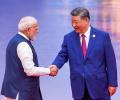
Ahead of Xi Jinping's visit, National Security Advisor Ajit Doval and Chinese Foreign Minister Wang Yi held extensive talks in Beijing on August 25 on the boundary issue and reached an eight-point consensus.

A proposed Rs 1,200 crore Secretariat-Assembly complex in Pattinapakkam, Chennai, has ignited significant opposition from local fishing communities and various political parties. Residents fear displacement, loss of livelihood, and environmental damage, citing ancestral rights and broken promises. Political leaders across the spectrum are urging Chief Minister C Joseph Vijay to reconsider the site, highlighting concerns about ecological impact, traffic, and financial priorities.

BRICS members have expressed 'serious concerns' over the unilateral imposition of trade and finance-related measures, including higher tariffs and non-tariff barriers, stating these actions distort trade and are inconsistent with WTO rules. The grouping also highlighted elevated risks to the global economic outlook due to geopolitical tensions, trade fragmentation, and protectionism.

The Ministry of External Affairs (MEA) has issued a warning against 'malicious' and 'misleading' social media posts concerning the health of world leaders, specifically Chinese President Xi Jinping and South African President Cyril Ramaphosa, who attended the recent BRICS Summit in New Delhi. The warning comes amidst unverified claims about Xi's health and an official statement from Ramaphosa's office confirming his withdrawal from public engagements due to ill health.

National Stock Exchange (NSE) Chairman Srinivas Injeti stated that post-listing, the exchange's duties as a stock trading marketplace and its responsibilities as a commercial entity will see public interest overriding business interests if the two intersect.

The proposal followed an order by the Supreme Court on August 13 asking the Union government, in consultation with experts, to decide on the visual format of the front-of-pack label.

'The total carbohydrate intake remains the deciding factor.'

China has strongly rejected a US bill that would impose tariffs on countries, including India, for purchasing Russian oil and gas. Beijing views the "Lindsey O Graham Sanctioning Russia and Iran Act 2026" as an act of "long-arm jurisdiction" and interference in its sovereign trade relations, asserting that its economic cooperation with other nations is based on equality and mutual benefit.
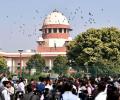
A heated exchange occurred in the Supreme Court between senior advocate S Muralidhar and Solicitor General Tushar Mehta over Mehta's use of the term "Naxalites" during a hearing on the national song Vande Mataram. Muralidhar strongly objected to the remark, demanding its withdrawal, while Mehta defended his statement, referring to an ideology rather than individuals. The bench intervened, emphasising decorum and constitutional issues.
The Supreme Court has indicated that individuals with a conscientious objection should not face criminal consequences for declining to sing Vande Mataram, while asking the Centre to consider a 1986 judgment protecting similar rights concerning the national anthem.

For India, the goal is not simply to host another grand diplomatic gathering. It is to prove that a diverse coalition of emerging powers can still deliver.
Prime Minister Narendra Modi, in bilateral talks with Chinese President Xi Jinping, emphasized that both nations must show sensitivity to each other's core issues and be guided by mutual respect, sensitivity, and interest. Modi highlighted the critical importance of peace and tranquillity along the Line of Actual Control for the development of India-China relations, while also addressing concerns regarding Taiwan and Tibet.
