
Addressing a press conference, farmer leader Gurnam Singh Chadoni said if the Centre does not accept their demands during Saturday's talks, they will intensify their agitation against the new farm laws.

The common man was bearing the brunt of the escalating prices of petrol, diesel and cooking gas, the Congress said.

Bhartiya Janata Party, Left and Samajwadi Party have decided to protest against the steep hike in the prices of petrol and would hold countrywide demonstrations, dharnas and court arrest to register their anger against the move during Thursday's Bharat bandh.

'Whatever Modi had promised us on OROP has not been delivered. He lied to us'
How effective are these strikes to solve an issue as vexing as this? Aren't strikes a bane for a nation already reeling under a heavy dose of inflation? Don't strikes put more pressure on an inflationary economic structure like India's?

The central government has asked public sector undertakings to dissuade their employees from participating in the bandh.

Shops, schools and other commercial establishments were closed in parts of Bihar, Rajasthan, Madhya Pradesh, Uttar Pradesh and Punjab but the shutdown call by anti-reservation bodies had little impact elsewhere in the country.

Ramping up his attack against the prime minister, the Congress chief questioned the prime minister's silence on rising fuel prices, the Rafale jet deal and issues such as farmer suicides, atrocities against women and unemployment.

The Shiv Sena has spurned Congress' request to participate in the bandh.
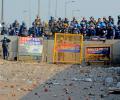
Union Agriculture and Farmer Welfare Minister Munda, Commerce and Industry Minister Piyush Goyal and Minister of State for Home Affairs Nityanand Rai represented the Centre at the meeting over the farmer unions' various demands, including a law guaranteeing a minimum support price (MSP) for crops. Punjab Chief Minister Bhagwant Mann also joined the meeting at the Mahatma Gandhi State Institute of Public Administration in Sector 26. The meeting started at around 8:45 pm on Thursday and lasted for around five hours.
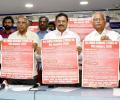
Most of the lenders had informed their customers in advance about the strike call given by All India Bank Employees Association (AIBEA), All India Bank Officers' Association (AIBOA), BEFI, INBEF, INBOC and Bank Karmachari Sena Mahasangh (BKSM), and its impact on banking services.

Thousands of farmers from around 100 villages of Noida and Greater Noida on Thursday took to the streets seeking hiked compensation, bringing traffic to a standstill in several parts of Delhi-NCR as they made an unsuccessful bid to march towards Parliament.

A nationwide agitation was held on the call of 'December 8 Kisan Mahaandolan' as protesting farmers vociferously reiterated their demand of repealing the new farm laws, which they have termed as "kala kanoon".
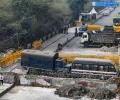
As the 'Delhi Chalo' agitation of farmers entered the third day on Thursday, two key border points between Delhi and Haryana remained closed for traffic, while security personnel in anti-riot gear conducted drills and mock exercises to ensure their fool-proof preparation.
The biggest message is: the country is rather tired of the price spiral which has remained quite high for a long spell. The pocket is pinching and that counts, writes Mahesh Vijapurkar.
Normal life was hit in National Democratic Alliance and Left-ruled states on Monday as rail, air and bus services were disrupted during a bandh called against fuel price hike
Describing the two-day nation-wide general strike as the biggest working class action since Independence, Left parties on Thursday warned the government that 'bigger actions' will follow if the demands raised by the workers are not immediately met.
The strike has been called jointly by the Bhartiya Majdoor Sangh (BMS), All India Trade union Congress (INTUC), All India Trade Union Congress (AITUC), Hind Mazdoor Sabha (HMS), Centre of Indian Trade Unions (CITU), All India United Trade Union Centre (AIUTUC) and other affiliated organisations.

So how is it going to affect the common citizen?
A bandh called by the National Democratic Alliance, Left parties and the Samajwadi Party to protest against diesel price hike, Foreign Direct Investment in multi-brand retail and cap on subsidised LPG on Thursday evoked mixed response as protestors disrupted road and rail traffic in parts of Uttar Pradesh, Bihar, West Bengal and Odisha but it had little impact in Mumbai.

Trade union leaders claimed that the strike would be even bigger than the one last year as the number of striking workers is expected to swell to 18 crore

The Samyukta Kisan Morcha (SKM), a forum comprising 40 farmer unions, called for a Bharat Bandh on Monday against the Centre's three agriculture laws. Here is its impact across the country:

Share prices of both upstream and downstream public sector oil companies fell up to two per cent on Monday. Even Essar Oil, a private fuel retailer, fell 1.50 per cent on the Bombay Stock Exchange.
Normal life was hit on Monday in several parts of Maharashtra, particularly Mumbai where stone-pelting BJP and Shiv Sena activists tried to disrupt road and rail traffic during the 12-hour bandh called by the opposition to protest price rise.
Sources said the impact of the bandh is likely to be the worst in at least 10 states where the opposition was holding reins. The bandh is also expected to have total impact in states like Maharashtra.
How effective are strikes to solve an issue as vexing as this? Aren't strikes a bane for a nation already reeling under a heavy dose of inflation?
A bandh is supposed to be in support of a cause. But does it actually serve that cause? One just cannot be too sure.
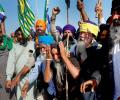
'Fifteen days ago, we were only talking of Ayodhya. Now we are talking about farmers.'
A trade union leader trying to stop a bus from plying was killed in Ambala as the two-day nationwide strike called by Central trade unions disrupted normal life in many states today and hit banking and transport sectors leaving commuters in the lurch.
The Central government has taken measures to deal with the two-day strike called by 11 trade unions from Wednesday.
The meeting between central trade union leaders and senior ministers failed in New Delhi on Monday night with the unions refusing to accept the government's appeal to postpone their two-day call for strike from Wednesday.
Trade unions in various sectors including transport, banking, construction and public sector undertakings will participate in a two-day nation strike on February 20-21 to protest the Centre's inability to tackle issues of inflation, unemployment and labour law violations. The protesting unions will also hold protest rallies at Azad Maidan and in Bandra. Union members have also threatened to hold a public rally till Parliament to press for their demands.
Samajwadi Party workers on Thursday held demonstrations in some parts of Uttar Pradesh and stopped a train in Allahabad in support of the bandh against Foreign Direct Investment in retail and hike in diesel prices.
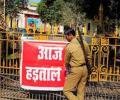
Over 18 crore workers are expected to participate making this a much bigger strike than last year.

Ten trade unions to go on strike to protest against changes in labour laws

The morcha claimed that the response to the bandh call was 'more widespread than before' and nearly all opposition political parties extended an unconditional support to it.
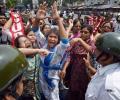
Ten trade unions with a combined membership of 15 crore workers in public and private sector, including banks and insurance companies, are on a nationwide strike to protest against changes in the labour laws.
A trade union leader was killed in Ambala in the wee hours as the two-day nationwide strike called by the 11 trade unions began on Wednesday.

Trade, transport and hotels form a major part of the country's GDP and these sectors were crippled by the strike

However, no one was injured in the incident.
 © 2026 Rediff.com - Advertise with us - Disclaimer - Privacy Policy - Sitemap - Feedback - About us - Terms of use - Grievances