
10 things you must know about the most famous foreign correspondent in India who made Bharat his home.

Ram Vilas Vedanti, a prominent leader in the Ram Janmabhoomi movement and former Bharatiya Janata Party MP, died of a heart attack at the age of 67 in Rewa, Madhya Pradesh. His last rites will be performed in Ayodhya.

Yet another book has levelled an allegation that P V Narasimha Rao had connived at the demolition of Babri Masjid claiming that the late prime minister had sat in a puja when the kar sevaks began pulling it down and rose only when it was over.
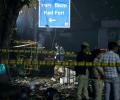
Investigations into the 'white collar' terror module busted after the recent car bombing near Red Fort showed that the mastermind Dr Umar-un Nabi had attempted to recruit a second suicide bomber but could not succeed as he backed out of the terror plot citing the need to help his family during the apple harvest, officials said on Sunday.

Posters announcing plans for an Ayodhya-style Ram temple complex in Salt Lake have appeared, escalating the political duel between religious groups ahead of the Bengal assembly polls. The proposed complex includes a school, hospital, and old-age home.
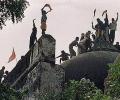
A bench comprising Justices P C Ghose and R F Nariman asked all the parties in the case to file their written arguments by April 6 and posted the matter for further hearing on April 7.
The hearing in the Babri masjid demolition case was on Tuesday deferred as the notification for nomination of a judge is still to be issued by the Allahabad high court. "The matter was not taken up today as a notification regarding nomination of magistrate is yet to be issued by the high court," prosecution sources said
Justice Liberhan took 17 years, 1,029 pages and 48 extensions at a cost of Rs 8 crore -- and added an 18-page postscript and blamed his own counsel to explain the delay in handing out news that everyone has known or suspected all along.Many of the politicians and officials who testified before the Liberhan Commission in more than a decade-and-a-half have retired, some have passed on, the country's political map has been dramatically redrawn.
Eighteen years after the Babri Masjid was demolished in Ayodhya on December 6, 1992, the judgment about the disputed land has finally been pronounced. But the case against the accused in the mosque demolition is still going on in the Central Bureau of Investigation's special court.The case has now been deferred to October 5 since a notification appointing a new judge for the CBI special court is yet to be issued. The court is likely to resume hearing in the second week of Oct

Humayun Kabir, recently suspended from the TMC, has launched a new political party, Janata Unnayan Party, and announced candidates for the 2026 assembly elections.
"It is surprising that even after going through with the completion of recording of evidence of witnesses and arguments, the commission has failed to submit its findings. So much so that Mumbai High Court had to comment adversely regarding the functioning and delay in the completion of inquiry by the commission. "Consequently, there is genuine feeling among the vast sections of the society, especially among Muslims," the resolution noted.

Mark Tully, the renowned journalist, author, and Indophile, has passed away at the age of 90. He spent a lifetime in India as a journalist, mingling with its people and telling their stories.
Senior Bharatiya Janata Party leader Murli Manohar Joshi on Thursday lashed out at the Central Bureau of Investigation after the Supreme Court asked it to explain the delay in filing an appeal against the Allahabad High Court's order for dropping the conspiracy charges in the Babri Masjid demolition case.

Singh, who was the chief minister of Uttar Pradesh when the 16th-century structure was razed on December 6 in 1992, was first taken in judicial custody by the court after he appeared before it in response to the summons in the demolition case.
The defence counsel pleaded that CBI was only an investigating agency and had no right to prosecute.
The Babri Masjid demolition is just an incident and there is nothing famous or infamous about it, the Supreme Court on Monday said while listing Central Bureau of Investigation's plea for levelling charges of criminal conspiracy against senior Bhartatiya Janata Party leader L K Advani, Shiv Sena Chief Bal Thackeray and 18 others to March 27.
A generation has passed and the demolition appears to be a story of a era gone by, says Rediff.com's Sharat Pradhan, who shares his experience as a witness in court in the Babri Masjid demolition case.
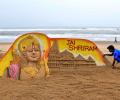
The following is the chronology of events related to the Ram Janmabhoomi-Babri Masjid land dispute in which, after the Supreme Court verdict, Prime Minister Narendra Modi on Wednesday conducted the 'Bhoomi Pujan' or ground breaking ceremony and laid the foundation stone for the temple's construction.
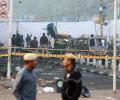
The National Medical Commission has removed several doctors from the National Medical Register following their implication in the Delhi blast investigation under the Unlawful Activities (Prevention) Act.
Bhartiya Janshakti Party President Uma Bharti in Bhopal on Tuesday said she is ready to own responsibility for the demolition of the disputed Babri mosque at Ayodhya and has no problem even if she is hanged on the issue.
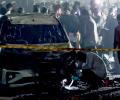
Data extracted from the mobile phone of the Red Fort suicide bomber, Dr. Umar-un-Nabi, reveals a video justifying the attack as a 'martyrdom operation'. The evidence was unearthed following the interrogation of Umar's brother, Zahoor Illahi.
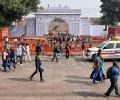
The sophisticated 'white-collar' terror module, spearheaded by a group of doctors recently busted by Jammu and Kashmir Police, had been actively scouting for a suicide bomber since last year, with key planner Dr Umar Nabi pushing the agenda, officials said on Sunday.

Amir Rashid Ali, a key accused in the Red Fort area car bomb blast case, has been remanded in 10 days' NIA custody. The agency seeks to unravel the conspiracy behind the inter-state "white collar" terror module.
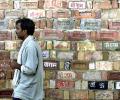
These images of deities on pillars of the structure are not found in mosques and found in temples, the counsel for the deity told SC.
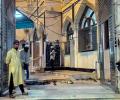
The Indian government has officially classified the car explosion outside the Red Fort as a terrorist incident, vowing to bring the perpetrators to justice swiftly. The Union Cabinet, led by Prime Minister Narendra Modi, has reaffirmed its zero-tolerance policy towards terrorism and expressed condolences for the victims.
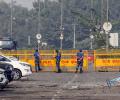
Officials reveal details of a foiled Jaish-e-Mohammed terror plot involving a doctor who planned a bomb blast near the Red Fort, timed around the Babri Masjid demolition anniversary. Arrests and investigations uncovered the interstate network.

A bench headed by Justice P C Ghose said the appropriate bench comprising him and Justice R F Nariman will be hearing the matter on Thursday. Justice Nariman was not present in the court on Wednesday.

The EC notice stated that it was a violation of chapter 4 of the model code of conduct, which pertains to maintenance of harmony between castes, communities, religious, linguistic groups.
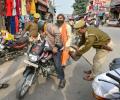
The Vishwa Hindu Parishad has too decided against observing the 27th anniversary of the demolition as "Shaurya Diwas".
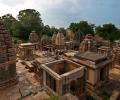
'If at all human beings require a religion, the future religion will be Hinduism.'
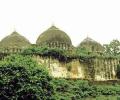
'Prince' Yakub Habeebuddin Tucy likes to introduce himself as a great-great grandson of Bahadur Shah Zafar.
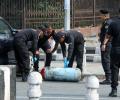
Indian authorities have uncovered a Jaish-e-Mohammad (JeM) terror plot involving doctors from south Kashmir, a Faridabad university, the recovery of 2,900 kg of explosives, and a car bomb near the Red Fort. Eight people have been arrested in connection with the plot.
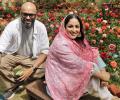
'I wanted to go for the heart, and at the same time, open the audience's mind.'

'The appearance of idols of deities inside Babri was not a miracle. It was a planned and surreptitious attack to put them on the intervening night of December 22-23, 1949'
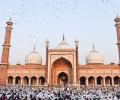
'Only because of the absence of a dedication record in writing, how can such properties be treated as located on misappropriated government land?'
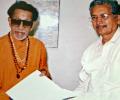
'In Independent India's politics you will not find any leader of a political party who has not contested elections or not held a powerful post.' 'It was only Balasaheb who never contested elections or held a post.' On the occasion of Balasaheb Thackeray's 99th birth anniversary, close aide Subhash Desai recalls vignettes about the Shiv Sena founder.
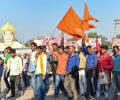
It will be heard by a five-judge Constitution Bench headed by Chief Justice Ranjan Gogoi.
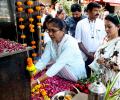
The 1993 Mumbai bombings were a series of 12 coordinated explosions across the city on March 12, 1993, killing 257 people and injuring hundreds.
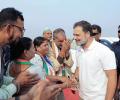
A seasoned politician and two-term Member of Parliament, Dr Shakeel Ahmad, who has served as a Union minister and senior Congress leader, resigned from the Congress party, marking the end of his decades-long association with an organisation that his family has been part of for three generations. In an interview with Syed Firdaus Ashraf/Rediff he speaks why he quit the party.
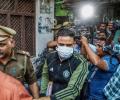
Radical Islamist networks are deliberately targeting Muslim youths embedded within the country's professional and academic ecosystems, leveraging their skills, mobility, and digital reach to quietly strengthen operational capabilities. This trend highlights a dangerous evolution in terror recruitment -- one that exploits ideological faultlines, online echo chambers and transnational radical Islamist influences to attract individuals who outwardly embody India's modern and aspirational narrative, points out Dr Kanchan Lakshman.
