
Negotiations between the BJP and the PDP to finalise the Common Minimum Programme have intensified

In the words of a senior PDP leader, the party, in order to continue its alliance with the BJP, only needs 'a long spoon to sup with the devil.'
Dubbing the next election a choice between governance and development on one side and chaos on the other, the prime minister cited the example of Karnataka, where the Congress-Janata Dal(Secular) alliance 'stole the mandate' to form government with 'development taking a back seat'.
She also underlined that 'black laws' like AFSPA would be repealed from the state only when the situation improves.

'Worryingly, intelligence assessments indicate that growing disaffection amongst the youth is ceding ground to fundamentalist Islamist groups like Islamic State,' reports Ajai Shukla.

Rifleman Aurangzeb, who belonged to the 44 Rashtriya Rifles, was on way back home on June 14 to celebrate Eid when terrorists abducted him.

The government on Tuesday asserted in Lok Sabha that it will not allow anti-national acts.

'If the nub of India's sensitivity over the Chinese presence in Doklam is the enhanced threat to the Siliguri Corridor, a vital link to the northeast, does it serve the national purpose to have the districts along it, and then much of the tribal northeast, in turmoil?' asks Shekhar Gupta.

5 states that contribute just under a fifth of the Lok Sabha's seats will go to the polls early this year.

The tension between the way the law views justice, and the way public opinion views justice, is the best reason not to make laws based on public opinion, says Mitali Saran

'The provisions of the AFSPA must remain on the statute books given the increasingly violent and uncertain times.'

'Openness is a great weapon in the armoury of more open societies. That's why the fight with Pakistan isn't just about India be six times bigger, but equally bitter and insecure Pakistan,' argues Shekhar Gupta.
Tripura should be taken as a case study on how misuse of the AFSPA can be avoided even while transforming public opinion and controlling insurgency, says Sanjib Deb.

Because of the treaty, no big dams or power projects can be built by India on Jhelum, Indus or Chenab.
My travels made me realise how different the ground situation and people's mindsets in the two states are. People seemed happy and secure in Tripura whilst there was only complaining and suspicion in J&K, says Sanjeev Nayyar.

Hard men with guns cannot manage the state forever.

Congress President Sonia Gandhi on Wednesday attacked Prime Minister Narendra Modi for his "blatant U-turn" on the issue of transparency.

As the BJP snaps at its heels, can the Communists stay relevant in the electoral game?

Irom Sharmila's decision to end her 16-year-old fast against the AFSPA continues to be hotly debated and contested in Imphal.
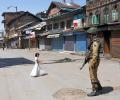
We must repeal AFSPA to begin to heal Kashmir, and to enhance India's moral stature and that of the army, says Ajai Shukla

'When you start delving deeper into these disappearances, you have to face the question: Was it a policy at the State level?' 'It surely couldn't have been random officers acting on their own.' 'Was it planned? What does it mean if the State allows its police to become lawless and act with impunity?' 'Perhaps the NHRC, for the 21 years that it has been seized of the matter, avoided these questions.'
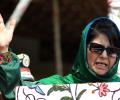
"When the people of BJP (Bharatiya Janata Party) talk of Article 370, they talk of technical integration. We have to make them understand that we also want that Jammu and Kashmir should fully integrate with India emotionally," she said.

Not everyone in Jammu and Kashmir is optimistic about the alliance between the Peoples Democratic Party and Bhartaiya Janata Party. Upasna Pandey/Rediff.com spoke to Kashmiri pandit organisations to find out how they view the new coalition politics in the valley.

When he was chief minister, Mufti Mohammad Sayeed was able to blunt inter-regional and inter-communal tensions which Farooq and Omar Abdullah could not do. Whether he can repeat it with the BJP by his side would have to be seen, says Mohammad Sayeed Malik.
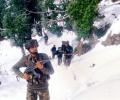
The army of the future needs a system of transparency and research. An open sociology of the army is a democratic necessity. An openness of information is a necessity of the army of the future fighting the next peace and next war on behalf of society, says social scientist Shiv Visvanathan.
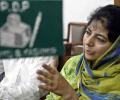
Kashmir's youth are being radicalised. The once-alienated separatists are ready to return to their old haunting ground. The ruling PDP-BJP coalition finds itself on the defensive over almost every issue of governance.
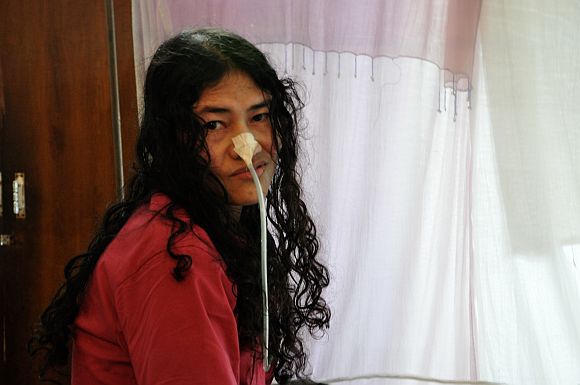
Tubes gone, Irom Sharmila the brand is dead. As long as she was trying to kill herself, she had value to the cynics trying to build their careers over her fast, says Shekhar Gupta.

The stage on which the Jammu and Kashmir flood disaster played out is littered with protagonists, most of whom did not receive the attention they deserve, says Ajai Shukla
'Abrogation of Article 370 is not legal because it is the legal basis of Kashmir's accession to India.'

'The National Conference and the Peoples Democratic Party, as recent events suggest, are quite content as New Delhi's collaborators rather than trying to be true representatives of the Kashmiri people,' says Athar Parvaiz.

Lifting the AFSPA can certainly be attempted but the provisions of the AFSPA, as an emergency law that empowers the army -- the nation's instrument of last resort -- must continue to remain on the statute books given the increasingly violent and uncertain times that the subcontinent is likely to face in coming years, says Nitin A Gokhale.

The woman whose lone fight against the establishment all these long years has only the state machinery to keep her safe from the public whose cause she championed all this while.
Apart from Kerala, the northeast perhaps is the only region where Congress can expect a decent win in the recently held Lok Sabha elections. K G Suresh looks at what the elections hold for the northeast.

Jammu and Kashmir Chief Minister Omar Abdullah on Monday ruled out post-poll alliance with the Bharatiya Janata Party given its stand on issues like Article 370, Uniform Civil Code and Babri Masjid as also with any other party.
Deepti Priya Mehrotra, who documented Irom Sharmila's struggle for peace in Manipur in the book Burning Bright, puts the icon's electoral loss in perspective.

Why does the army remain embroiled in counter-insurgency, denying itself a peace dividend even after expending blood and treasure in imposing calm?
To expect that these past decades of grief, inter-group killings, anxiety and fear will be brushed aside because of the Naga peace accord is being unrealistic. Memories are built on old wounds and they heal slowly. So, it is important to be cautiously optimistic, says Sanjoy Hazarika.

Expelled BJP ideologue Prof Hari Om speaks to Pervez Majeed.

'We have made no effort in recent years to build a national opinion on Kashmir amongst political parties.' 'At least we should speak as one country.' 'It has been a failure of our foreign policy that we have not been able to convince world opinion that something needs to be done about Pakistan.'
An economist from J&K and a popular face from the RSS/BJP sat together to craftily weave an alliance in what is one of the most difficult agenda-setting exercises in recent history.
 © 2026 Rediff.com - Advertise with us - Disclaimer - Privacy Policy - Sitemap - Feedback - About us - Terms of use - Grievances