
Dixon Technologies' January-March quarter (Q4) results came in well below expectations, but the potential for signing up a new mobile client, and plans for backward integration into display manufacturing kept investors happy. Dixon's Q4FY24 revenue grew 52 per cent year-on-year (Y-o-Y) to Rs 4,660 crore, below Street consensus, due to weakness in consumer electronics (Rs 890 crore) and home appliances (Rs 294 crore) segments.

The struggling smartphone maker has been slashing prices of its handsets in India -- Z30, Z10, Q5, 9320 and 9720 -- to drive sales due to competition from Android, iOS and Nokia's Windows Phone, which have been offering devices at affordable prices.

That makes it the best phone in Indian market for the price it's offered.
The news of Dixon Technologies (India)'s tie-up with HP in addition to its existing Lenovo and Acer partnerships has led to a 5 per cent stock uptick since the start of the week. Dixon can target roughly 60 per cent of India's addressable IT hardware market with these contracts. Dixon targets Rs 48,000 crore in revenue from IT hardware under the PLI scheme over the next six years.

Qualcomm launched its new affordable, India-designed chipset, the Snapdragon 4s Gen 2, on Tuesday. This chipset will enable mobile device makers to sell 5G smartphones operating on a standalone (SA) network for Rs 8,300 or less.

As many as 40,000 units of the much-hyped handset launched exclusively on Flipkart, was sold out within 4.2 seconds, said company head Hugo Barra on Twitter.
The stock of Dixon Technologies (India), the country's largest listed electronic manufacturing services (EMS) player, was up 6 per cent in 10 trading sessions, boosting the gains over the last three months to 21 per cent. The gains came following reports that Dixon will produce laptops in India in partnership with US and Chinese firms under the production-linked investment (PLI) scheme. It recently signed an agreement to make smartphones for Xiaomi India.

Shipments of 5G smartphones spurted by 74 per cent in 2022 even as overall mobile phone shipments declined by 8 per cent in the year, CyberMedia Research said on Tuesday. According to the CyberMedia Research (CMR) report, Xiaomi led the overall smartphone market with a 21 per cent market share while Samsung led in the shipment of 5G smartphones with a 23 per cent market share. Driven by a resilient consumer appetite to switch and upgrade, the premium smartphone market continued to gain traction, the report said.

At Rs 8,999 Micromax's 4G phone is pitched against the likes of Xiaomi, OnePlus and Oppo. But will it steal the limelight from these budget-smartphone worthies?

The Moto G4 Plus is a worthy consideration under the Rs 15,000 budget, but users looking for a better build quality and more processing power will do well to opt for either Xiaomi Redmi Note 3, or even the ZUK Z1, says Himanshu Juneja

The way video is being watched and monetised is changing. This is the first thing that stands out as the penetration of smart TVs continues to rise.

Despite the robust growth in this country, Apple's India share in its overall global sales remained modest -- constituting 1.5 per cent of its overall turnover of $389 billion in FY23.
As many as 37 per cent of smartphones sold in India in 2022 cost Rs 15,000 or more.

Similar discounts compared to online led to a spike in demand for offline, where customers can get a more personal and hands-on product experience.

iPhone maker Apple led India market with highest revenue in 2023 for the first time while Samsung topped the chart in terms of sales volume, market research firm Counterpoint Research said on Wednesday. While India's smartphone shipments remained flat in 2023 at 152 million units, Samsung and Chinese mobile phone makers Vivo and Oppo were able to grow their shares, according to Counterpoint's Monthly India Smartphone Tracker report. "Apple's focus on India is also aiding the trend, with the brand surpassing the 10-million-unit mark in shipments and capturing the top position in revenue in a calendar year for the first time, propelled by robust demand for both its latest and older iPhones.

Smart devices maker Samsung continued to lead the smartphone market in the country for the fourth consecutive quarter in July-September with a 17.2 per cent market share, market research firm Counterpoint said on Wednesday. Shipments of iPhone maker Apple crossed 2.5 million units in the reported quarter thereby registering an all-time high in a quarter, according to the Counterpoint's Monthly India Smartphone Tracker report. "Samsung maintained its leading position for the fourth consecutive quarter with a 17.2 per cent share driven by the success of its A and M series.

Zetwerk is not exactly a household name, but this unicorn, boasting revenues of Rs 11,450 crore as of last year, is among the top four electronics manufacturers in India. The startup is capitalising on a notable trend in smart TV sales - fall in collective shipments from top brands like Xiaomi, Samsung, LG and an uptick in the market share of smaller, regional, and online brands. Emerging as a key Electronics Manufacturing Services (EMS) player, Zetwerk operates a plant in Haryana that caters to 10 per cent of the country's overall smart TV production capacity.

The Delhi Police, in a first information report (FIR) filed under anti-terror law Unlawful Activities (Prevention) Act (UAPA) following allegations against news portal NewsClick, has alleged that a large amount of funds came from China in order to disrupt India's sovereignty and cause disaffection against the country.

Home-grown companies, including electronics manufacturing services (EMS) firm Dixon Technologies and mobile device maker Lava International, have started exploratory talks with Chinese sub-assemblies and component players for setting up joint ventures (JVs) in the country. Sources in the industry say many domestic companies have also had preliminary discussions with original design manufacturers (ODMs) in China to look at a JV model for manufacturing smartphones. Key ODM players in mobile devices in China include Longcheer, Huaqin, and Wingtech, which has already set up a plant in Tirupati.

The Enforcement Directorate (ED) on Tuesday conducted searches at 44 places across the country in a money laundering investigation against Chinese smartphone manufacturing company Vivo and related firms, officials said. The searches are being carried out under sections of the Prevention of Money Laundering Act (PMLA) at locations in several states including in Delhi, Uttar Pradesh, Meghalaya, Maharashtra and others. The agency is conducting searches at 44 places related to Vivo and associated companies, they said.

Walmart-owned digital payments firm PhonePe has decided to halt its proposed acquisition of Goldman Sachs- and Xiaomi-backed ZestMoney, a Bengaluru-based buy now, pay later (BNPL) platform. The deal, which was poised to fetch anywhere between $150-200 million and $300 million, has hit a snag over lapses in due diligence, disagreements over valuation, sustainability of the business, and shareholding structure of ZestMoney, according to people familiar with the matter. The collapse of the deal is also being attributed to a slowdown in the financial technology (fintech) sector in the midst of a funding winter, difficult regulatory environment, and macroeconomic uncertainty, informed other sources.

Smartphone shipment in India declined by 10 per cent to hit a three-year low of 43 million shipment in the July-September 2022 period, market research firm International Data Corporation said on Monday. The 5G smartphone share reached 36 per cent of total smartphones during the reported quarter with 16 million units at a slightly higher average selling price of $393, about Rs 32,000, apiece compared to $377, about Rs 30,600, in the previous quarter. "India smartphone market declined 10 per cent year-over-year (YoY) shipping 43 million units in July-September 2022.

Making the Pixel 8 in India will not necessarily bring the price down -- witness iPhones made in India that are more expensive than those in the US and Dubai.

India's smartphone market has fallen by one per cent in the first half of 2022, as shipments of Xiaomi - the top-selling brand - declined 28 per cent due to weak consumer demand in the quarter ended June. According to the International Data Corporation's (IDC's) Worldwide Quarterly Mobile Phone Tracker, 71 million smartphones were shipped from January to June this year. The highest decline was in the below-$100 segment, which lost its market share by 5 per cent.
Dixon Technologies right now is a beehive of activity. It is building a new facility in Noida to make 1.3 million laptops for Taiwanese PC maker Acer. The facility must be up and running in four months. The pace of activity will only increase. Last week Dixon won a similar contract from Lenovo, the Chinese personal computer maker and the third largest information technology (IT) hardware brand in India, to assemble laptops and notebooks. Though the clientele in these two cases is Taiwanese and Chinese, Dixon is a company reaching for the stars with its feet planted firmly in the Indian government's policy.

NavIC consists of a constellation of seven satellites and a network of ground stations and is touted to be more accurate than GPS.

Though leading brands like Samsung, Apple, Xiaomi, OnePlus, and Oppo managed to absorb the initial lockdown shock and resumed their local production back to 60 per cent, they would likely suffer a 20-25 per cent loss of sales in the October-December quarter.

Google, in its latest appeal to the Supreme Court, has said the Competition Commission of India (CCI) is protecting Amazon's interests after having complained that India's anti-competition body (CCI) had copied part of a European Commission ruling against it for allegedly abusing the market dominance of Android. The latest twist to the Google-CCI case comes as Google filed an appeal in the Supreme Court on June 26, against the National Company Law Appellate Tribunal's (NCLAT's) March 29 order. The tech giant's contention is that the NCLAT failed to apply the "effect analysis" part in the CCI order.

The steep rise in prices of key components, coupled with a ban on the import of finished sets, is expected to hit prominent Chinese brands, such as OnePlus, Xiaomi, TCL, and Realme.
China's Vivo said on Thursday it will export more than one million 'Made in India' smartphones in 2023 to achieve a target announced last year when it sent out its first indigenous shipment to Thailand and Saudi Arabia. Vivo India, known for its economical phones, has proposed investing Rs 7,500 crore in the country and it is set to spend Rs 3,500 crore of that amount by end of this year. According to the firm's India Impact Report 2022, it will start production at a new 'state of the art' manufacturing facility by early 2024 after regulatory clearance.

India doubled its exports of smartphones to $11.1 billion (about Rs 91,000 crore) in 2022-23 (FY23) over the previous year's figure of $5.48 billion (Rs 45,000 crore), thanks largely to the Apple juggernaut, according to data from the India Cellular and Electronics Association (ICEA). Union Minister for Communications, Electronics & IT Ashwini Vaishnaw said: "With the doubling of exports of smartphones to over Rs 90,000 crore, India is well on its way to becoming a leader in the global mobile device market." On the flip side, despite the government prodding Chinese companies to export more, their smartphone shipments fell steeply by 26 per cent from $214 million in FY22 to $157 million in FY23.

Bharti Airtel on Thursday said its 5G services have gone live in eight cities of Delhi, Mumbai, Chennai, Bengaluru, Hyderabad, Siliguri, Nagpur and Varanasi. The customer availing 5G services will have to pay as per their existing 4G plan, it said. "Airtel has been at the forefront of India's telecom revolution for the last 27 years.

Xiaomi topped the chart as the most sold smartphone brand by its users with 26 per cent share, followed by Apple (20 per cent), Samsung (16 per cent), Vivo, and Motorola (6 per cent each) among others, it said. Most smartphones sold by users were in the sub-Rs 10,000 brackets, it added. Among models, the iPhone 7 was the hottest selling model along with some other models as well as Redmi Note 4 and OnePlus 6 during the year. The number of smartphone repairs was the highest in Delhi in 2020.
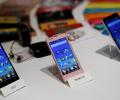
In spite of being attacked from all corners, a faltering supply chain and negative sentiments soaring high among the local consumers, top Chinese smartphone brands gained market share during the most critical phase - the April-June quarter of this year.

'Last year we sold 18 million phones in India, this year we should do 23-24 million, and next year our target is to hit 40 million.'

Mobile device maker Realme has overtaken South Korean giant Samsung to grab the second spot in the branded smartphone market, with 18 per cent volume share in October this year, revealed Counterpoint Research. Its rival Samsung ended October with 16 per cent share. Xiaomi (including its brand POCO) was at 20 per cent; Vivo at 13 per cent. The ascent brings Realme closer to its ambition to reach the No. 1 berth by 2022 when it hopes to sell over 40 million smartphones annually.
The move, however, is unlikely to prompt its rivals in India - Chinese manufacturers like Oppo, Vivo, and Xiaomi - to do the same.

Yes you heard it right, will you buy this Xiaomi's signature edition of its flagship Redmi K20 Pro just launched.