
This is not the first time Erdogan has spoken about the Kashmir issue during his UNGA address. Last year in September, he had called for a resolution on the issue of Kashmir at UNGA.
India on Tuesday firmly rejected Turkish President Recep Tayyip Erdogan's reference to Jammu and Kashmir during his address at the 81st United Nations General Assembly (UNGA), asserting that the issue pertains strictly to the country's territorial integrity and sovereignty.
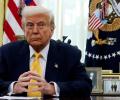
US President Donald Trump is set to engage in a series of high-profile meetings during the 81st United Nations General Assembly High-Level Week in New York, including discussions with NYC Mayor Zohran Mamdani, French President Emmanuel Macron, and Ukrainian President Volodymyr Zelenskyy.

Pakistan's Prime Minister Shehbaz Sharif used his UN General Assembly address to thank former US President Donald Trump for his "timely intervention" in the 2025 conflict with India, a claim India consistently denies. Sharif also raised the Kashmir issue and discussed the Indus Waters Treaty, while touting Pakistan's role in mediating US-Iran peace.

India's External Affairs Minister S Jaishankar, addressing the UN General Assembly, strongly criticised Pakistan for its support of terrorism, asserting India's right to self-defence and stating that friendship cannot coexist with terrorism. He also highlighted India's global responsibilities, contributions to the Global South, and its stance on reformed multilateralism and AI.

India, through First Secretary Petal Gahlot, strongly criticised Pakistan at the UN General Assembly, labelling it a "puppet regime" and warning of consequences for its continued support of terrorism. This came after Pakistan Prime Minister Shehbaz Sharif raised the Kashmir issue and credited Donald Trump for intervening in a hypothetical 2025 conflict. India highlighted Pakistan's internal political issues, its history with Osama Bin Laden, and the human rights situation in Pakistan-occupied Kashmir, while also condemning its blasphemy laws and treatment of minorities.

External Affairs Minister S Jaishankar, addressing the UN General Assembly, condemned the targeting of commercial shipping and seafarers in the Gulf, calling it "simply unacceptable." He also voiced deep concern over the "weaponisation of everything," which he stated has severe consequences for Global South nations, impacting peace, progress, and development globally. India urged restraint, de-escalation, and protection of civilians, while also highlighting the 4F crisis (food, fuel, fertiliser, finance) faced by developing countries.

Iranian President Masoud Pezeshkian delivered a strong address at the UN General Assembly, rejecting US allegations against Iran and accusing Washington and Israel of aggression and terrorism. He criticised US sanctions, defended Iran's peaceful nuclear programme, and highlighted the Palestinian issue.

External Affairs Minister S Jaishankar met US Secretary of State Marco Rubio on the sidelines of the UN General Assembly session in New York. India raised its concerns regarding the recently signed "Lindsey O. Graham Sanctioning Russia and Iran Act of 2026," which authorises tariffs on countries buying Russian oil and gas. Both leaders also discussed bilateral relations, regional priorities, and the situations in the Gulf and Ukraine.

India's Ministry of External Affairs spokesperson Randhir Jaiswal stated that India desires positive, constructive, and forward-looking ties with Bangladesh and is ready to discuss all bilateral issues. This comes amidst queries regarding the state of relations following a change in Bangladesh's government and upcoming international engagements.

India has strongly rejected a report by a UN human rights expert, Gina Romero, which claimed that young people in India face retaliation or stigmatisation for discussing mental health or gender justice. India's First Secretary Anuj Swarup labelled the report as "hearsay" based on "anonymous and unverified claims," asserting that it does a disservice to the expert's mandate. Swarup highlighted India's constitutional freedoms, independent judiciary, and government's proactive engagement with youth, citing examples like the amendment to the Public Examinations Act and the Viksit Bharat Young Leaders Dialogue.

The UK has successfully test-fired a US torpedo from an undersea drone, marking a significant advancement in submarine technology for the AUKUS partners (UK, US, Australia). This development coincides with Prime Minister Andy Burnham's visit to the UN General Assembly, where he is discussing global challenges like AI, the Ukraine conflict, and West Asia security with international leaders, and announced the UK will host the G20 Leaders' Summit in Manchester next November.

Israeli Prime Minister Benjamin Netanyahu criticised delegates who walked out of the United Nations General Assembly during his speech, labelling them 'moral cowards.' He also addressed rising antisemitism and accused New York City Mayor Zohran Mamdani of fostering an unsafe environment for Jewish residents.

External Affairs Minister S Jaishankar strongly rebuked a Pakistani journalist at the UN headquarters who questioned India's alleged sponsorship of terrorism, calling Pakistan a "terrorist country."

Pakistan Prime Minister Shehbaz Sharif repeatedly refused to answer reporters' questions regarding Lashkar-e-Taiba (LeT) chief Hafiz Saeed during his visit to the United Nations headquarters for the 81st United Nations General Assembly (UNGA).

Bangladesh's State Minister for Foreign Affairs, Humaiun Kobir, announced that the country seeks to "reset" its relationship with India, moving towards a new bilateral engagement based on mutual interests. He described ties during the previous government's tenure as "uncomfortable" and emphasised the need for Bangladesh to approach India as "just another country," focusing on balanced relations rather than an "excessive preoccupation." This comes after Bangladesh's Prime Minister Tarique Rahman did not attend the BRICS Summit in India.

US President Donald Trump has expressed interest to his advisers in setting up a meeting with Iranian officials present in New York for the UN General Assembly's 81st session, "if the conditions are right."

Iran has conveyed seven conditions to the United States through Qatari mediators for starting negotiations to end the ongoing war, while warning that Tehran is prepared for a "decisive war" if Washington rejects its demands.

India successfully facilitated a significant diplomatic meeting between Iranian President Masoud Pezeshkian and UAE Crown Prince Sheikh Khaled bin Mohamed bin Zayed Al Nahyan on the sidelines of the BRICS Summit in New Delhi. This interaction, a diplomatic breakthrough given ongoing West Asia conflicts, occurred as BRICS adopted a declaration urging restraint and protection of civilians in the region, highlighting the bloc's commitment to peace and stability.

The UN General Assembly has adopted a resolution, backed by India, to correct the world map for a more accurate representation of continental landmasses. The resolution addresses the distortions caused by the widely used Mercator projection, which minimises the perceived sizes of regions like Africa, Latin America, and South Asia, promoting an unbalanced global view. India supports the move towards more accurate cartographic practices, specifically endorsing broader use of Equal Area map projections.

BRICS nations have successfully reached a consensus on a joint statement following extensive negotiations, with India playing a crucial role in bridging differences, particularly among West Asian members like Iran, Saudi Arabia, and the UAE, despite regional conflicts and geopolitical tensions.

This article details the quarter-century journey of BRICS, from its inception as an economic acronym by a Goldman Sachs economist to its current status as an expanded eleven-member international bloc. It highlights its growth, key historical moments, and the significance of its upcoming summit, particularly with Iran's renewed importance in discussions.

India is hosting the BRICS summit, leveraging the platform to address global trade tensions and champion the developmental priorities of the Global South, including food, energy, and supply chain security. The summit, attended by leaders like President Xi Jinping and Vladimir Putin, will focus on resilience, innovation, cooperation, and sustainability, with India aiming to strengthen intra-BRICS collaboration and discuss global matters. The expanded BRICS grouping represents a significant portion of the world's population and GDP, making its discussions crucial for global economic stability.

The BRICS summit in New Delhi brings together leaders from major emerging economies to address global challenges like trade disputes, geopolitical upheavals, and the economic impact of conflicts in Ukraine and West Asia. India, as chair, aims to position BRICS as an economic growth engine, focusing on the Global South's food, energy, and supply chain security. The summit also highlights the grouping's expansion and its growing influence in global governance.

Prime Minister Narendra Modi led thousands in a yoga session at Kolkata's Red Road to celebrate the 12th International Day of Yoga, actively participating and assisting attendees. Several dignitaries also joined the mass demonstration, continuing a tradition Modi has upheld since the event's UN adoption in 2015.

India abstained from a UN General Assembly resolution demanding Russia ensure the return of Ukrainian children. The resolution passed with 91 votes in favor.

In his address, Jaishankar warned that those who condone nations that sponsor terror will find that it "comes back to bite them".
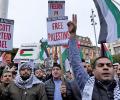
His remarks came in response to several European nations announcing their decision to recognise a Palestinian state during a summit at the UNGA on Monday. While the move was largely symbolic, it added to Israel's diplomatic isolation. Washington, however, has made clear it does not support the step.
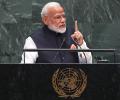
External Affairs Minister S Jaishankar will address the session on September 27
Prime Minister Narendra Modi is likely to address the UN General Assembly in September. The session will address global conflicts and trade negotiations between the US and India.

The escalating crisis in West Asia and its impact on the global energy supply chain are expected to dominate deliberations at a two-day meeting of BRICS foreign ministers to be hosted by India.

Iranian Foreign Minister Abbas Araghchi is in India for a BRICS foreign ministers' meeting, where discussions will focus on the escalating crisis in West Asia and its impact on global energy supply chains.

US President Donald Trump accused China and India of being the "primary funders" of the Ukraine war by continuing to purchase Russian oil during his address to the UN General Assembly. He also criticized NATO countries for not cutting off Russian energy.
India has voiced regret over the Ukraine conflict's 'collateral consequences', including prices of fuel, saying countries of the Global South have been left to fend for themselves, as Delhi underscored that diplomatic efforts hold the promise to end the war and bring lasting peace.

India has expressed strong concern over the targeting of commercial shipping in the Strait of Hormuz during the West Asia conflict, urging for the restoration of unimpeded navigation and global commerce.

In recent years, the Turkish leader has referred to the issue of Kashmir in his address to world leaders at the high-level UN General Assembly session.

US President Donald Trump reiterated his claim at the UN General Assembly that he stopped the conflict between India and Pakistan, while also criticizing the UN's lack of involvement in resolving global conflicts.
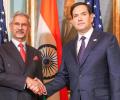
This will be the first face-to-face meeting between Rubio and Jaishankar following President Donald Trump's imposition of an additional 25 per cent tariff on India for Delhi's purchases of Russian oil, taking the total levies imposed on India by the Trump White House to 50 per cent.

UN General Assembly President Philemon Yang will visit India from February 4 to 8, his first official trip as President of the 79th session. Yang highlighted India's "remarkable transformation" over the past decade, particularly in digital and technological innovation, and plans to see how these advancements have reached the grassroots level during his visit. He also praised India's contributions to peacekeeping, humanitarian efforts, and its voice for the Global South.
Prime Minister Narendra Modi will not address the annual debate at the United Nations General Assembly session later this month, according to a revised provisional list of speakers issued by the UN.
