
Maharashtra Governor Jishnu Dev Varma has advocated for a bamboo-based economy to drive sustainable development, create rural livelihoods, and offer green alternatives to plastic. Speaking at a summit, he highlighted bamboo's crucial role in climate change mitigation, its potential to empower local communities, and its benefits for farmers.

BRICS leaders, in their New Delhi Declaration 2026, have called for wider access to Artificial Intelligence resources and stronger international cooperation to ensure the technology is safe, secure, inclusive, and reliable. The declaration outlines a broad technology agenda covering AI, cybersecurity, digital public infrastructure, telecom, quantum technologies, and advanced manufacturing, committing to implement the grouping's statement on 'Global Governance of Artificial Intelligence'.

The Ministry of External Affairs (MEA) has issued a warning against 'malicious' and 'misleading' social media posts concerning the health of world leaders, specifically Chinese President Xi Jinping and South African President Cyril Ramaphosa, who attended the recent BRICS Summit in New Delhi. The warning comes amidst unverified claims about Xi's health and an official statement from Ramaphosa's office confirming his withdrawal from public engagements due to ill health.

Xi's bilateral meeting with Modi was substantial and readouts from both sides gave indications of rapprochement, if not a reset of bilateral relations between India and China, notes Ambassador T P Sreenivasan.
Ahead of Xi Jinping's visit, National Security Advisor Ajit Doval and Chinese Foreign Minister Wang Yi held extensive talks in Beijing on August 25 on the boundary issue and reached an eight-point consensus.

The highlight of the successful BRICS Summit was its ability to deliver a joint statement that all members, including Iran and the United Arab Emirates, embroiled in the war in West Asia, signed.

Chinese President Xi Jinping's upcoming visit to India for the BRICS summit is a pivotal diplomatic event poised to significantly impact bilateral ties and global cooperation amidst ongoing international instability.

Executive Chef Kaushik Misra of the Taj Mahal, New Delhi, has meticulously curated an 'India Friendship Menu' for the 18th BRICS Summit delegates, blending India's regional flavours with international comfort foods and culinary references from participating countries.

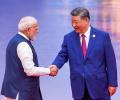
Prime Minister Narendra Modi conveyed to Chinese President Xi Jinping that peace and tranquillity along the frontier remains an "essential" basis for the development of India-China relations, even as the two leaders welcomed "steady progress" in bilateral ties during their talks on the sidelines of the BRICS summit.

For India, the goal is not simply to host another grand diplomatic gathering. It is to prove that a diverse coalition of emerging powers can still deliver.

The BRICS Youth Ministers' Meeting, organised by India's Sports Ministry, successfully concluded in Visakhapatnam. Presided over by Sports Minister Mansukh Mandaviya, the meeting built upon previous youth engagements, focusing on developing young leaders and promoting youth cooperation among BRICS nations.

Rajasthan Governor Haribhau Bagde highlighted ethanol's potential to protect India from volatile petroleum markets and geopolitical risks, advocating for its widespread production and use. He, along with other officials, emphasised ethanol's role in strengthening the rural economy, ensuring timely cane payments, and combating carbon emissions, while also discussing its historical context and current government support.

Iranian President Masoud Pezeshkian urged BRICS nations to expand trade in national currencies and build an inclusive global economic framework. He criticised "unilateral sanctions" by Western powers, stating they make emerging economies vulnerable and impact global food security. Pezeshkian emphasised BRICS' role in creating a balanced world order and highlighted Iran's geopolitical and energy capacities for cooperation.

Chinese President Xi Jinping is in New Delhi for the 18th BRICS Summit, where he is scheduled to hold bilateral talks with Prime Minister Narendra Modi. This visit, his first to India in nearly seven years, comes amidst efforts to normalise India-China relations following the 2020 Eastern Ladakh standoff and is expected to have significant implications for bilateral ties and BRICS cooperation.

India's External Affairs Minister S Jaishankar, addressing the UN General Assembly, strongly criticised Pakistan for its support of terrorism, asserting India's right to self-defence and stating that friendship cannot coexist with terrorism. He also highlighted India's global responsibilities, contributions to the Global South, and its stance on reformed multilateralism and AI.

The BRICS summit in New Delhi brings together leaders from major emerging economies to address global challenges like trade disputes, geopolitical upheavals, and the economic impact of conflicts in Ukraine and West Asia. India, as chair, aims to position BRICS as an economic growth engine, focusing on the Global South's food, energy, and supply chain security. The summit also highlights the grouping's expansion and its growing influence in global governance.

This article details the quarter-century journey of BRICS, from its inception as an economic acronym by a Goldman Sachs economist to its current status as an expanded eleven-member international bloc. It highlights its growth, key historical moments, and the significance of its upcoming summit, particularly with Iran's renewed importance in discussions.

Sports Minister Mansukh Mandaviya will chair a two-day meeting of BRICS Sports and Youth Ministers in Visakhapatnam, aiming to strengthen cooperation in youth affairs and sports, with a focus on sports manufacturing, indigenous disciplines, and youth development.

Iranian President Masoud Pezeshkian concluded his visit to India for the 18th BRICS Summit, announcing that Iran and the UAE agreed to move past previous tensions. This diplomatic breakthrough occurred during talks with Abu Dhabi's Crown Prince on the summit sidelines. Pezeshkian also met with PM Modi to discuss bilateral ties and West Asia developments, with Modi emphasising dialogue for regional peace. The BRICS summit adopted the New Delhi Declaration 2026, calling for global governance reforms and de-escalation in West Asia.

A top UN official has emphasised the critical role of women in India's development, highlighting that gender equality should be viewed as both a human right and a key factor in development effectiveness.

Prime Minister Narendra Modi cautioned against the 'weaponisation' of technology and critical minerals at the BRICS summit, advocating for cooperation to foster shared prosperity. Concurrently, Chinese President Xi Jinping announced plans for an open-source AI ecosystem for BRICS nations, positioning Beijing as a key technology partner amid global AI competition.

Chinese President Xi Jinping addressed the BRICS summit, urging the bloc to play a significant role in achieving peace and tranquillity in West Asia and the Gulf region. He highlighted BRICS' growth over two decades, its efforts in tackling global challenges, and its steadfastness in safeguarding the interests of the Global South. Xi called for opposing the Cold War mentality, strengthening multilateralism, and promoting cooperation in emerging domains like AI, as China prepares to chair the next summit.

Xi brought in asymmetrical power play by stating that India should have 'strategic cognition' and 'strategic judgement made on the basis of the stage of development the two countries are at'. This is a very nuanced way of asserting China's coercive diplomatic posture and reflects Beijing's penchant to unleash border instability at will, restrict rare earth metal exports, exert pressure on India at global and regional orders, asserts China expert Srikanth Kondapalli.

Notwithstanding the economic complementarities and the host of agreements for deepening economic relation on a host of areas, both sides share common viewpoints on the foreign policy domain and seek common grounds to serve as a counterweight to China, notes Dr Rajaram Panda.

Indian and Chinese armies held their first high-level commanders' flag talks in the Arunachal Pradesh sector, following Special Representatives dialogue. These talks, aimed at maintaining peace along the Line of Actual Control, occurred amidst reports of aggressive military posturing and just days before Chinese President Xi Jinping's visit to India for the BRICS summit.
South African President Cyril Ramaphosa on Friday described BRICS as an important global forum, highlighting the grouping's growing demographic and economic weight and noting that its members account for around half of the world's population and 40 percent of global GDP.

During the 18th BRICS Summit in New Delhi, Chinese President Xi Jinping and Prime Minister Narendra Modi held a bilateral meeting, outlining a four-point approach for the steady and long-term development of China-India relations. The leaders stressed strategic understanding, win-win cooperation, mutual respect, and inclusive multilateral engagement, reaffirming their commitment to resolving the boundary question and addressing economic concerns. They also discussed global challenges and strengthening people-to-people ties.

The BRICS New Delhi Declaration has endorsed India's proposals for a Working Group on Sports Technology and a Sports Goods Manufacturing Conclave, aiming to enhance cooperation and innovation among member nations in the sports sector.

Prime Minister Narendra Modi hosted Iranian President Masoud Pezeshkian in New Delhi for talks focusing on the West Asia situation, bilateral relations, and BRICS cooperation. The meeting, Pezeshkian's first visit to India as president, comes amidst heightened tensions in West Asia due to new US sanctions on Iran and concerns over global oil supplies from the Strait of Hormuz. Both leaders emphasised regional stability and economic resilience.

Prime Minister Narendra Modi, addressing the SCO summit in Bishkek, called for a united front against terrorism and its financing, rejecting double standards. He emphasised resolving conflicts through dialogue and diplomacy, not battlefields. Modi also highlighted that connectivity projects must respect national sovereignty and territorial integrity, a veiled reference to China's Belt and Road Initiative. India's vision for SCO rests on security, connectivity, and opportunity.

National Security Advisor Ajit Doval engaged in Special Representatives talks with Chinese Foreign Minister Wang Yi in Beijing, focusing on the India-China boundary question and enhancing bilateral relations. These crucial discussions precede Chinese President Xi Jinping's anticipated visit to New Delhi for the BRICS summit, aiming to address persistent border differences and stabilise ties strained by past conflicts like the Galwan Valley clash.

India on Tuesday conveyed to China the importance of maintaining peace and tranquility along the Line of Actual Control (LAC) for overall bilateral ties as national security advisor Ajit Doval held talks with Chinese Foreign Minister Wang Yi focusing on delimitation of the frontier and sustaining work on trans-boundary cooperation.

Russian President Vladimir Putin has proposed a new investment platform, based on the New Development Bank (NDB), to fund projects in trade, infrastructure, logistics, and technology across BRICS nations, emphasising that the grouping's expanding economic cooperation is not 'against anyone' but aims to advance members' national interests.

Former CDS Anil Chauhan stated that China poses a long-term and comprehensive challenge to India, with the boundary issue remaining unresolved due to differing perceptions of the Line of Actual Control. However, he emphasised that India's ties with Beijing cannot be solely defined by border disputes, advocating for engagement through platforms like SCO and BRICS. He also highlighted the broader global geopolitical flux and instability in India's neighbourhood as significant security concerns, stressing the need for self-reliance.

India's total goods trade with BRICS nations more than doubled from FY21 to FY26, reaching USD 417.5 billion, but a significant surge in imports, particularly from China and Russia, has caused India's trade deficit with the bloc to more than triple, reaching USD 226.1 billion.

Modi's comments on underlining the importance of ensuring the safety of seafarers came against the backdrop of growing anger in India over the killing of the three Indian crew members in a US military attack on a merchant ship off the coast of Oman last week.

US President Donald Trump has reportedly urged Israeli Prime Minister Benjamin Netanyahu to withdraw Israeli military units from southern Syria and Lebanon, warning that Israel's continued presence could escalate regional tensions.

Former NITI Aayog CEO Amitabh Kant warns that artificial intelligence (AI) could exacerbate global inequalities if not used for the benefit of people, highlighting its immense energy requirements and the need for renewable energy solutions.

India's position appears to be anchored around three red lines: Hasina's safety and the guarantee of a fair trial; assurances that Bangladeshi territory will not be used for activities hostile to India; and the restoration of an inclusive democratic process in Bangladesh.
Comptroller and Auditor General of India K Sanjay Murthy highlighted the need for stronger accountability systems to support India's urban transformation and sustainable mobility push at the BRICS Supreme Audit Institutions Leaders' Summit in Bengaluru.
