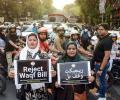
The Congress party announced its intention to challenge the constitutionality of the recently passed Wakf (Amendment) Bill, 2024 in the Supreme Court. AICC general secretary Jairam Ramesh stated that the party will "very soon" file a petition, citing concerns about the bill's impact on constitutional principles. Ramesh highlighted the Congress's ongoing legal challenges against other legislation, including the Citizenship Amendment Act (CAA), amendments to the Right to Information (RTI) Act, and changes to the Conduct of Election Rules. He emphasized the party's commitment to defending the Constitution's principles, provisions, and practices.
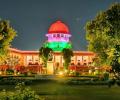
The Supreme Court has declined the Centre's request to postpone the hearing on petitions challenging the constitutional validity of the 2023 law, which excludes the CJI from the committee responsible for appointing election commissioners, stating the matter is of utmost importance.

Both Houses of Parliament were adjourned sine die, concluding a Budget session marked by the passage of key legislations and the defeat of a Constitution amendment bill on women's reservation. The session saw frequent opposition protests and discussions on various issues, including the West Asia conflict.

The Dravida Munnetra Kazhagam on Thursday said that it will move the Supreme Court against the delimitation bill, if it is passed in the Parliament.

Prime Minister Narendra Modi's upcoming visit to Israel is facing political complications as opposition leader Yair Lapid threatens to boycott his parliamentary address unless the Supreme Court chief is invited, adhering to standard protocol.

Supreme Court Justice B V Nagarathna has emphasised the critical importance of an independent Election Commission to ensure the neutrality and integrity of the electoral process in India.
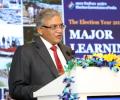
The opposition is likely to submit a notice in both Houses of Parliament to remove Gyanesh Kumar as the chief election commissioner, marking a historic first. This article details the legal procedure for removing a CEC, including the roles of Parliament, the Supreme Court, and the investigation process.

The observations came from a bench of Chief Justice Surya Kant and Justice Joymalya Bagchi which was hearing pleas questioning the validity of Section 152 of the Bharatiya Nyaya Sanhita (BNS).

'It was a disaster on his part to give an oral remark which allowed ascertainment of the religious character of places of worship.' 'This disrupted the social harmony of the country.'

Chief Election Commissioner Gyanesh Kumar declined to comment on the opposition's notice to move a motion in Parliament for his removal, amidst accusations of partisan behaviour.
Opposition MPs have submitted notices in both Houses of Parliament seeking a motion for the removal of Chief Election Commissioner (CEC) Gyanesh Kumar, alleging partisan conduct and obstruction of electoral fraud investigations.

The Supreme Court of India has ruled that individuals converting from Hinduism, Sikhism, or Buddhism cannot retain Scheduled Caste status, reinforcing existing constitutional provisions.
Rajya Sabha Chairman and Lok Sabha Speaker reject opposition notices to remove Chief Election Commissioner Gyanesh Kumar, citing insufficient grounds.
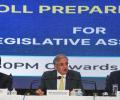
Over 130 Lok Sabha and 63 Rajya Sabha MPs have signed notices seeking the removal of Chief Election Commissioner Gyanesh Kumar, alleging partisan conduct and obstruction of electoral fraud investigations.

Opposition parties in India are preparing to move a motion seeking the removal of Chief Election Commissioner Gyanesh Kumar, alleging degradation of the office. The move requires significant support from both houses of Parliament and follows concerns raised by opposition leaders.
Opposition MPs in India have moved notices in Parliament seeking the removal of Chief Election Commissioner Gyanesh Kumar, accusing him of bias, misconduct, and acting under the influence of the executive.

US Vice President J D Vance stated that while progress was made during peace talks in Islamabad, it is now up to Iran to further the discussions and address US concerns regarding its nuclear ambitions.
Opposition parties in India have submitted notices seeking the removal of Chief Election Commissioner Gyanesh Kumar, citing concerns over his appointment, conduct, and alleged manipulation of electoral processes.

The Indian Parliament is expected to extend its budget session to introduce a bill increasing Lok Sabha seats to 816, reserving 273 for women, and amending the women's reservation law.

West Bengal's new government, led by Chief Minister Suvendu Adhikari, has approved several key policy changes, including the implementation of the Ayushman Bharat health scheme, land transfer for border fencing, and the adoption of new criminal laws.
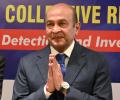
Lok Sabha Speaker Om Birla has reconstituted a three-member committee to investigate the potential removal of Justice Yashwant Varma following the recovery of cash from his residence. The committee has been granted a three-month extension.
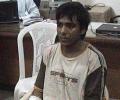
'The jail staff told me Kasab was served only jail food and not biryani.' 'They told me that Kasab was beaten regularly after court proceedings.' 'And they filled Kasab's bottle with urine so that whenever he felt thirsty he used to drink urine.'

The West Bengal government, led by Chief Minister Suvendu Adhikari, has announced the implementation of several key administrative and policy measures, including the adoption of the Ayushman Bharat health scheme, land transfer to the BSF for border fencing, and the implementation of the BNS criminal law.
The West Bengal government, led by Chief Minister Suvendu Adhikari, has announced the implementation of several key administrative and policy measures, including the adoption of the Ayushman Bharat health scheme, land transfer to the BSF for border fencing, and the implementation of the BNS criminal law.

Chief Justice of India Surya Kant has recused himself from hearing petitions challenging the constitutional validity of the 2023 law regarding the appointment of election commissioners, citing a potential conflict of interest.

For the longest time, the court did not even hear important matters that the government did not want it to. Of late, it has begun to form benches. Meanwhile a lot of the damage has been done and continues to be done, asserts Aakar Patel.
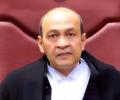
Justice Yashwant Varma of the Allahabad High Court has resigned amid impeachment proceedings sparked by the discovery of burnt currency at his residence, raising questions about judicial conduct and accountability.

'The Supreme Court stated that once the delimitation plan is approved by Parliament and receives assent of the President, it cannot be undone. Nor can it be modified.'

TMC leader Abhishek Banerjee has accused the BJP of misusing democratic institutions and stoking communal discord in Bengal, criticising their 'double engine' governance model.

Bihar MP Rajesh Ranjan, also known as Pappu Yadav, has faced criticism for his controversial remarks regarding women's reservation in Parliament, with his comments sparking outrage and prompting a notice from the Bihar Women's Commission.

Sri Lanka's response to the Easter attacks has been slow and politically contested, unlike India's swift institutional reforms after the 2008 Mumbai terror attacks, observes Colonel R Hariharan (retd).

'On hard cases like this one, the Supreme Court has only episodically stood against Parliament and the executive government.' 'I worry that this decision sets a precedent where President's rule is imposed in another state... and during the operation of President's rule, the state is fundamentally altered.'

Opposition MPs and transgender rights activists are urging the withdrawal of the Transgender Persons (Protection of Rights) Amendment Bill, 2026, citing concerns that the proposed changes could weaken the rights of transgender individuals.
Opposition MPs and transgender rights activists are calling for the withdrawal of the Transgender Persons (Protection of Rights) Amendment Bill, 2026, citing concerns that the proposed changes could dilute the rights of transgender individuals.

Sonia Gandhi criticises the government's proposed delimitation, claiming it's a politically motivated move to delay the caste census and gain an unfair advantage, rather than genuinely promoting women's reservation.
Even as Parliament passed a bill late on Friday that maintains the right of lawmakers in jail to contest polls, the Supreme Court has asked the Centre to enforce its order for the immediate disqualification of sitting MPs, MLAs and MLCs who have been convicted for an offence attracting a sentence of two years or more.

'I cannot imagine that any NSA before Ajit Doval would have given us this kind of time and this kind of engagement. They would have offered slogans, or nothing at all. That, too, tells you something.'

The Supreme Court of India has agreed to examine petitions challenging the constitutional validity of the Digital Personal Data Protection (DPDP) Act, 2023, focusing on concerns about its impact on the Right to Information Act.
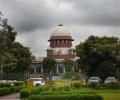
The Supreme Court refused to entertain a PIL seeking to prevent discrimination and violence against citizens from the northeast and other regions, stating that identifying persons on grounds of race, region, sex, and caste would be a regressive step.

Supreme Court judge Justice Ujjal Bhuyan asserts the independence of the judiciary and its importance in upholding the Constitution, emphasizing that the government has no role in the transfer of judges.
 © 2026 Rediff.com - Advertise with us - Disclaimer - Privacy Policy - Sitemap - Feedback - About us - Terms of use - Grievances