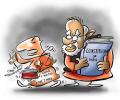
'Since the goal of taking everyone along on the path of development -- sabka saath sabka vikas -- requires an atmosphere of amity, there cannot but be an emphasis on the primacy of law and order -- and it cannot be only against road-side Romeos or gutka chewers,' says Amulya Ganguli.

'Amit Shah and his fellow travellers need to realise that India was divided because of competitive communalism of forces like Hindu Mahasabha and the Muslim League, prodded, aided and abetted by the colonial power,' says Mohammad Sajjad.

'Modi has become confident enough not only to look forward to a second term in 2019, but also to celebrate the 75th year of India's Independence in 2022.' 'It will be in the fitness of things if the vestiges of the past are swept away and the country is reminded that the 1,200 years of 'slavery' under the Muslims and the British were a bad dream.' 'And what better way to achieve this objective than by rubbing out the names of the invaders?' says Amulya Ganguli.

'One big problem for the RSS is, while they spread their ideology of hard, Hindu-ised Indian nationalism, the absence of their own pantheon of modern nationalist giants. They missed out on the freedom movement quite comprehensively, in some ways comparable to the Muslim League and latter-day Communists. They have to find heroes elsewhere.' 'They borrow who they can from the Congress, like Madan Mohan Malviya and Sardar Patel, and then steal the entire lot of revolutionaries, from Bhagat Singh to Netaji, never mind that many of them were extreme leftists.'

'In its history, the RSS has never seen success as it is seeing now. And it wants to extend their base.'
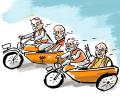
'After Vajpayee-Advani, Modi-Shah is the second best in India.'

'Many tourists are keen to break the law and see the tribals. But what difference would it make? They are humans like us. We do not like intruders, neither do they. Very little of their homes is left, so we might as well let them be,' says Chintan Purohit.

'Both Nehru and Patel were thorough gentlemen and whatever their differences never disrespected each other.' 'Neither Modi nor Rahul Gandhi has much in them to claim such legacies.' 'They are symptomatic of the sad days that have befallen the nation midwifed and contemplated by Nehru and Patel,' says Mohan Guruswamy.

Although much loved amongst the right wing in India, few Indians know of and about Pandit Madan Mohan Malaviya. Respected by Mahatma Gandhi, Malaviya was a long standing member of the Congress party, and was one of the founding members of the far-right party the Akhil Bharatiya Hindu Mahasabha. So here's a rundown of top ten things you didn't know about Madan Mohan Malaviya.
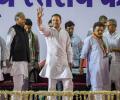
"Even when Vajpayee is ill in hospital, I was the first one to visit him, since the Congress believes he has contributed to the country," he said.
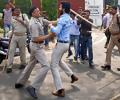
'Besides electoral opportunism, a sustained vilification of AMU on one or the other pretext helps them sustain their 'everyday communalism', the new strategy of the BJP of the Narendra Damodardas Modi-Amit Anilchandra Shah era,' says Mohammad Sajjad.

'The valiant upholder of national honour is strangely silent when African envoys are complaining about the insecurity of blacks in 'tolerant' and 'incredible' India,' says Amulya Ganguli.

Sena president Uddhav Thackeray on Thursday attacked the coalition partner on issues like Pakistan, beef, Ram temple and inflation but ruled out walking out of the Maharashtra government any time soon.

'Must every believing Hindu automatically be assumed to subscribe to the Hindutva project?' asks Shashi Tharoor.

'Unsurprisingly, the joint statement issued after Modi's visit contains a paragraph on terrorism.' 'It is on the usual lines that India would have with, say, Croatia.' 'The surprising part is that it shies away from getting into specifics,' points out Ambassador M K Bhadrakumar.
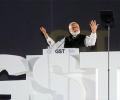
'And Indians are loving it,' says Shekhar Gupta.

'Modi is the first BJP leader to try to include Dalits in its fold.' 'But the rank and file of his party is backward and want to bash up Muslims and Dalits whenever they have a chance.'

'Godse is no more, but the mindset which gave birth to such distorted philosophy is unfortunately still with us.'

The intensity of the fire was so high that people in the villages around were woken up to a loud noise, with their houses shaking.
AMU has once again been pulled into a crossfire of crass political opportunism. In these post-truth times, that the university also had political stirrings not subscribing to the Muslim League is chosen to be forgotten, says Mohammad Sajjad.

'If JNU students are anti-national, why do we send in the police? Why not send in intellectuals like M V Kamath to have a debate and discussion?'

From Aurangzeb to Sangh Parivar, the year 2016 offers plenty of hope in historical and modern literature.
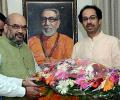
'The bonhomie that once characterised the Shiv Sena and BJP was clearly missing this time. Is there a deeper divide than what was apparent?'

'Unity in diversity is a dated notion as India, today, is more unified and cohesive and yet more pronouncedly diverse than ever in its history,' argues Shekhar Gupta.
Just like with millions of Indian Muslims, even the vice president of India has been forced to undergo the covert loyalty test: 'you are presumed to be pro-Pakistan until you demonstrably prove you are a nationalist', says Shehzad Poonawalla.
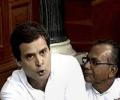
Congress Vice President Rahul Gandhi on Wednesday launched a stinging attack in the Lok Sabha on Prime Minister Narendra Modi accusing him of releasing Pakistan from a small "cage" in which it was put after the 26/11 attacks by his sudden visit to Lahore and bringing a "fair and lovely" scheme to launder 'black' money.

The perception about JNU being 'radical' is one that is as old as JNU itself. But the university is more than just that. At its heart, its campus is a mosaic of ideologies that allow its students to breathe politically.

'The summer of 1857 saw violence, perpetrated by the Indians and the Britons, on an unprecedented scale.' 'Never before and never after in the history of British rule in India was there violence at the level that 1857 witnessed.'

Taking a dig at UPA government's ambitious food security programme, Gujarat Chief Minister Narendra Modi has said that the Centre was under the impression that merely bringing in the Bill would lead to food reaching the needy.

'We are passing through a very historical moment. The UP election next year and the Lok Sabha election of 2019 will decide the course of India.' 'Maybe the unlettered will save India again because they have inherited a different India and a different idea of India,' says eminent social scientist Achyut Yagnik.

'We have made no effort in recent years to build a national opinion on Kashmir amongst political parties.' 'At least we should speak as one country.' 'It has been a failure of our foreign policy that we have not been able to convince world opinion that something needs to be done about Pakistan.'

'It is difficult to imagine the BJP becoming the legatee of Ambedkar. Whichever way one looks at it, Ambedkar's thought and Hindu nationalism are not easy to reconcile.'

After many false starts, India may well be at the inflexion point that Deng Xiaoping took China to post-1978. The window of opportunity is wide open right now, says Rajeev Srinivasan.
