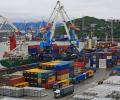
The White House has launched a major crackdown on the 'Great Transhipment Scam', accusing India and over 40 other nations of helping Chinese exporters bypass US tariffs by misrepresenting the origin of goods. The US plans to use AI-driven monitoring and anti-transhipment clauses in future trade agreements to strengthen enforcement.

The India-US ties witnessed a major downturn after President Trump slapped a whopping 50 per cent tariff on Indian goods, including a 25 per cent punitive levy over Russian oil purchases.

'Modi's a great leader... But I don't understand why he's getting into bed with Putin and Xi Jinping...'
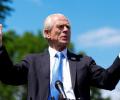
Using an expletive in his post on X, Navarro said, "Fact: India didn't buy Russian oil in large quantities before Russia invaded Ukraine. It's blood money and people are dying."
'Everybody in America loses because of what India is doing.'
The White House trade advisor's remarks came on a day US President Donald Trump announced that India and the US are continuing negotiations to address the trade barriers.
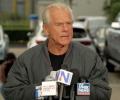
Calling the community note on X "crap", Navarro alleged that Elon Musk is allowing "propaganda" and reiterated his accusations of India purchasing Russian oil only to make profits.

England goalkeeper Jordan Pickford is set to face Lionel Messi for the first time in his career during Wednesday's World Cup semi-final against Argentina, an occasion he described as carrying a 'sense of history' given his long-standing admiration for the eight-time Ballon d'Or winner.
The White House trade adviser, Peter Navarro, on Sunday (local time) again added to his previous meltdown, after being corrected over spreading misinformation pertaining to India's purchase of Russian oil, by dismissing the community notes on X and accusing it of serving 'foreign interests' that meddle in domestic US economics and politics.
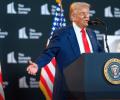
Sullivan remarks come amid the rising friction between Washington and New Delhi due to the 50 percent tariffs imposed on Indian goods, which include a 25 percent penalty for buying Russian oil.
Ahead of trade talks between Indian and United States officials in Delhi, White House trade advisor Peter Navarro said India, which has the 'highest tariffs' of any major country, is 'coming to the table'.
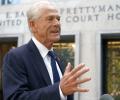
Former White House trade advisor Peter Navarro has criticised India for continuing to procure Russian oil, alleging profiteering and contributing to the Russia-Ukraine war. India defends its energy procurement as driven by national interest and market dynamics.

India has rejected White House Trade advisor Peter Navarro's comments on New Delhi for its procurement of Russian crude oil, calling them 'inaccurate and misleading'. The relations between New Delhi and Washington are on a downturn after President Donald Trump doubled tariffs on Indian goods.

Former White House trade advisor Peter Navarro accuses India of being an 'oil money laundromat' for Russia, alleging that India's oil purchases are funding Putin's war in Ukraine. The accusations come amid existing trade tensions and tariffs imposed by the US.
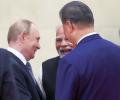
Navarro's remarks came after the public display of bonhomie by the three leaders on the sidelines of the Shanghai Cooperation Organisation (SCO) summit in Tianjin on Monday.

The turning point came with the appointment of Sergio Gor as the US ambassador to India.
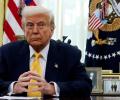
Trump also said he is "very disappointed" that India would be buying "so much oil" from Russia.

Amid escalating India-US trade tensions, Nita Mukesh Ambani Cultural Centre -- the tony cultural event outfit run by billionaire Mukesh Ambani's wife -- has postponed next week's theatrical event in New York, citing "unforeseen circumstances".
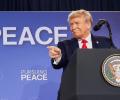
Notably, US President Donald Trump and his administration have continuously targeted India over its purchase of Russian crude oil. India, on the other hand, has always maintained that India's purchases are based on its domestic needs and economic security.

Ukraine's Ambassador to India Oleksandr Polishchuk asserted that Kyiv "will not give up and will not accept any territorial concessions" amid the ongoing Russia-Ukraine war. He also suggested Moscow has benefitted from trading with New Delhi.

New Delhi 'will have to take a call which supply source suits us the best,' the finance minister said, pointing out that crude oil accounts for the bulk of India's foreign exchange spend.

External Affairs Minister S Jaishankar defends India's purchase of Russian oil, stating it is not the largest purchaser and that the US had previously supported such actions to stabilize energy markets. He also addresses concerns about tariffs and trade relations with the US.

'India is cosying up to Xi Jinping. They don't need the Russian oil. It's a refining profiteering scheme.'
He added that India sells to the US, its biggest "client", "massive" amounts of goods, "but we sell them very little - Until now a totally one sided relationship, and it has been for many decades."
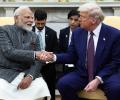
Prime Minister Narendra Modi on Saturday 'deeply' appreciated United States President Donald Trump's 'positive assessment' of the India-US partnership after the American leader hailed the 'special' relationship between the two nations -- remarks seen as an attempt to check the downturn in the ties.

Democratic Senator Jeanne Shaheen's comments came amid a major downturn between New Delhi and Washington after US President Donald Trump doubled tariffs on Indian goods to a whopping 50 percent, including a 25 percent additional duties for India's purchase of Russian crude oil.
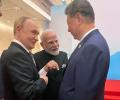
The relations between New Delhi and Washington are on a downturn after Trump doubled tariffs on Indian goods to a whopping 50 per cent, including a 25 per cent additional duties for India's purchase of Russian crude oil.
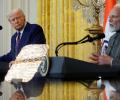
The Trump administration has told the US Supreme Court that it imposed tariffs against India for purchasing Russian energy products as part of its strategy to address the war in Ukraine.
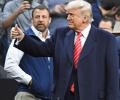
Trump is confident the US will eventually emerge the winner from whatever turmoil his policies cause, notes T T Ram Mohan.

The government has no say in where the country's refiners source oil from because these are commercial transactions.

Russian President Vladimir Putin briefed Prime Minister Narendra Modi on his summit talks with US President Donald Trump on ending the war in Ukraine.

The US remains the largest market for IT outsourcing, and for Indian giants TCS, Infosys and Wipro, it contributes around 40 per cent of their top line.
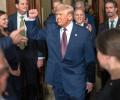
The White House has said India imposes a 100% tariff on American agricultural products and the high levies charged by other countries make it "virtually impossible" for US products to be exported to those nations. President Donald Trump has repeatedly criticised the high tariffs charged by India and other countries on American goods. He plans to roll out a set of reciprocal tariffs on April 2, which he says will be "Liberation Day" for the US.
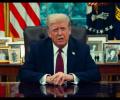
'What the US appears to be doing is to force India to be "the buyer of last resort", on whom their products can be dumped, 1.4 billion people have to eat something, so why not eat American corn?' 'What is exercising the Trump lot is the fact that most of the farms are in solidly Republican Midwestern states: Illinois, Indiana, Kansas, Michigan, Minnesota, Missouri, Nebraska, North Dakota, Ohio, South Dakota, Wisconsin,' points out Rajeev Srinivasan.
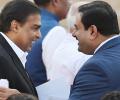
Who else will take on the might of Microsoft, Google, and Amazon if not the Adanis, Ambanis, Birlas, or Tatas?, asks R Jagannathan.

'...it should not delude itself into thinking that India's security or its great-power ambitions will be advanced by those partnerships.'
'Instead, what India should focus on is on riding out the next three-and-a-half years of Trump's presidency with minimal damage to itself.'
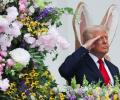
Trump may temper his approach from time to time, but to think that he will change his basic philosophy is delusional, asserts T T Ram Mohan.
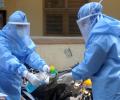
'In the months of January and February, China bought 18 times more amount of masks'

Spain's Carla Suarez Navarro became the first player through to the quarter-finals of the Australian Open as she dug herself out of a hole to beat Estonian Anett Kontaveit 4-6, 6-4 ,8-6 on Sunday.
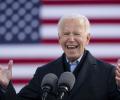
The Chinese side hopes that the next US administration will return to a sensible approach, resume dialogue with China, restore normalcy to the bilateral relations and restart cooperation, Wang, who is also a state councillor, told the state-run Xinhua news agency in an interview.
