The Tamil Nadu government has argued in the Supreme Court that Governor R N Ravi's repeated withholding of assent to bills passed by the state legislative assembly would lead to the failure of the democratic system in India. The top court has questioned the delay by the Governor in granting assent to several bills passed by the state assembly and asked why governors should wait for parties to move the court with their grievances. The court has also said that the Governor cannot refer bills passed by the legislature and re-adopted by it for presidential assent.

The organisation has challenged the action of Uttar Pradesh and Tripura governments directing that students of unrecognised madrassas should be shifted to government schools.
The Supreme Court of India has expressed concern over the protracted trials in heinous offences related to Maoist activities, stating that indefinite incarceration violates the right to liberty under Article 21 of the Constitution. Two separate benches of the court granted relief to two accused, citing the delayed trials. One bench expedited the trial of a man accused of transporting ammunition for a banned organization, while the other granted bail to a man accused of transporting materials for Naxal activities. The court emphasized the importance of speedy trials and suggested the establishment of special courts to handle Maoist-related cases, aiming to expedite proceedings. The court also criticized the practice of examining an excessive number of witnesses, which can lead to indefinite delays in the conclusion of trials.

The Supreme Court on Friday held that the Prohibition of Child Marriage Act cannot be stunted by personal laws and that marriages involving children violate the free will to have a life partner of choice.

The bench asked the petitioner to circulate three copies of the petition for the three judges and cautioned with imposition of fine.

Refusing to stop streaming live proceedings in the suo motu case related to the incident, the apex court said it was a matter of public interest and the public must know what is transpiring in the courtroom.
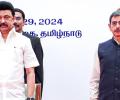
A bench comprising Justices J B Pardiwala and R Mahadevan said, "He (the governor) seems to have adopted his own procedure. He says, 'I withhold assent, but I will not ask you to reconsider the bill'. It does not make sense to keep withholding assent and not send it to the legislature, thereby frustrating the provision of Article 200."

Senior advocate S Muralidhar, appearing for the petitioner on whose plea the verdict was delivered, said a prayer in the application sought non-hinderance to the exercise of the NCRB data collection by the direction of caste reference removal from the registers.
Commencing final arguments on a batch of pleas against the verdict, the bench, heard senior lawyers including Abhishek Manu Singhvi, Salman Khursheed and Menaka Guruswamy for the petitioners.

The Supreme Court of India has directed all high courts, state governments, and union territories to ensure the availability of separate toilet facilities for men, women, persons with disabilities (PwDs), and transgender persons in all court premises and tribunals across the country. The court stressed the importance of public health and the right to privacy, stating that adequate public toilets protect women and transgender persons. The court also expressed concern about the condition of public toilets near toll plazas on national highways and emphasized the need for proper sanitation facilities in court premises for judges, advocates, litigants, and staff members. This decision highlights the importance of access to basic amenities in ensuring a fair and dignified justice system.

The Supreme Court on Monday used the legal term 'inchoate crime' to refer to mere possession of any child pornographic material that it said would constitute offences under the POCSO even if not disseminated further.

In his address, CJI Chandrachud recounted his journey, from sitting in the last row of the court as a young law student to his time on the revered corridors of the top court.
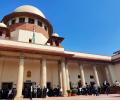
The observations came while upholding the constitutional validity of Section 6A of the Citizenship Act which grants Indian citizenship to immigrants from Bangladesh who entered Assam on or after January 1, 1966 but before March 25, 1971.

The Supreme Court on Thursday upheld the constitutional validity of Section 6A of the Citizenship Act related to the grant of Indian citizenship to illegal immigrants in Assam by a majority verdict of 4:1.

Chief Justice D Y Chandrachud, who is demitting office on November 10, Wednesday deferred by four weeks hearing on pleas challenging the immunity granted to husbands in cases of marital rape.
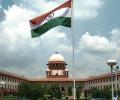
The Supreme Court on Monday came to the rescue of a Dalit youth, who had lost his seat in IIT Dhanbad after missing the deadline to deposit a fee, by asking the institute to admit him to the BTech course.

The petition filed by advocate Srinivasan has also sought a direction to poll panel to take effective steps to restrain political parties from making promises of freebies during the pre-election period.

Kumar's parents failed to deposit Rs 17,500 as the acceptance fee by June 24, the deadline for depositing the requisite fees for blocking the seat.

The bench wondered if it struck down the immunity clause in the penal codes then the offence will be covered under the main provision on rape or "can the court create a separate offence or adjudicate the validity of the exception (clause)".

The Supreme Court on Monday took strong note of former Chief Justice of India Ranjan Gogoi being made a party to a PIL and seeking of an in-house inquiry against him for dismissing a plea earlier related to a service dispute.
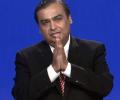
The Supreme Court on Monday dismissed a plea filed by Sebi against a Securities Appellate Tribunal order which set aside the penalty imposed by the market regulator on RIL chairman Mukesh Ambani and two other entities in a case related to alleged manipulative trading in shares of the erstwhile Reliance Petroleum Ltd (RPL) in November 2007. A bench of Justices J B Pardiwala and R Mahadevan said it was not inclined to interfere with the order passed by SAT.
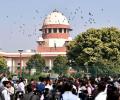
In 1997, the seven-judge bench ruled that the Centre had the regulatory power over the production of industrial alcohol. The case was referred to the nine-judge bench in 2010.

The top court said it had already passed an order on this issue and it was for the law enforcement agencies to implement the order.

Under the title of "legal enforcement", states and Union Territories were directed to appoint officers solely responsible for discharging the functions of Child Marriage Prohibition Officers at the district level.
Singh has sought the application of a more liberal remission policy to ensure his premature release from a prison in the state where he is lodged for more than 24 years.
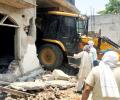
Citizens' voices cannot be throttled by a threat of destroying their properties and 'bulldozer justice' is simply unacceptable under the rule of law, the Supreme Court has said.
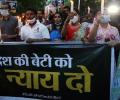
The Supreme Court on Thursday said the fight against caste-based discrimination was not a battle that can be won overnight and it requires sustained effort, dedication, and the willingness to confront and challenge societal norms that perpetuate inequality.
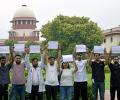
The Supreme Court on Tuesday dismissed the pleas seeking cancellation and re-test of the controversy-ridden National Eligibility-cum-Entrance Test-Undergraduate (NEET-UG) 2024, holding that there was no data on record to indicate a systemic leak of question paper and other malpractices.

The 22-year-old from Almora, who had come close to winning an Olympic medal in Paris before finishing fourth, will undergo a series of tests at the Red Bull Athlete Performance Centre in Salzburg to get a detailed evaluation to rev up his fitness and game.

On February 1, grappling with the intractable issue of the AMU's minority status, the top court said the 1981 amendment to the AMU Act, which effectively accorded it a minority status, only did a "half-hearted job" and did not restore the institution the position it had prior to 1951.

A local court in Ajmer has issued notices to the dargah committee, the Ministry of Minority Affairs, and the Archaeological Survey of India on a plea seeking to declare the shrine of Sufi saint Khwaja Moinuddin Chishti a temple. The petition, filed in September, has sparked a heated debate, with politicians and community leaders weighing in on the potentially volatile issue. The dargah committee has declined to comment, but the Anjuman Syed Zadgan, a body representing the caretakers of the dargah, described the petition as a deliberate attempt to fracture society along communal lines. The petition comes just days after four people were killed in Sambhal, Uttar Pradesh, following a local court ordering survey of a Mughal-era shrine. The Places of Worship (Special Provisions) Act, 1991, which fixed August 15, 1947, as the cut-off date for status quo on the character of religious places, is at the centre of much of the debate. Several politicians, including Union minister Giriraj Singh and PDP chief Mehbooba Mufti, have weighed in on the issue. The Communist Party of India (Marxist) has called the civil court's decision to entertain the petition unwarranted and has asked the Supreme Court to immediately intervene.

The high court erred in holding that the law was violative of the principle of secularism, said a bench comprising Chief Justice of India D Y Chandrachud and Justices J B Pardiwala and Manoj Misra.
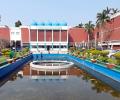
The Supreme Court on Friday deferred the question of Aligarh Muslim University's minority status to a fresh bench and overruled the 1967 judgment that said the university cannot be considered a minority institution since it was created by a central law.

The review pleas filed by advocate Mathews J Nedumpara and others contended that the matter related to the scheme falls in the exclusive domain of legislative and executive policy.
The Supreme Court on Friday refused to entertain a public interest litigation (PIL) seeking a probe into the Hathras stampede that left 121 dead, and asked the petitioner to move the Allahabad high court.
In a significant verdict, the Supreme Court by a majority of 7:2 on Tuesday held all private properties cannot form part of "material resources of the community" empowering states to take them over for distribution to serve "common good" under the Constitution.

The Central Bureau of Investigation (CBI) alleged in the Supreme Court on Thursday that there was an attempt to cover up the rape and killing of a post-graduate medic at Kolkata's RG Kar Medical College and Hospital by the local police as the crime scene was altered by the time the federal agency took over the probe.
Aligarh Muslim University is not a minority educational institution, Supreme Court's Justice Dipankar Datta said on Friday and noted had it not been a "race against time" he would have articulated better in his dissenting opinion. The judge also flagged a non-exchange of ideas and opinions in a "true democratic spirit" to build a consensus.

A bench headed by Chief Justice DY Chandrachud directed the protesting doctors to get back to work by 5 pm on Tuesday and assured them that there will be no adverse action if they resume duty.

In a significant verdict, the Supreme Court on Wednesday set aside the National Company Law Appellate Tribunal's (NCLAT) verdict that had stopped insolvency proceedings against embattled ed-tech firm Byju's. A bench of Chief Justice D Y Chandrachud, and Justices J B Pardiwala and Manoj Misra also reversed the order of the NCLAT approving Byju's Rs 158.9 crore dues settlement with the Board of Control for Cricket in India (BCCI) and directed the cricket board to deposit the settlement amount of Rs 158.9 crore with a committee of creditors.
 © 2026 Rediff.com - Advertise with us - Disclaimer - Privacy Policy - Sitemap - Feedback - About us - Terms of use - Grievances