
Indian benchmark indices Sensex and Nifty closed lower, snapping a two-day rally, as a spike in crude oil prices, triggered by reports of fresh US military operations in southern Iran, dampened investor sentiment and reignited fears of renewed energy supply disruptions.

The Kuwaiti Army reported intercepting hostile missile and drone attacks, while tensions escalate between the US and Iran with reported strikes and confrontations near the Strait of Hormuz.

A tailor has been arrested for allegedly setting vehicles on fire during labour unrest in Noida on April 13. Police allege the accused incited workers to strike and then participated in arson, damaging vehicles with iron pipes. The accused was identified using scientific and electronic evidence.
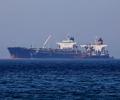
Iranian forces fired upon three commercial vessels in the Strait of Hormuz, with one possibly headed for Gujarat, raising concerns about maritime security in the strategic waterway.
The seventh edition of the Indian Open of Surfing will be held in Mangalore from May 29 to 31, serving as vital preparation for the country's Asian Games debut later this year.

Tensions escalate between Iran and the US over control of the Strait of Hormuz, a crucial shipping lane for global oil supplies, as both sides discuss extending a fragile ceasefire.

The United States Central Command (CENTCOM) has announced that American forces are maintaining a strict maritime restrictive operation in the region, continuing to enforce a blockade against Iranian ports.
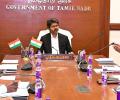
Tamil Nadu Chief Minister C Joseph Vijay will handle key portfolios including police, general administration and welfare of women, youth and children. Veteran leader K A Sengottaiyan has been designated as the Finance Minister.

Iranian Foreign Minister Seyed Abbas Araghchi spoke with Indian counterpart S Jaishankar to discuss the West Asia crisis, following discussions with Russian President Vladimir Putin.

A section of industry may need to begin compliance immediately, even as most states are yet to notify their rules.
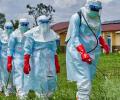
The Union Health Ministry has directed states and Union territories to enhance surveillance, hospital preparedness, and screening of international travellers after the WHO declared the Ebola outbreak in the Democratic Republic of Congo and Uganda a public health emergency of international concern.
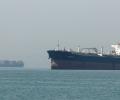
In a significant diplomatic development, US and Iranian negotiators have reportedly reached a tentative 60-day memorandum of understanding (MoU) aimed at extending a fragile ceasefire and paving the way for formal talks regarding Iran's nuclear programme.
China has called on Iran to reopen the Strait of Hormuz and expressed appreciation for Tehran's commitment not to develop nuclear weapons, a key demand of the US to end the conflict.

Indian benchmark indices Sensex and Nifty rebounded in early trade after three days of decline, driven by a rally in Sun Pharma following its USD 11.75 billion acquisition of US-based Organon & Co, alongside a positive trend in global equity markets.

Iranian Foreign Ministry spokesperson Esmail Baghaei stated that Iran is instead working with Oman to establish a mechanism for the safe passage of ships through the Strait.

Indian benchmark indices Sensex and Nifty closed higher, with the Sensex climbing 355.90 points, driven by positive state election results and better-than-expected Q4 earnings, despite ongoing geopolitical concerns.

An India-flagged vessel carrying 15,400 tonnes of liquefied petroleum gas (LPG) successfully crossed the Strait of Hormuz and arrived at Jawaharlal Nehru Port Authority (JNPA), demonstrating the resilience of maritime operations amid geopolitical tensions in West Asia.
Indian markets on Dalal Street rallied sharply as easing tensions in the US-Iran conflict and stable oil prices boosted sentiment. Track Nifty 50 and BSE Sensex performance and key global triggers.

Iran has announced the reinstatement of strict military control over the Strait of Hormuz, citing US violations of previous agreements regarding maritime passage. This decision follows claims of continued American blockade of Iranian ports and a statement from former US President Trump regarding the persistence of the naval blockade until a comprehensive peace agreement is reached.

An Indian-flagged LPG vessel successfully transited the Strait of Hormuz, reducing the number of Indian ships stranded in the Persian Gulf. India is in talks with Iran to ensure safe passage for its tankers, and Indian refiners continue to purchase crude oil and LPG from Iran despite regional tensions.

The BJP experienced a mixed bag of results in the West Bengal Assembly elections, with several heavyweight candidates securing victories while others faced defeat. Key wins included Dilip Ghosh, Suvendu Adhikari, and others, but some prominent faces failed to win.

Dozens of US planes carrying ammunition landed in Tel Aviv, raising concerns about potential strikes on Iran. Negotiations between the US and Iran remain deadlocked over key issues, with both sides issuing fresh demands and warnings.

Mayor Firhad Hakim has distanced himself from notices issued by the Kolkata Municipal Corporation (KMC) to properties allegedly linked to TMC leader Abhishek Banerjee, asserting that such matters are handled by the civic body's executive wing.

A Swiss International Air Lines flight bound for Zurich aborted its takeoff at Delhi airport due to an engine issue, prompting an emergency evacuation of 232 passengers.

There are rewards in the gentle rhythm of travelling with elders. You can actually unwind, relax and chill. You will not need a holiday to recover from the holiday when you return home!
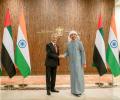
Frankly, was it really necessary in the middle of a fratricidal war for External Affairs Minister S Jaishankar to travel to Abu Dhabi for a one-on-one with the sheikh on April 12?Or, for National Security Advisor Ajit Doval to follow up on April 26? Or, for PM Narendra Modi to follow through today? There are no easy answers, notes Ambassador M K Bhadrakumar.
The US has threatened to prosecute those buying or selling sanctioned Iranian oil and has announced a blockade of the Strait of Hormuz after peace talks failed.

The US blockade on Iranian ports is aimed to curb Iranian energy exports, thereby crippling its economy to force Iran back to the negotiating table, points out Commodore Venugopal Menon (retd).

An Iranian tanker successfully bypassed the US Navy to deliver crude oil to the Asia-Pacific region, despite ongoing tensions and a US blockade.

West Bengal BJP president Samik Bhattacharya has expressed the state government's desire for the Tata Group to return to Singur, viewing it as an economic necessity and a signal that West Bengal is open for business. The move aims to reverse the negative perception created when the Nano project was forced out of the state.
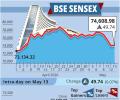
Indian benchmark equity indices, Sensex and Nifty, closed marginally higher, breaking a four-day losing streak, despite elevated crude oil prices and ongoing geopolitical uncertainties. The market saw a temporary pause in panic selling, though cautious sentiment persists.

'Historically, India has depended on the Middle Eastern Gulf for nearly 90 per cent of its LPG imports. Shifting to alternative suppliers is not something that can happen quickly.'
The United States has clarified that its naval blockade in West Asia targets Iranian ports and coastline, not the Strait of Hormuz, applying to all ships regardless of nationality. US officials warned Iran against threatening commercial ships and hinted at ceasefire negotiations as an alternative.

An India-bound container vessel, the 'Epaminondes', was seized by Iran's Islamic Revolutionary Guard Corps in the Strait of Hormuz, with an Indian merchant navy officer from Rajasthan among the crew, his family reported. The family has appealed to the Indian government for assistance in ensuring the safe return of the crew.
The Indian rupee depreciated by 52 paise to settle at 93.35 against the US dollar, driven by failed US-Iran peace talks, surging crude oil prices due to a potential US blockade of Iranian ports, and a global flight to the greenback. This geopolitical uncertainty is also leading to foreign capital withdrawal from domestic equities.

Iran has asserted that maritime movement through the Strait of Hormuz will be strictly controlled by Tehran, stating that passage will be allowed only through designated routes and under Iranian approval.

Tensions escalate as Iranian forces attack a container ship in the Strait of Hormuz after Trump announced the ceasefire extension.

US President Donald Trump said the United States faces a stark choice in its approach to Iran, either to pursue a negotiated settlement or escalate militarily, as tensions continue to rise in the West Asia region.

Iranian Foreign Minister Seyyed Abbas Araghchi stated that the Strait of Hormuz remains open to all commercial vessels, requiring ships to coordinate with Iranian naval forces due to regional tensions and a US blockade.

India has said it will take all steps to protect its national interests and ensure comprehensive national security in all domains after Pakistan and Saudi Arabia signed a strategic defence pact.
