
It is very unfortunate that China has decided to proceed with the controversial mega hydropower plants(despite the apparent opposition of many scientists in China). Why is Delhi silent about the development? asks Claude Arpi.
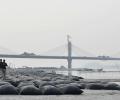
China has formally started the construction of a USD 167.8 billion dam over the Brahmaputra River in Tibet, close to the Indian border in Arunachal Pradesh, raising concerns in India and Bangladesh.
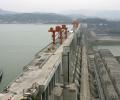
China defends its construction of a dam on the Brahmaputra river in Tibet, addressing concerns from India and Bangladesh about its potential impact on water flow and the environment.

China on Friday operationalised its first fully electrified bullet train in the remote Himalayan region of Tibet, connecting the provincial capital Lhasa and Nyingchi, a strategically located Tibetan border town close to Arunachal Pradesh.

In underlining the role of border villages as custodians of India's frontiers, New Delhi is following China's example in Tibet.

China, which is building numerous villages in Tibet close to its borders with India and Bhutan, has held several celebratory events to mark its takeover of Tibet in the new border villages with a mix of border troops and the local population, the official media in Beijing reported.

The Tibet-bound plane was carrying 113 passengers and nine crew members, state-run Xinhua news agency reported.

Xi arrived at the Nyingchi Mainling Airport on Wednesday and was warmly welcomed by local people and officials of various ethnic groups, Xinhua news agency reported.

About 30 airports have been either built or under construction in Tibet and Xinjiang provinces which will boost China's civil and military infrastructure in the remote regions bordering India, the country's official media reported.
Important for India was Xi's meeting with representatives of PLA officers and soldiers stationed in Tibet. The video of the encounter was interesting to watch, especially the large number of lieutenant generals and major generals, observes Claude Arpi.
Xi asked about their condition and whether they were able to "receive fresh vegetables" in the inhospitable terrain.
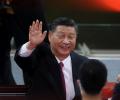
Xi's visit to Nyingchi, bordering Arunachal Pradesh, signals China's opening of another front to India in the eastern sector, observes Srikanth Kondapalli, the leading China expert.
The Sichuan-Tibet Railway will be the second railway line into Tibet after the Qinghai-Tibet Railway project. It will go through the southeast of the Qinghai-Tibet Plateau, one of the world's most geologically active areas, according to the Chinese official media.
Xi commended the battalion members for their remarkable efforts in guarding China's border region, noting that they have dedicated their youth to securing the country's territorial integrity and have accomplished their missions well, state-run Xinhua news agency reported.

Xi has called on Chinese border troops to enhance their capabilities in border defence and control to forge a "great wall of steel" along the country's borders, it said.
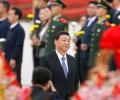
Wang Junzheng, Tibet's new Communist party boss, is on a number of sanctions lists by the US, Britain, the EU and Canada, for his tough role in Xinjiang, aimed at China's Uyghur ethnic minority, observes Jayadeva Ranade, the retired senior RA&W officer and distinguished China expert.

China plans to build a new highway along the Line of Actual Control (LAC) with India as part of Beijing's efforts to strengthen its strategic position and project its power, a media report said on Wednesday.

India's reaction came in response to Beijing announcing Chinese names for 15 more places in Arunachal Pradesh which the neighbouring country claims as South Tibet.

A visit to Tibet appears to have become the new touchstone for expressing fealty to Xi Jinping, observes Jayadeva Ranade, the retired senior RA&W officer and distinguished China expert.

'When you look at the border -- from Ladakh to Arunachal -- which is called the Sino-Indian border, but in effect it is actually the Indo-Tibet border.' 'Since the borders are still not secure, it has resulted in transgressions in Galwan, Dokalam etc.'

After the Ladakh fiasco where Xi Jinping did not expect the Indian Army to resist his land-grabbing tactics, he has to save face before his colleagues in the Communist party.' To bring the threat of a mega-dam to the northern Indian border is a clever move, observes Claude Arpi.

China is training Buddhist monks and nuns in Tibet to carry out anti-espionage operations along the remote Sino-Indian border.

Situated at a height of 15,200 feet above sea level, the pass sits on the top of a craggily formed Himalayan range that separates the Tibetan plateau from the Indian sub-continent.

China is worried about the situation post the Dalai Lama and that his reincarnation could surface in Arunchal Pradesh, a region it claims as its own, but which is part of the Indian Republic, says former RA&W Additional Secretary Jayadeva Ranade.

China will develop Tibet's picturesque Nyingchi prefecture, located close to Arunachal Pradesh border, into a major tourist hub with an investment of $63.5 million which included construction of 22 "well-off model villages".
"The government is aware that China is developing infrastructure in border regions opposite India in Tibet and Xinjinag Autonomous Region. This includes the Qinghai-Tibet railway line with proposed extension upto Xigaze and Nyingchi and the development of road and airport facilities," Defence Minister A K Antony told the Rajya Sabha

China plans to divert about 200 billion cubic metres of water annually from the Brahmaputra at its highest point, namely the Great Bend, where it turns into India. China's Brahmaputra dam will severely impact India, warns former senior RA&W officer and China expert Jayadeva Ranade.

China on Friday inaugurated its second railway line in Tibet, built at a cost of $2.16 billion, close to Indian border in Sikkim, enhancing mobility of its military in the remote and strategic Himalayan region.

Prime Minister Narendra Modi's visit to Arunachal Pradesh on Friday, February 20, irritated the Chinese government so much that it summoned the Indian ambassador to register its protest against Modi visiting a territory China claims as Southern Tibet.

'Guarding the borders in extreme weather conditions is not easy and most people don't realize it is a very tough job.'

The Indian Army has shown it can face down the PLA, but is too often held back by a political leadership that lacks boldness, asserts Ajai Shukla.

Overall, the People's Liberation Army Air Force (PLAAF) has focused on building ground-based air defense networks and network-centric operations rather than trying to match the Indian Air Force (IAF) in terms of straight fighter numbers along the border. All air assets fall under the Western Theater Command of the PLA, the largest geographic region of China's five military theater commands.

The Tibetan nation still lives under the yoke of the Chinese Communist Party, and Beijing today has a guilty conscience; this creates a great uneasiness for Xi Jinping and his colleagues observes Claude Arpi.

Nearly two decades ago, then defence minister George Fernandes said: 'China has built roads up to the border, while there has been negligence on India's part.' Since Fernandes uttered these brave words, what has been done on the Indian side? The Modi Sarkar is apparently trying, but little has been achieved so far, says Claude Arpi.

'Why did your generals try to grab a few square kilometres of Indian territory in Ladakh?' 'And what happened to the hard work that you and Prime Minister Modi put into the Wuhan and Mamallapuram meets?' Claude Arpi writes a letter to Xi Jinping, China's self-styled supreme leader, who turns 68 today, June 15.

China has sharply reacted to India's plans to construct a road network along the McMohan line in Arunachal Pradesh and expressed hope that India will not take any action which may complicate the situation before a final settlement is reached to end the boundary dispute.
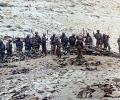
In fact, given the current tensions and massed troops on both sides, there is a danger that the LAC will become more like the Line of Control with Pakistan, a heavily fortified and strongly defended border where weapon fire exchanges regularly occur. Indeed, Stratfor Worldview research has listed a sharp increase in new Chinese facilities along the LAC in 2019-20.

The Chinese air force is now a 400,000-person force that flies some 2,000 combat aircraft -- more than thrice the size of the Indian Air Force.
China is spending billions of dollars to improve infrastructure in Tibet and other parts of its border with India. Claude Arpi explains why New Delhi can't afford to ignore Beijing's plans.

'Tibet remains a prickly issue between the giant Asian nations. China still claims more than 80,000 sq kilometres of Indian territory in the Northeast. Why? Just because Beijing refuses to acknowledge the McMahon line which separates India and Tibet, and this, simply because the 1914 Agreement delineating the border was signed by the then government of independent Tibet with India's then foreign secretary (Sir Henry McMahon),' says Claude Arpi.
