
The NCERT has issued a public apology and withdrawn a social science textbook for Class 8 after the Supreme Court objected to a chapter on judicial corruption. The court imposed a ban on further publication of the book.
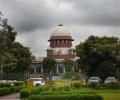
Three academics involved in drafting a controversial NCERT textbook chapter on corruption in the judiciary have approached the Supreme Court to defend their work, stating it was a collective effort and not the view of any single individual.

IIT-Gandhinagar is reviewing Michel Danino's position as guest professor after the Supreme Court directed institutions to disassociate from him due to a controversy over a chapter on judicial corruption in a withdrawn NCERT textbook.

Union Education Minister Dharmendra Pradhan has expressed strong disapproval of a chapter in an NCERT Class 8 textbook addressing judicial corruption, prompting government action and a Supreme Court ban on the book's circulation.

The NCERT has apologised for 'inappropriate content' in a Class 8 textbook chapter discussing judicial corruption, following Supreme Court criticism. The textbook will be rewritten, and its circulation has been put on hold.

The Centre has directed the NCERT to review all textbooks after the Supreme Court raised concerns about 'offending' content on corruption in the judiciary in a Class 8 social science book.
The NCERT's class 8 textbook is under scrutiny for its content on judicial corruption, potentially leading to its removal after government concerns and objections from the judiciary.
The apex court ordered that the Centre and state authorities comply with its directions immediately, and warned of 'serious action' if directions are defied in any form.
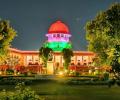
The Supreme Court has initiated suo motu action regarding an NCERT class 8 textbook that references corruption in the judiciary, raising concerns about potential defamation and the integrity of the judicial system.

The six-page section, titled The Ghaznavid Invasions, states that Mahmud of Ghazni conducted 17 campaigns in India, returning each time with large quantities of treasure. The old NCERT class 7 history textbook had a paragraph on Mahmud of Ghazni.

Art education, physical education and wellbeing, vocational education and interdisciplinary studies will be compulsory.

Union Education Minister Dharmendra Pradhan announced that all high schools in India will have broadband internet connection within the next 2-3 years, with a focus on integrating Artificial Intelligence (AI) into education.

Ahead of NEET UG 2026 -- which opens the door to 1.2 lakh MBBS seats in the country annually -- education expert Nagarajan JSK explains why lakhs of students attempt the exam every year.

A controversy has erupted after an NCERT Class 8 textbook depicted present-day Rajasthan as part of the Maratha Empire, drawing criticism from royal families and political leaders who call the depiction factually incorrect and misleading.

The book, to be introduced in schools from the 2025-2026 academic year, marks a shift in tone in its portrayal of the Mughal emperors, offering detailed accounts of conquest, religious decisions, cultural contributions, and brutality.
The National Council of Educational Research and Training (NCERT) has removed all references to the Mughals and Delhi Sultanate from its class 7 textbooks. The new textbooks, released this week, have been designed in line with the new National Education Policy (NEP) and the National Curriculum Framework for School Education (NCFSE) 2023, which emphasize incorporating Indian traditions, philosophies, knowledge systems, and local context into school education. The textbooks now include new chapters on ancient Indian dynasties, sacred geography, and government initiatives like Make in India and Beti Bachao, Beti Padhao. The revamp has been met with criticism from opposition parties who equate it with "saffronisation."
'You can see both being used in our textbooks already and that will continue in new textbooks'

The suggestions have been part of the final position paper on social sciences, which is a key perspective document that helps in the development of new NCERT textbooks on the subject. The proposal has yet to get a final nod from NCERT.
There are tweaks in references to B R Ambedkar's experience about the discrimination.

Dropping references to the demolition of Babri Masjid in Ayodhya, the killing of Muslims in Gujarat riots and Hindutva, and tweaking the reference to Manipur's merger with India are among the latest set of revisions made public by the National Council of Educational Research and Training (NCERT) in its textbooks.

References to freedom fighter and India's first education minister Azad have been removed from the new class 11 political science textbook by the National Council of Educational Research and Training (NCERT).
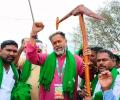
The National Council for Educational Research and Training (NCERT), however, said the withdrawal of anyone's association is out of question as textbooks at the school level are developed on the basis of knowledge and understanding on a given subject and at no stage, individual authorship is claimed.

Palshikar and Yadav, who were chief advisors for the original Political Science books for classes 9 to 12, said, "While the modifications have been justified in the name of rationalisation, we fail to see any pedagogic rationale at work here. We find that the text has been mutilated beyond recognition. There are innumerable and irrational cuts and large deletions without any attempts to fill the gaps created.

He hinted that the same hue and cry is not made about 1984 riots not being in textbooks.

Certain references and subjects being quietly dropped from the new NCERT textbooks without any notification has kicked off a political controversy with the Opposition accusing the ruling Bharatiya Janata Party of 'whitewashing with vengeance'.

References to freedom fighter and India's first education minister Maulana Abul Kalam Azad have been removed from the new class 11 political science textbook by the National Council of Educational Research and Training (NCERT).

More than 1,800 scientists, science teachers and educators have written an open letter raising concerns about the chapter on 'Theory of Biological Evolution' being dropped from the NCERT textbook for Class 10.

The NCERT has dropped references to the demand for a separate Sikh nation of Khalistan from the class 12 political science textbook following objections from the Shiromani Gurdwara Parbandhak Committee (SGPC), according to top education ministry officials.

The Left leader said the NCERT, which was set up on the basis of the 2005 National Curriculum Framework, has been demolishing the very goals of the NCF through the removal of such passages from textbooks.

The signatories to a letter sent to NCERT Director Dinesh Saklani include Kanti Prasad Bajpai, a former Jawaharlal Nehru University professor who currently serves as the vice dean at the National University, Singapore, Pratap Bhanu Mehta, a former vice-chancellor of the Ashoka University, Rajeev Bhargava, a former director of CSDS, Niraja Gopal Jayal, a former JNU professor, Nivedita Menon, a JNU professor, Vipul Mudgal, the head of civil society watchdog Common Cause, K C Suri, a former professor at the University of Hyderabad who is now associated with the Gitam University, and Peter Ronald deSouza, a former director of the Indian Institute of Advanced Studies.
The committee has also recommended highlighting 'Hindu victories' in various battles in the textbooks.

rediffGURU Radheshyam Zanwar offers expert advice to students preparing for engineering college admissions and competitive exams.

rediffGURU Nayagam PP, career counsellor and the founder of EduJob360, counsels students and aspiring professionals about how they can make the right career decision.

The SERT, an autonomous body of the general education department, is considering a decision by its curriculum steering committee to include these deleted portions in the state syllabus.
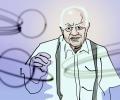
Jayant Narlikar wrote alternative what-if histories, explained difficult scientific theories with funny analogies, and leavened his lectures with jokes and humorous asides.
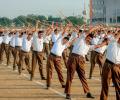
"Gandhi's pursuit of Hindu-Muslim unity provoked Hindu extremists" and "Organisations like RSS were banned for some time" are among the texts missing from the class 12 political science textbook for the new academic session.

His comments come after the new NCERT textbooks hit the market and it was found that more contents than the ones notified in the curriculum rationalisation booklet last year are missing.
The textbooks themselves have not been finalised by the National Syllabus and Teaching Learning Material Committee (NSTC), he said.

As per the NCERT, the decision has been taken to reduce the content load on students in view of the COVID-19 pandemic.

"A controversy is going on these days that Darwin's theory of evolution has been removed from science books by the NCERT and the periodic table has been left out, but I would like to state here publicly that nothing of this sort has happened," he said.
 © 2026 Rediff.com - Advertise with us - Disclaimer - Privacy Policy - Sitemap - Feedback - About us - Terms of use - Grievances