'In this country, if any government acquires one of these images -- anti-farmer, or anti-poor or corrupt -- the government doesn't survive.' 'The Modi government is fast acquiring that anti-farmer image, that is why it is nervous.'
'If they add a small paragraph that no purchase will be allowed below the MSP, they have a winner on their hands'
Ahead of the no-confidence vote against the Manohar Lal Khattar Haryana government, senior Jananayak Janata Party (JJP) MLA Devender Singh Babli on Tuesday urged his party to withdraw support to the Bharatiya Janata Party government over farmers' issues.
If more commodities which have seen a sharp rise in MSP are to be procured, such as pulses, oilseed and cereals, there could be a storage problem. Also, if state-owned Cotton Corporation of India joins in, this problem will aggravate.

The party asked Prime Minister Narendra Modi why a conspiracy was being hatched to destroy the minimum support price (MSP) system and snatch the livelihood of 62 crore farmers.

Deputy Commissioner of Police (Outer North) Bijendra Kumar Yadav said farmers have formally declared that they will start returning home from Saturday onwards, but it is not a time bound exercise as their movement will keep progressing through the day.
British lawmakers will debate the issue of press freedom and safety of protesters in India next Monday in response to an e-petition which had crossed the 1,00,000-signature threshold required for such a debate, the House of Commons Petitions Committee had confirmed earlier this week.
He appealed to farmers to be ready as the call for 'Delhi march' can be given at any time.
Government's food subsidy bill tends to rise in tandem with the MSP increase.
In MP, farmers say sales under new 'Sauda Patrak' method below MSP; Haryana mustard farmers wait for their turn to sell. The annual purchases of major rabi crops in North India largely wheat, mustard and also chana to some extent have been delayed as most cereal mandis were closed in the aftermath of the nationwide coronavirus lockdown.

The letter by 'Sanyukt Kisan Morcha', which represents farmer bodies mostly from Punjab, comes against the backdrop of the government holding talks with several farmers organisations from different states who the Centre claimed have extended their support to the new agriculture laws.

Addressing reporters at the Singhu border where they have been protesting for almost two weeks to demand a rollback of the law, the farmer unions also reiterated that they will intensify their agitation and start blocking all highways leading to the national capital.

As India looks to mend its Covid-battered economy, one thing that will grab the attention of all concerned is the path that both wholesale and retail inflation will follow. Even the Reserve Bank of India in its latest policy statement said, "Going forward, the inflation trajectory is likely to be shaped by uncertainties impinging on the upside and the downside.

Kejriwal's centralised way of governance might work in Delhi, but Punjab will call for delegation, observes Sanjeev Nayyar.

Karnataka, Andhra Pradesh, Tamil Nadu, Rajasthan, Maharashtra, Bihar, Uttar Pradesh, Madhya Pradesh, and Gujarat account for 85 per cent of India's maize production.

He maintained that the laws were for their benefit and then apologised to people of the country, adding that the government could not convince a section of farmers despite its clear heart and clean conscience.

"The increase in minimum support price of many crops may keep the food inflation from falling in the current year," said the finance ministry in the mid-year review. MSP, which is determined by the government to protect the farmers' earnings, has increased by 15-40 per cent in the current fiscal for three major categories -- wheat, paddy and coarse grains. The latest hike in MSP announced during this election year is the largest in the last four years.

Farmers have taken down their settlements and have vacated the borders around Delhi, which were their protesting sites for the last one year.
'They wil show the whole world see how this government is treating its farmers.'

Tikait also said if the government continues to dismantle the resources, one day India will be known as 'Mazdoor colony' and only labour class (will be left) in the country.

The farmers' agitation against new agri laws will lead to economic loss of over Rs 70,000 crore in the December quarter owing to supply chain disruptions, particularly in Punjab, Haryana and border areas of Delhi, the PHD Chamber of Commerce and Industry said on Thursday. The chamber's president Sanjay Aggarwal said "the 36 days farm agitation so far will have more than Rs 70,000 crore economic loss in the Q3 FY 2020-21 due to...disruption in supply chains and day-to-day economic activities particularly in the progressive states of Punjab and Haryana and border areas of national capital Delhi."
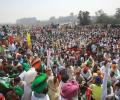
Sixty-eight people have died due to varied reasons while protesting against the Centre's farm laws at the state borders with Delhi, Haryana Home Minister Anil Vij told the Assembly in Chandigarh on Monday.

The new party -- Bharatiya Aarthik Party -- claims to represent farmers, traders and labourers,

Sources said they discussed and finalised the government's position for the Wednesday meeting.
Sidhu attacked the Aam Aadmi Party, alleging that the Arvind Kejriwal government in Delhi had last year notified one of the farm laws even when farmers were sitting at the borders of national capital protesting against the legislations.

The protest march led to massive traffic snarls in several parts of the national capital, including Lutyens' Delhi and ITO.

Food Corporation of India will be the nodal agency.

Prime Minister Narendra Modi on Friday squarely blamed those with political agenda for the deadlock in the Centre's talks with protesting farmers.

'If banging thalis could drive corona as Modi said, banging thalis will drive away the farm laws.'

Congress president Sonia Gandhi on Friday said after almost 12 months of Gandhian agitation, the repeal of three farm laws is a 'victory of the will of 62 crore farmers and sacrifices of more than 700 farmers who laid their lives for this struggle,' and hoped that the Bharatiya Janata Party government would have drawn some lessons for future.

Bharatiya Kisan Union (BKU) leader Rakesh Tikait said that the government, in its letter, mentioned that it wants to hold talks over its earlier proposal of amendments in the new agri laws.

After over a year, the Singhu border, which was the epicentre of the farmers' agitation, now bears a deserted look with the last batch of demonstrators leaving for their home states on Monday.
The Bharatiya Kisan Union leader, who has held a series of 'kisan mahapanchayats' in Haryana this month, also warned that the government could find it difficult to stay in power if the new agri-marketing laws are not repealed.
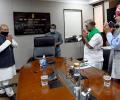
The minister also hoped that a resolution should be reached before the year ends and asserted that the Modi government is committed to address all genuine concerns of the farming community.

Earlier, Rajnath and Shah were leading deliberations among Union ministers to resolve the issues raised by the agitating farmers.
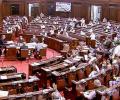
The joint Opposition including the Congress, the Dravida Munnetra Kazhagam, the Trinamool Congress, the Left, the Telangana Rashtra Samithi and the Aam Aadmi Party did not join the Question Hour of the session when the House reassembled after its first adjournment till noon.

The government's predicament is a result of its own doing: That of not ensuring adequate buy-in by the stakeholders before passage of the laws, notes Vivek Gumaste.

'With vendetta politics as its main plank, the BJP will be looking out for every opportunity to destabilise this Mahagatbandhan government.'
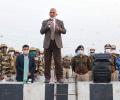
Union Home Minister Amit Shah on Thursday had a meeting with Delhi Police Commissioner S N Shrivastava, ahead of the 'chakka jam' announced by farmer unions protesting against the three agri laws at Delhi's borders, sources said.
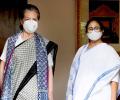
The TMC and the Congress are at daggers drawn over the recent instances of 'poaching' by the Mamata Banerjee-led camp.
