
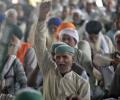
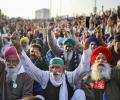
From carrying portraits of their sons and husbands who have committed suicide due to agrarian distress to picketing to doing sewa 24x7 at langars, women have shown a rare determination not to capitulate before the government.

The prime minister also said the government has offered to discuss clause by clause of the three farm laws and if there are any shortcomings it was ready to make changes.
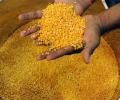
FCI's suspension of tur under MSP is likely to force farmers to undergo distress sales of the commodity.
According to a police official, the incident occurred when Grover along with the local BJP leaders reached the temple complex as part of their plan to watch from there the live telecast of Prime Minister Narendra Modi unveiling a statue of Adi Shankaracharya at the seer's rebuilt samadhi in Kedarnath.
'However, this time it looks like that is not working.'

"They are attacking democracy. There is a non-stop attack on democracy and that is why we are fighting here," Gandhi said, accusing the government of not allowing debate on price rise, Lakhimpur Kheri and other issues.

The focus of the Union Budget is on providing basic amenities to the poor, middle class and youth, Prime Minister Narendra Modi said on Wednesday, and asserted that it is imperative that India becomes self-reliant.
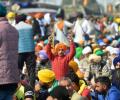
He also said that most of the farmers were "satisfied" with the steps taken by the central government, and added that their interests were "safe and secure" in its hands.

The Rashtriya Loktantrik Party (RLP), a constituent of the ruling National Democratic Alliance at the Centre, has extended its support to the call for Bharat bandh on December 8 by farmer groups protesting against three recent farm sector laws.

The leaders neither spoke from the podium of the Kisan Sansad (farmers' parliament) nor were they seated on the dais.

Tomar said the government is committed to "peaceful talks with farmers' leaders and does not intend to hurt farmers' sentiments".

'It is undemocratic and shows fascist tendencies.'
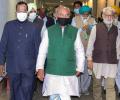
Tomar said the next meeting will take place on Saturday at 2 pm which he hoped would take the matter to a decisive stage and towards a final resolution.

According to government data, the prices have still not crossed the MSPs in some mandis.
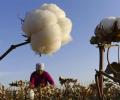
The ongoing Gujarat cotton farmers' agitation demanding better minimum support price took a new turn on Wednesday, after a 21-year-old farmer died due to self-immolation at the district's Vinchhiya marketing yard, because of not getting a good price for his cotton.

In televised remarks after Finance Minister Nirmala Sitharaman presented the budget, Modi said it has many provisions for the agriculture sector, including for making loans easier for farmers.

The two bills -- Farmer's Produce Trade and Commerce (Promotion and Facilitation) Bill, 2020, and the Farmers (Empowerment and Protection) Agreement of Price Assurance and Farm Services Bill, 2020 -- were passed by Lok Sabha on Thursday.

The farmer leaders claimed that they had caught the man from the protest site at the Singhu border.

With the farmers' protest against the three new laws and in support of legalising the minimum support price (MSP) going strong, state governments have announced a slew of measures in their annual Budgets to placate farmers. The Centre kicked things off in the Union Budget by assuring farmers that the MSP would continue and coming out with a report card to demonstrate its commitment. However, these efforts don't seem to have yielded tangible results. In their respective Budgets, states chose to go a step further by announcing a variety of measures.

The new bill will now be introduced in the Lok Sabha for passage in the upcoming Winter session of Parliament beginning November 29.
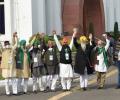
'Now that the home minister met us to discuss our demands a hope has definitely been kindled that farmers's demands will be met by this government.'

Shetkari Sanghatana president Anil J Ghanwat said the panel's report was in 'favour of farmers' and will decide next week on releasing the report in the public domain.

Addressing a press conference at Singhu Border in New Delhi, farmer leader Balbeer Singh Rajewal said that farmers never demanded the Supreme Court form a committee to resolve the impasse, alleging the central government was behind this development.

'Whatever I did, I did for the farmers and whatever I am doing, I am doing for the country'

The toll plaza employees allowed vehicles to pass through without paying any charge.

A special session of the Kerala Assembly is being convened on Wednesday to discuss the three contentious central farm laws and pass a resolution against the acts, whose repeal is being insisted by farmers agitating at the borders of Delhi for nearly a month.
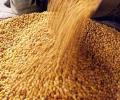
Chana is majorly imported from Australia and Tanzania and it attracts an import duty of 60 per cent. A section of the traders is demanding a reduction in import duty to around 35-40 per cent to tide over any shortage of the commodity as the new crop will start hitting the market only around mid-February.
"Manmohan Singh Ji (former Prime Minister) tried many times but could not do. Today when it is implemented, propaganda is being spread," Tomar said.
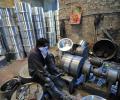
With the Covid-19 pandemic showing signs of ebbing and economic activity picking up, factory owners in Jalandhar had hoped that the worst was over. However, the heat wave in April and extensive power cuts that came with it, have crushed their hopes. The city's large number of micro, medium and small enterprises (MSMEs) are now gearing up for yet another struggle, this time to survive with the shortage of power that is severely impacting their operations.

A day after unprecedented violence in Delhi during the tractor parade, the government on Wednesday said it has never stated that the doors for dialogue with farmers are closed and stressed that it will inform whenever the decision is taken for fresh talks.

The police have put up barricades, tippers and rolled out water cannons to prevent protesting farmers from entering Chandigarh.

Thousands of farmers have reached the national capital on their tractor-trolleys and other vehicles, responding to the 'Delhi Chalo' call against the agri-marketing laws enacted at the Centre in September. On Saturday morning, it wasn't clear if they will agree to move to the Burari ground on the outskirts of the city, where police said they can continue with their protest. Many protesters were demanding a better venue in the centre of Delhi. Originally, the protest was meant to be on November 26 and 27.

On the occasion of Chinese president Xi Jinping's two-day visit, Indian exporters are looking for a big boost in export of agricultural commodities, especially the ones that have been impacted by the ongoing trade war between the United States and China.

A day after protesting farmer leaders paraded a youth who claimed a plot to disrupt their January 26 tractor rally, the Haryana police on Saturday said it had found no proof to support the allegations during its probe. It said the youth had claimed that he 'cooked up' the conspiracy story under fear after some volunteers at a protest site caught him and accused him of eve teasing.
The IMF believes the farm laws passed by the Indian government have the potential to represent a significant step forward for agricultural reforms, but a social safety net is needed to protect those who might be adversely impacted during the transition to the new system, a spokesperson of the global lender said in Washington.

'The PM cannot give a single reason why farmers should trust him.'

Former Punjab chief minister Amarinder Singh met Union Home Minister Amit Shah at his residence in New Delhi on Wednesday, raising speculation over his future plans ahead of the assembly polls in the state.
He is not good at thinking through laws and policies. His lockdown produced chaos and misery and didn't stop Covid. His GST finished off thousands of companies and reduced the amount of tax government collects to such an extent that he cannot pay state governments any more, observes Aakar Patel.

Chief Minister Charanjit Singh Channi had convened an emergency meeting of newly reconstituted Council of Ministers in view of the 'Bharat Bandh' call given by the Samyukt Kisan Morcha (SKM) to protest against the three agri laws, an official statement said after the cabinet meeting.

The farm sector has been resilient to the COVID-19 shock and is estimated to grow at 3.9 per cent this fiscal, the Economic Survey said on Monday, while suggesting to the government to give priority to crop diversification, allied farm sectors and alternative fertilisers like Nano urea. The Economic Survey 2021-22 also pitched for increasing agriculture research and development (R&D) and organic farming, besides use of new technologies like drones. "The performance of the agriculture and the allied sector has been resilient to the COVID-19 shock. ...Growth in allied sectors including livestock, dairying and fisheries has been the major drivers of overall growth in the sector," the Survey said. The agriculture sector has experienced buoyant growth in the past two years.
