
'It is to observe the Sun continuously that you have the Aditya L1 mission.' 'It is in a position from where it can observe the Sun continuously.'

'...but could demotivate employees seeking US residency.'

The US Department of Homeland Security (DHS) has proposed a new rule to eliminate the 60-day grace period for H-1B visa holders and other nonimmigrants after job loss, a move expected to significantly impact Indian technology workers.

'One important clarification is that the reported US action is not a blanket cancellation of all US tourist visas.'

The appointment comes as Agnikul prepares for Mission 02, a flight that will attempt, for the first time on Indian soil, the recovery of an orbital-class rocket booster and the extension of a rocket's upper stage into an on-orbit platform.

'Earlier, people used to hand money directly to priests after a ritual, and priests would keep it in their own pockets. We completely stopped that practice.'

As a part of Rediff's CAT 2026-prep series, MBA expert Patrick D'souza explains how you can maximise your preparation and complete your syllabus by August 2026.

This could come as a setback to thousands of Indian engineers who have waited for years for their work visas to pave the way for the coveted Green Card.
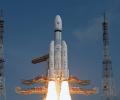
ISRO Chairman V Narayanan has emphasised the critical role of mission operations in ensuring the success of India's expanding space programme. He highlighted this at the Spacecraft Mission Operations conference, noting the importance of sustained teamwork and operational precision, particularly for long-duration missions like Chandrayaan-3 and the upcoming Gaganyaan programme.

The Trans-Lagrangian Point 1 Insertion manoeuvre marks the beginning of the spacecraft's about 110-day trajectory to the destination around the L1 Lagrange point, a balanced gravitational location between the Earth and the Sun.

AI is changing how IT companies hire, with skills like learning fast and solving problems now more important than degrees.

The smartphone is expected to be priced from 22,999, positioning it as a competitive offering in its segment.
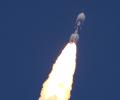
India's first solar mission, if successful, will showcase ISRO's ability to explore the cosmos, explains Kumar Abishek.

'Today, we are at a stage where we have launched a voice-to-voice model that supports 14 Indian languages.'

ISRO said on Saturday the Aditya-L1 spacecraft has travelled beyond a distance of 9.2 lakh km from Earth, successfully escaping the sphere of Earth's influence.

The images show VELC (Visible Emission Line Coronagraph) and SUIT (Solar Ultraviolet Imager) instruments as seen by the camera on-board Aditya-L1 on September 4, 2023.

Aditya-L1 is the first Indian space-based observatory that will study the Sun from a halo orbit around the first Sun-Earth Lagrangian point (L1), which is located roughly 1.5 million km from the Earth.

The Lagrange point 1 (L1) of the Sun-Earth system is about 1.5 million km from the Earth. It is about one per cent of the total distance between the Earth and the Sun.

Aditya -- the name in Sanskrit refers to the Sun -- is a coronagraphy spacecraft manufactured at the U R Rao Satellite Centre in Bengaluru to study the solar atmosphere.

These upcoming launches carry added significance in light of setbacks suffered in recent years.

Aditya L1, the first space based Indian mission to study the Sun underwent the second earth-bound manoeuvre successfully, during the early hours on Tuesday, Indian Space Research Organisation (ISRO) said.

A satellite placed in the halo orbit around the first Lagrangian point (L1) of the Sun-Earth system has the major advantage of continuously viewing the Sun without any occultation/eclipses, the IIA said.

Indian Space Research Oganisation (ISRO) on Sunday said it has successfully performed the first earth-bound manoeuvre of the country's maiden solar mission, Aditya L1, from ISRO Telemetry, Tracking and Command Network (ISTRAC) in Bengaluru.
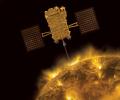
Data collected around L1 would provide insights into the origin, acceleration, and anisotropy of solar wind and space weather phenomena, it said.

According to ISRO officials, the spacecraft will be placed in a halo orbit around Lagrange point 1 (L1) of the Sun-Earth system, about 1.5 million km from the Earth. The L1 point is about one per cent of the total distance between the Earth and the Sun.
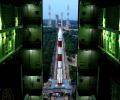
Aditya-L1 is a fully indigenous effort with the participation of national institutions., an ISRO official said.

The Indian Space Research Organisation (ISRO) will perform the final manoeuvre on Saturday to inject Aditya-L1 spacecraft -- the first space-based Indian observatory to study the Sun -- into its final destination orbit, some 1.5 million kilometres from the Earth.

The successful launch of the maiden solar mission of the Indian Space Research Organisation came on the heels of the historic lunar landing mission - Chandrayaan-3.
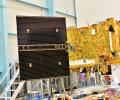
Aditya-L1 spacecraft is designed for providing remote observations of the solar corona and in situ observations of the solar wind at L1 (Sun-Earth Lagrangian point), which is about 1.5 million kilometres from the earth.
ISRO's maiden solar mission, Aditya L1, has captured its first high energy X-ray glimpse of solar flares. During its first observation period from approximately October 29, the High Energy L1 Orbiting X-ray Spectrometer (HEL1OS) on board Aditya-L1 spacecraft has recorded the impulsive phase of solar flares, the space agency said in a statement on Tuesday.
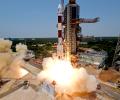
The successful launch of Aditya-L1 - the country's maiden mission to study the Sun - is expected to garner increased investor interest in the Indian space sector and trigger more funding for private players. Several private sector players, including Larsen & Toubro (L&T), MTAR Technologies, and Ananth Technologies, have played a pivotal role in the Indian Space Research Organisation's (Isro's) solar observatory mission. Aditya-L1 on Saturday set off on a 125-day journey on a PSLV-C57 rocket, in its attempt to study various elements relating to the nearest star from the halo orbit around Lagrange point 1 (L1) of the Sun-Earth system, which is about 1.5 million km from Earth.

White House Press Secretary Karoline Leavitt clarifies President Trump's stance on H-1B visas, emphasizing his priority for American workers while acknowledging the need for skilled foreign workers to train them in specialized industries.
Once Aditya L1 reaches its destination, it will help measure various events happening on the Sun for the next five years.

As India's first solar exploration satellite reached space, four Kerala public sector undertakings, including Keltron, have reason to be delighted as they too have contributed to this achievement by the country. Various products indigenously developed and manufactured by the four PSUs - Keltron, Steel and Industrial Forgings Limited (SIFL), Travancore Cochin Chemicals (TCC) and Kerala Automobiles Ltd (KAL) - have been used in the Aditya L1 mission. This milestone achieved by the PSUs was highlighted by state Industries Minister P Rajeev in a Facebook post.

The US President said that companies have to bring people to "get those plants opened, we want you to do that, and we want those people to teach our people how to make computer chips and how to make other things."

Tata Consultancy Services (TCS), Cognizant and eight other major corporations have been questioned by US Senators for filing thousands of H-1B skilled labour visa petitions after conducting "mass layoffs" of American employees.

Somanath said he realised that there were some health issues during the launch of the Chandrayaan-3 mission last year but was not very clear about it.

Scientists expect to get new information about the past, present and future of the Sun after analysing the data that will be collected by India's first solar mission Aditya-L1, scheduled to be launched by Indian Space Research Organisation (ISRO) on September 2.

In this process, millions and millions of tons of solar materials are thrown into the interplanetary space, he said, adding these CMEs can travel at a speed of approximately 3,000 km per second.

As per the new rule, foreigners who file to renew their EAD on or after October 30, 2025, will no longer receive an automatic extension, the DHS said in a news release.
