
More than 60 per cent followers of Mehdi Masroor Biswas, the Bengaluru-based executive, who was running a pro-Islamic State Twitter account, were non-Muslims and a majority of his Muslim followers were from western countries, particularly the United Kingdom, Home Minister Rajnath Singh said on Monday.

'We will have to wait till the snows melt in June/July 2016 before we can get a clearer idea of whether Pakistan intends to get serious about ending support for cross-border terrorism,' says G Parthasarathy, India's former high commissioner to Pakistan.

Using the Jinnah portrait as an issue, and by demonising AMU and consequently Indian Muslims, the politics of communal polarisation is sought to be played out ahead of the Kairana Lok Sabha by-poll and to sustain it till the next Lok Sabha election, says Mohammad Sajjad.
We should be prepared for a phase of increased tensions in India-Pakistan relationship thanks to the evolving situation in Afghanistan, says Shyam Saran.

'How can Kashmir be demilitarised if the terrorist threat remains and Pakistan continues to incite elements in Kashmir to keep the internal situation unstable?' asks former foreign secretary Kanwal Sibal.
'Instead of joining us in celebrating the strikes, the MoD has stabbed us in the back,' says a top general.

The increase in home-grown radicalised Islamic groups and the rise of Islamic State and Al Qaeda in Bangladesh should be a matter of worry for India, which shares a 4,100 km border with its eastern neighbour, says Rajeev Sharma.

'We were expecting death sentences, but now the court has acquitted them, despite Aseemanand himself admitting to his crime in front of a judge.' More importantly, it seems the tag of 'Hindu Terror' coined by the United Progressive Alliance government was wrong all along. Amjedullah Khan, spokesperson for the Majlis Bachao Tehreek, has been tracking the Mecca Masjid blast case from day one and was also involved in securing the release of more than 100 Muslims youths who were falsely accused in different terror cases in the aftermath of the blast. He spoke to Syed Firdaus Ashraf/Rediff.com about the acquittal of Swami Aseemanand and what it means.

'The Indian Army can easily initiate retaliation.' 'But escalation would be both inevitable and unpredictable.'
The Uri brigade was given pinpoint intelligence warnings about an impending attack. Yet, the Uri camp was taken by surprise.

'Those who genuinely seek justice do not differentiate between a victim and a victim or an accused and accused.' 'They demand justice for all,' says Utkarsh Mishra.

'If Indian armed forces entered Pakistan and succeeded in inflicting major damage on the Pakistani army and occupied territory in the Pakistani heartland, there is reason to think the Pakistani military would use some nuclear weapons against the incoming Indian forces to compel India to stop.'

'Why has the rhetoric gone down on the Indian side, Durrani wondered aloud.' 'I said because almost total normalcy and peace had returned on the ground in Kashmir,' recalls Shekhar Gupta. 'The general gave me that career spook's laser look. And he said: "That situation on the ground can change in no time".' 'This was precisely when the Pakistanis began their first incursions into Kargil.' 'Durrani had been retired for five years.' 'But once the ISI boss, you are always in the know.'

The Pakistani Taliban has announced a month-long ceasefire to facilitate the resumption of peace talks suspended by the government over the recent execution of 23 troops.

Operation Radd-ul-Fasaad launched to fight terrorism across country.
India must watch for signs after Peshawar that Pakistan is waking up to the dangers of Islamism, muses Ajai Shukla

'Washington is telegraphing here is its willingness to support a low-grade, limited use of force meant to send a strong message to Pakistan.' 'Perhaps something along the lines of the surgical strikes in 2016, or perhaps something a bit more -- but not much more.'

Recognising evolving global terror threats, India and Israel have resolved to deepen cooperation in fighting the menace and collaborate in the field of cyber security.

'Nobody knows what they teach in madrasas.' 'If we do not adapt to the ways of the modern world, how will we progress as a community?' 'How will these children compete in the modern world?'

There are a lot of very bad men out there. And Syed Asif Ibrahim is the best officer to deal with them. Aditi Phadnis reports
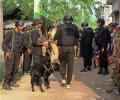
Prime Minister Narendra Modi's offer of central assistance in arresting the downward slide in West Bengal and National Security Advisor Ajit Doval's ongoing trip to the state and his asking for Mamata's cooperation in handling the situation and in dissolving the anti-national and inter-country network of jihad that has now chosen her state as one of its base, is perhaps Mamata's last best chance to salvage the situation, says Dr Anirban Ganguly.

The Simulia madrassa, on the outskirts of Bardhaman town in West Bengal, allegedly had links with Gulshana Bibi and Amina Bibi, the women arrested after the October 2 blast in the town. The NIA alleges the madrassa trained poor Muslim women in jihad. The madrassa had an unwritten convention: The women trained there would be married only to men who were on the same 'mission.'
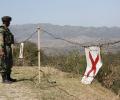
'The response to terror is not always reciprocal terror, nor is launching a conventional response the best response.' 'The best response is to make the sponsor pay a price he cannot afford,' says former RA&W chief Vikram Sood.
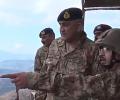
'The Pakistani military has encouraged and supported terrorist organisations, especially in Kashmir, as a means of waging proxy war against the Indian military and the country's superior economic resources.' 'The evidence is irrefutable with the recent killing of 46 paramilitary troops being just the latest example.'
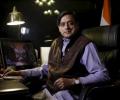
Tharoor had last week kicked up a controversy comparing Kanhaiya with freedom fighter Bhagat Singh, drawing strong criticism from the Bharatiya Janata Party while Congress distanced itself from his remarks.

'Against the backdrop of difficult administrative, political and economic problems, Imran's temperament and staying power will be the subject of intense expectation and public scrutiny,' says Rana Banerji, who headed the Pakistan Desk at the Research and Analysis Wing, India's external intelligence agency.

'India has both the wherewithal and the will to fight the enemy, but is living in a make believe world of its own since it is yet to accept that it is indeed at war,' says military historian Colonel Anil A Athale (retd).

Even as Prime Minister Nawaz Sharif headed to the United States for the 70th session of the UNGA and for bilateral meetings to be held on the sidelines of the multilateral summit, back home all that is expected of him is to internationalise the Kashmir issue, or as Pakistan puts it, the 'Kashmir dispute'.
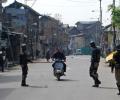
'Kashmir belongs to us all, even if we differ with each other.' 'Statesmanship demands that we sit together and let the left, right and centre of the political spectrum converge on the solution,' says former MP Tarun Vijay.

'With two nuclear neighbours, how likely is it for our armed forces to battle in a contaminated environment that could include nuclear, biological or chemical attacks by the adversary?' 'Are we prepared for the threat?' Brigadier S K Chatterji (retd) explains the meaning and significance of Operation Vijay Prahar.
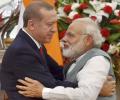
Turkish President Recep Tayyip Erdogan's has been trying to mollycoddle India with sweet nothings while having a very close relationship with Pakistan.

'That's the stunning achievement of two-and-a-half years of this government -- a political bait-and-switch, selling a promise of economic development, and delivering a triumphalist machine that sacralises country, nationalism, majoritarianism and tradition, to achieve Hindutva goals,' says Mitali Saran.
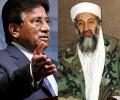
Former Pakistani military dictator Pervez Musharraf possibly knew about slain Al Qaeda leader Osama bin Laden and his place of hiding, an eminent British journalist who reported for years from Afghanistan and Pakistan for the New York Times has claimed.

'Pakistan's military leaders have to accept that the policy of proxy wars has damaged Pakistan more than it has damaged the enemy,' says former R&AW chief Vikram Sood.
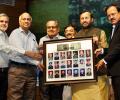
At a time when nationalism is a much-debated topic and the Armed forces' sacrifices are being ignored, a 'Wall of Heroes' at schools and colleges across the country to inspire the youth is a must, says Tarun Vijay.

Pakistani ships in high seas can pose a jehadi threat, Navy Chief Admiral R K Dhowan today said, citing reports of an attempt by militants to hijack a Pakistan navy frigate in September. He said that threat of maritime terrorism is increasing and the force was prepared for it.
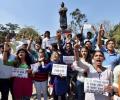
Even if I completely disagree with what Gulmehar says, I must, as a father, as an Indian, protect her rights and her dignity. Otherwise I am not entitled to be called an Indian, says Tarun Vijay.

Girls in the Kashmir valley hurling defiance at the security forces will detract from the legitimacy of India's response and its standing in the world, says Ajai Shukla.

A suspected SIMI operative and an aide of Indian Mujahideen media in-charge have been arrested from Secunderabad, with police saying that they were allegedly planning to go to Afghanistan to get training from Al Qaeda for carrying out terror activities in India.

The Devyani Khobragade row, India-Pakistan bickering over Afghanistan and a nightclub act by two diplomats were some of the issues discussed at one of the sessions at Jaipur Lit Fest, reports Sanchari Bhattacharya.
 © 2026 Rediff.com - Advertise with us - Disclaimer - Privacy Policy - Sitemap - Feedback - About us - Terms of use - Grievances