
The Quad has emerged as a key grouping to work for peace, progress, and prosperity in the Indo-Pacific region, Prime Minister Narendra Modi said on Saturday as he left for the United States on a three-day visit.

'If Washington has to balance Chinese power, she will have to turn to the third biggest power in the world which is India.' 'The United States and India will have to work together in order to keep Chinese ambitions in check.'

'The President-elect firmly believes we can avoid conflict with the Chinese Communist party because they need our markets.'
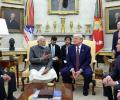
India and the United States have agreed to deepen their strategic partnership in several key areas, with President Donald Trump announcing plans to provide India with F-35 fighter jets and billions of dollars in military supplies. The two leaders also discussed energy cooperation, critical technologies, connectivity, and countering terrorism. They agreed to work together on the India-Middle East-Europe Economic Corridor, and Trump noted India's reforms to welcome US nuclear technologies. Prime Minister Modi said the two countries can shape a better world through their cooperation. Both leaders also addressed the Russia-Ukraine conflict, with Modi stressing India's commitment to peace.
'Looking at how quickly the hostilities were escalating, the nuclear threshold did not seem that far.'
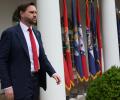
US Vice President J D Vance and National Security Adviser Michael Waltz are scheduled to visit India on April 21, reflecting Washington's focus on strengthening its relationship with India amidst global concerns over President Donald Trump's tariff policy. Vance's visit is likely to be more of a private trip, while Waltz's visit will be a business trip with discussions on security in the Indo-Pacific region, high technology, critical minerals, and export controls. Both are expected to meet Prime Minister Narendra Modi before his trip to Saudi Arabia. The visits come in the wake of Trump's recent pause on tariffs on all countries except China, following widespread economic concerns.
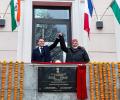
Prime Minister Narendra Modi and French President Emmanuel Macron have called for enhancing trade and investment ties between their countries and committed to further deepening their engagement in the Indo-Pacific. They discussed a full spectrum of bilateral relations, including key global and regional issues, and stressed the urgent need for reform in the United Nations Security Council. The leaders also underscored their commitment to ensuring the global AI sector can drive positive social, economic, and environmental outcomes.
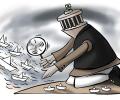
Australia on Wednesday unveiled an ambitious roadmap to deepen and diversify its trade and investment ties with India. The roadmap identified four "superhighways of growth" -- clean energy, education and skills, agribusiness, and tourism. Broadly, it sets out a pathway to focus ongoing efforts, including to boost two-way investment, and work with Indian-Australian communities and businesses.

The war and Modi's recent visit to Ukraine is expected to figure prominently in the bilateral meeting, according to US National Security Adviser Jake Sullivan.

US President Joe Biden on Saturday rolled out the red carpet to welcome leaders of Quad countries, Prime Ministers Narendra Modi of India, Anthony Albanese from Australia and Fumio Kishida of Japan.
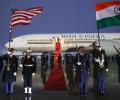
Ahead of the visit, officials from key government departments held intense discussions to identify key trade-related proposals.
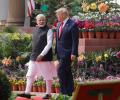
Prime Minister Narendra Modi will visit the US for a two-day working visit starting Wednesday. He will meet with President Donald Trump and engage in bilateral discussions on trade, investment, technology, defense cooperation, counterterrorism, Indo-Pacific security, and people-to-people relations. The visit is expected to further strengthen the India-US partnership.

'As the global economy undergoes significant transformations in 2025, India's ability to navigate the complexities of trade wars, financial realignments, and emerging blocs will be pivotal,' explain Harsh V Pant and Soumya Bhowmik.

The annual Quad summit at President Joe Biden's hometown Wilmington is expected to roll out a series of new initiatives to boost cooperation in the Indo-Pacific and explore ways to find peaceful solutions to the conflicts in Ukraine and Gaza.
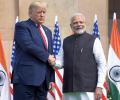
Prime Minister Narendra Modi and US President Joe Biden will have a substantive engagement on the sidelines of the Quad summit on Saturday, and the two sides will sign at least two agreements following the talks.

The Squad seeks to counter China's power assertions in the South China Sea region.
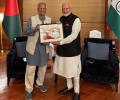
In his first meeting with Bangladesh Chief Adviser Muhammad Yunus, Prime Minister Narendra Modi on Friday flagged concerns over the attacks on minorities, including Hindus and conveyed that any rhetoric that vitiated the environment was best avoided.
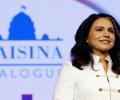
'Pick up momentum and find opportunities from an intelligence-sharing standpoint.'
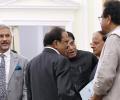
India's National Security Advisor Ajit Doval held bilateral talks with US Director of National Intelligence Tulsi Gabbard, and chaired a conclave of top global intelligence chiefs focusing on strengthening cooperation in confronting various security challenges including terrorism and threats posed by emerging technologies. The meeting also focused on security in the Indo-Pacific region, cooperation to counter terror funding and money laundering, and issues relating to extradition and immigration.
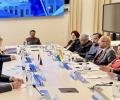
India has secured international support in its fight against terrorism, with Russia, Japan, and the United Arab Emirates expressing solidarity and a commitment to working together to combat the threat. This follows a recent terrorist attack in Pahalgam, India, which claimed 26 lives. Multi-party parliamentary delegations from India briefed the leaderships of these countries on Operation Sindoor, India's response to the attack, and discussed ways to enhance cooperation in counter-terrorism and combating radicalism. These developments highlight the growing global consensus against terrorism and the importance of international collaboration to address this shared challenge.
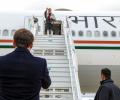
Prime Minister Narendra Modi has concluded his visit to France, which included co-chairing an AI summit and bilateral talks with French President Emmanuel Macron. He is now headed to the US for a bilateral meeting with President Trump. Modi's visit to France included discussions on trade, defense, energy, and cultural linkages. He also inaugurated India's new consulate in Marseille. During his visit to the US, Modi will also interact with business leaders and members of the Indian community.
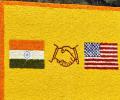
The Budget has given signals that India is sensitive to the US needs and willing to walk the extra mile, but if need be, we should respond in equal measure as a sovereign nation, notes Ajay Srivastava.

The India-United States relationship is set to expand under the Donald Trump administration, but there could be some unease on issues like imports, tariffs and immigration, strategic affairs experts said after the Republican leader won the fiercely contested presidential election.
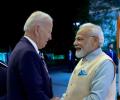
The White House readout of the call had no reference to Bangladesh, which was mentioned in an 'X' post by PM Modi.

The ties between India and Canada came under severe strain following Canadian Prime Minister Justin Trudeau's allegations of a "potential" involvement of Indian agents in the killing of Khalistani separatist Hardeep Singh Nijjar in June.
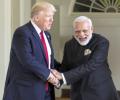
'Trump has no more elections to fight and his soaring ambition, which is no secret, will be to carve out a presidential legacy that outshines by far all his mediocre predecessors.' 'Trump's turnaround on the H-1B visa debate shows that he can take tough decisions and there are no holy cows in his domain,' asserts Ambassador M K Bhadrakumar.

Prime Minister Narendra Modi on Friday held bilateral talks with Italian counterpart Giorgia Meloni in Bari during which they discussed defence and security cooperation and hoped for further enhancing the defence industrial collaboration.

The Quad also vowed to work towards a free, open and prosperous Indo-Pacific, a region that has seen increasing Chinese military muscle-flexing in the last few years.
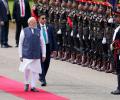
'Granting the country's highest civilian honour to Prime Minister Modi was surprising as it indicated the government was going out of its way to have India as a close partner.'

Prime Minister Narendra Modi concluded his visit to the United States after holding high-level bilateral talks with President Donald Trump on a wide range of subjects, including trade and technology, defence and security, energy and people-to-people ties. The two leaders decided to take a significant step in deepening their strategic ties, particularly in the areas of defence, energy, and critical technology. Modi also met with key American officials, including National Security Advisor Michael Waltz and Director of National Intelligence Tulsi Gabbard, and prominent business leaders like SpaceX CEO Elon Musk and Indian-American entrepreneur Vivek Ramaswamy.
'The policies announced by his administration are implemented faster.'
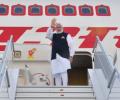
New initiatives to boost cooperation to ensure stability in the Indo-Pacific, ways to find peaceful solutions to the conflicts in Ukraine and Gaza and addressing concerns of the global South will be the focus of Prime Minister Narendra Modi's three-day visit to the US beginning Saturday.
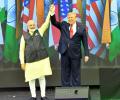
President Trump made these remarks on Monday while talking to reporters aboard Air Force One on his way back to Joint Base Andrews from Florida.
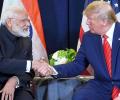
It would be the prime minister's first bilateral visit to the US after Trump became president for a second term.

The latest diplomatic row between India and Canada will not impact bilateral military engagement and the Canadian Army will take part in the conclave of the Indo-Pacific army chiefs in Delhi next week, a senior Indian Army official said on Wednesday.

The India-US strategic partnership is characterised by mutual trust and both sides are increasingly in agreement on key issues, such as countering China's aggression, promoting a free and open Indo-Pacific and addressing regional security challenges, Defence Minister Rajnath Singh said on Friday.
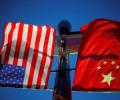
China has toned down its rhetoric on fighting a trade or any other type of war with the US, saying that no such wars should be fought because they cannot be won. Foreign Ministry spokesman Lin Jian responded to US Secretary of Defence Pete Hegseth's remarks that his country doesn't seek a war with China, but will rebuild the military and prepare for war. However, on Tuesday, Lin had said that China is ready to fight till the end if the US wants a trade war or any other type of war. Hegseth said on Wednesday that the US is not actively seeking conflict with China, but is rebuilding its military and establishing deterrence.
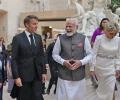
The Ukraine conflict and Chinese activities in the Indo-Pacific region figured in last week's talks between Prime Minister Narendra Modi and French President Emmanuel Macron, and both sides have similar views over the two issues, sources said on Monday.

The leaders said they stand for adherence to international law, peaceful resolution of disputes and respect for principles of the UN Charter, including territorial integrity and sovereignty of all states.

With Donald Trump all set to become US president, Indian exporters may face high customs duties for goods like automobiles, textiles and pharmaceuticals if the new US administration decides to pursue the 'America First' agenda, opined trade experts. Experts also said that Trump could also tighten H-1B visa rules, impacting costs and growth for Indian IT firms. Over 80 per cent of India's IT export earnings come from the US, making it vulnerable to changes in visa policies.
