
US Secretary of State Marco Rubio says relations between India and the US have not lost momentum and are set to strengthen, with hopes for a trade deal soon.
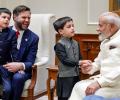
US Vice President JD Vance and Prime Minister Narendra Modi held a phone call to discuss expanding the India-US comprehensive global strategic partnership, focusing on trade, defence, energy security, emerging technologies, and critical minerals. The discussion comes amidst rising tensions in West Asia and recent regional realignments, with both leaders reaffirming their commitment to strengthening cooperation.

Celebrations marking India's 80th Independence Day in the New York tri-state area culminated in a world record, with more than 1,300 US flags surrounded by Indian tricolours arranged to form the number "250", in a tribute to America's semiquincentennial anniversary.

We are back to the 1971 moment with both China and the US supporting Pakistan, asserts Colonel Anil A Athale (retd).

The US senate last week passed a bill that would allow Washington to impose tariffs on major buyers of Russian energy.

New Delhi must look for formal, institutional statements issued directly from Washington rather than rely on casual pronouncements meant for local audiences, notes Ambassador Rajasekhar.

The US Commission on International Religious Freedom (USCIRF) has recommended sanctions against the Rashtriya Swayamsevak Sangh (RSS) and advised the US government against extending diplomatic courtesies to its leaders. This comes ahead of RSS Chief Mohan Bhagwat's visit to the US, with USCIRF officials citing allegations of attacks on religious minorities by RSS sub-groups. India has consistently rejected USCIRF's reports as biased and selective.

'All these reports and announcements by the US seem like attempts to gain a lever in trade deal negotiations with India.'

US Vice-President J D Vance's unexpected phone call to Prime Minister Narendra Modi on August 8 has ignited speculation about a potential diplomatic overture, possibly seeking India's support amidst the escalating US-Iran conflict and a shifting global power landscape, suggests Ambassador M K Bhadrakumar.

Indian farmers staged a significant protest at the Shambhu border against a proposed India-US trade deal, fearing its detrimental effects on the domestic agricultural sector and demanding its immediate abandonment. They later ended their agitation after assurances from the Haryana Agriculture Minister regarding the release of detained farmers and a meeting with the Union Agriculture Minister.

'Tariff action relating to the excess-capacity investigation will be even more susceptible to judicial overturn.'

American industry groups sought punitive tariffs on Indian goods at USTR hearings, while Indian officials defended the country's manufacturing growth as demand-led and WTO-compliant.

A readout by the US said the agreement marked a milestone in the strategic partnership between the two nations to ensure that the foundational elements required for advanced technology and energy are available within trusted networks.

The question nobody seems to ask is why a democracy should be silent when many of its citizens are concerned about the way the US is deviating from its traditional ways of consultation, cooperation and collaboration and moving away from traditional allies, asks Ambassador T P Sreenivasan.
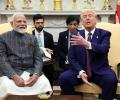
Prime Minister Narendra Modi and US President Donald Trump discussed the West Asia crisis and the importance of keeping the Strait of Hormuz open and secure. They also reviewed progress in bilateral ties and anticipated upcoming deals in the energy sector.

Despite decades of efforts towards energy transition, oil will remain the critical energy source for all nations for some decades. We can hope for peace opening the Strait of Hormuz, but must prepare for war closing it, points out former foreign secretary Ranjan Mathai.

Key discussions focused on major defence procurements, including India's plan to acquire six additional P-8I aircraft for anti-submarine warfare. The deal, estimated at around Rs 30,000 crore, is under advanced negotiations.

US President Donald Trump lauded Prime Minister Narendra Modi as a "very tough negotiator" and hinted at a future visit to India during their meeting on the sidelines of the G7 Summit, where they discussed trade, defence, and the West Asia crisis.

Indian-American lawmakers are encouraging the diaspora to actively participate in US politics and run for public office at all levels. This call comes amidst increasing incidents of anti-India and anti-Hindu hate, with leaders emphasising that political representation is crucial to address community concerns and ensure their voices are heard.

New Delhi will substantially reduce tariffs on industrial and agricultural goods while continuing to protect sensitive sectors. Tariffs on some agricultural products that are not traditionally considered sensitive will be brought down to zero, while in the case of relatively sensitive items, duties will be reduced in a graded manner and quotas will be imposed.

Gwadar is viewed as a critical pearl in China's maritime strategy as it would give a permanent logistical footprint near an important choke point - the Strait of Hormuz and the oil rich Persian Gulf, explains Commodore Venugopal Menon (retd).
India and the US have reported positive progress in recent trade talks in Washington, agreeing to maintain engagement to finalise a bilateral trade agreement, which now requires recalibration following new US tariffs.

Trump lauded the defence relations between India and US and affirmed support precisely for the PM Modi-led nation during conflict situations.

US Ambassador to India Sergio Gor on Thursday met with Union Home Minister Amit Shah to discuss enhancing cooperation on combating terrorism and bringing criminals to justice in both countries.

Indian benchmark indices Sensex and Nifty rebounded in early trade, recovering from previous losses, driven by softening crude oil prices and renewed buying interest in blue-chip stocks. Analysts note that the fall in Brent crude below USD 77 has removed significant macro headwinds for India, contributing to market stability.

Prime Minister Narendra Modi urged US President Donald Trump to prioritise the safety of Indian seafarers in the Strait of Hormuz during the implementation of Washington's proposed Iran peace deal, as both leaders focused on repairing strained bilateral relations at the G7 summit.

After the US Supreme Court struck down President Donald Trump's global tariffs, Congress leader Rahul Gandhi accused Prime Minister Narendra Modi of being "compromised", saying his "betrayal" in the India-US interim trade deal stood exposed.

'The flip side of this is that he won't hesitate to call out India if he thinks its policies are hurting US economic interests or border US foreign policy goals.'

The deal shifts the US posture towards India from hostile to neutral, and that matters for growth, points out T T Ram Mohan.

Prime Minister Narendra Modi and US President Donald Trump exchanged pleasantries and held a brief conversation at the G7 summit, their first in-person encounter in 16 months, setting the stage for high-stakes bilateral talks amidst continuing strain in India-US relations.

Prime Minister Narendra Modi and US President Donald Trump are set to hold comprehensive talks focusing on a bilateral trade deal, defence cooperation, and energy and critical minerals sectors during the G7 summit in Evian-les-Bains, France.

Former US President Donald Trump lauded Prime Minister Narendra Modi as a 'great leader' and 'tough guy' who has been in power for over 12 years, placing him alongside China's President Xi Jinping as leaders he admires for their power and ability to execute.
US President Donald Trump lauded Prime Minister Narendra Modi's 'calm, cool, killer' persona at the G7 leaders' lunch in France, underscoring the deeply strategic relationship and formidable diplomatic skills of the Indian leader ahead of their crucial bilateral meeting.

AAP national convener Arvind Kejriwal has criticised Prime Minister Narendra Modi for thanking US President Donald Trump, arguing that India's sovereignty and national interest should be paramount. Kejriwal questioned the basis of Modi's gratitude, citing incidents involving attacks on ships carrying Indians and the deaths of Indian nationals, and called for strong leadership to protect India's interests.

India and the US have decided to reschedule their meeting to finalize the interim trade pact due to recent developments and implications, including changes in US tariffs.

Modi highlights the potential for large-scale employment generation for women and youngsters.

US Secretary of State Marco Rubio will visit India for four days to strengthen bilateral relations, holding talks with Indian leaders and attending the Quad foreign ministers' meeting.
India and the United States are committed to finalising an interim trade agreement, despite recent challenges including the US imposing a blanket 10 per cent surcharge and India's decision to wait for a new global tariff architecture. The US Trade Representative's annual report highlights India's maintained high import tariffs and various non-tariff barriers across several sectors.

US Secretary of State Marco Rubio arrived in Kolkata for a four-day diplomatic tour to India, marking the first visit by a US secretary of state to the city in 14 years. His itinerary includes meetings with Indian officials, energy talks, and a Quad Foreign Ministers Meeting.
Chief negotiators from India and the US are set to begin three-day talks in Washington to recalibrate the bilateral trade agreement (BTA) framework, following significant changes in the US tariff landscape, including a new 10 per cent tariff imposed on all countries.
