ISRO Chairman V Narayanan has emphasised the critical role of mission operations in ensuring the success of India's expanding space programme. He highlighted this at the Spacecraft Mission Operations conference, noting the importance of sustained teamwork and operational precision, particularly for long-duration missions like Chandrayaan-3 and the upcoming Gaganyaan programme.
'There's too much coincidence in back-to-back failures of missions critical to national security.'

Concerns are rising about the status of GalaxEye Space's Mission Drishti, India's first Made in India OptoSAR satellite, launched on May 3. Reports suggest the satellite is tumbling in space, and experts highlight potential issues with solar panel deployment and stabilisation. The company has remained silent on the matter, fueling further speculation.

The EoI comes at a time when ISRO is working to enhance LVM3's payload capacity to five tonnes in GTO and is also evaluating the procurement of a Russian semi-cryogenic engine for the vehicle's second stage.

The RusBeam 2800 is now India's largest electron-beam wire deposition 3D printer operating under vacuum. The machine was custom-built for India and is operated with software developed by Rosatom.

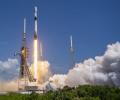
ISRO's PSLV-C62 successfully launched an earth observation satellite along with 14 other commercial payloads from Sriharikota, marking the first launch of the year.
ISRO chairman announces plans for nine major launches by the end of the fiscal year, including the Blue Bird Block2 communication satellite for the US in collaboration with NASA.
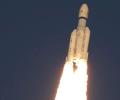
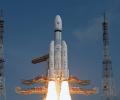
Indian Space Research Organisation scientists have carried out a new experiment on the indigenously developed C25 cryogenic stage of the LVM3-M5 rocket which successfully placed the Communication Satellite CMS-03 into the intended orbit on Sunday, said its Chairman V Narayanan.

Weighing 6,100 kg, the communication satellite would be the heaviest payload to be placed into the Low Earth Orbit (LEO) in LVM3 launch history from Indian soil.

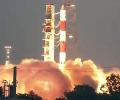
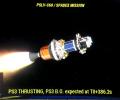
Indian Space Research Organisation's 101st mission from Sriharikota, an earth observation satellite onboard the agency's trusted Polar Satellite Launch Vehicle (PSLV) rocket, could not be accomplished on Sunday following a pressure issue in the third stage of the launch vehicle, the space agency said.

From a surge in startups to crewed mission preparations, 2025 marks a transformative year as India eyes $44 billion space economy by 2033.
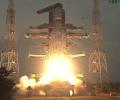
The heaviest communication satellite to be launched from the Indian soil onboard a new generation, homegrown 'Bahubali' rocket was successfully placed into the intended orbit on Sunday, the Indian Space Research Organisation said.

The Bharatiya Antariksh Station represents the next phase of India's human spaceflight ambitions, enabling long-duration presence in space, advanced microgravity research and technology development, and supporting future human exploration missions.
'ISRO recommended to carry out in-situ repairs or replacement and conduct a low-temperature leak test to validate system performance and integrity, before proceeding with launch.'
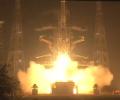
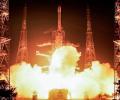
The Indian Space Research Organisation successfully launched its 100th mission on Wednesday, with a GSLV rocket carrying navigation satellite NVS-02.
ISRO's vendor policy and quality control processes are under scanner.
Dubbed as a prelude to ISRO setting up its own Space Station by 2035, the PSLV-C60 mission would also make India join an elite club in achieving this feat which is expected to take place in the coming days.
Demonstration of seed germination in outer space, a robotic arm to catch a tethered debris there, and testing of green propulsion systems are some of the experiments planned on the POEM-4 -- the fourth stage of ISRO's PSLV rocket that remains in orbit after launching a satellite.

Researchers at IIT Mandi have developed a real-time landslide monitoring and early warning system that has been deployed in landslide-prone areas of Mandi district, Himachal Pradesh. The system uses machine learning and sensors to detect ground movements and provide early warnings to authorities and the public.
'A solid motor, once ignited, burns until the propellant is exhausted. It cannot simply stop mid-burn,' said a retired senior ISRO official. 'That is what makes this failure puzzling.' Venkatachari Jagannathan reports on the latest PSLV failure.
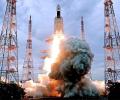
'You can observe a lot of things from space.' 'Another thing is communication, in real time, especially in war-like situations.' 'During Operation Sindoor, we could play our part well.'
'The solution is to replace, clean up, retest and proceed.' 'There is nothing to worry about if corrected.'

On Sunday morning, in its mission to place an earth observation satellite and students satellite into the low earth orbit, the SSLV-D1/EOS-02 blasted off precisely at 9.18 am amid cloudy skies from the first launch pad at Satish Dhawan Space Centre in this spaceport.

Prime Minister Narendra Modi was accorded a warm reception as he arrived at the Indian Space Research Organisation headquarters in Bengaluru on Saturday morning.
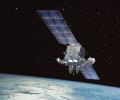
The Indian Space Research Organisation said it successfully carried out an "extremely challenging" controlled re-entry experiment of the decommissioned orbiting Megha-Tropiques-1 (MT-1) satellite.
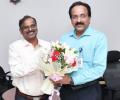
Narayanan has a long and distinguished career at ISRO, having played a key role in several important missions, including Chandrayaan-2 and 3, and the Gaganyaan programme.

"I noticed her absence during the #AdityaL1 launch. I thought she might be out of the office or something. But I didn't expect this sad news. I'll really miss her. Om Shanti," one user wrote.
'The satellite's condition is healthy.'
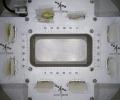
The Indian Space Research Organisation (ISRO) has announced that cowpea seeds sent to space onboard the PSLV-C60 POEM-4 platform have successfully germinated under microgravity conditions, marking a significant milestone for India's space program. This experiment, known as CROPS (Compact Research Module for Orbital Plant Studies), aims to understand how plants grow in the unique conditions of space, which is essential for future long-duration space missions.
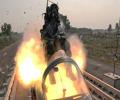
The DRDO conducted the test in collaboration with the Aeronautical Development Agency and Hindustan Aeronautics Limited.
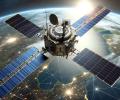
India is marching towards becoming the fourth country in the world to have space docking technology.

The Indian Space Research Organisation (ISRO) successfully launched its third and final developmental flight of Small Satellite Launch Vehicle here on Friday whose payloads can be used in applications like satellite-based surveillance, disaster and environmental monitoring, fire detection, volcanic activity among others.
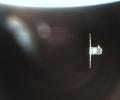
The Indian Space Research Organisation (ISRO) has successfully performed the docking of satellites as part of the Space Docking Experiment (SpaDeX). The docking was achieved after a series of maneuvers, including a trial attempt on January 12. The SpaDeX mission, launched on December 30, 2024, aims to demonstrate in-space docking technology using two small spacecraft. This technology is crucial for achieving complex mission objectives that require multiple rocket launches.
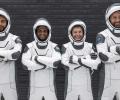
If Rakesh Sharma represented the dreams of a nascent India looking outward, Shubhanshu Shukla embodies a confident India reaching for the controls.

ISRO's Thiruvananthapuram-based Vikram Sarabhai Space Centre successfully conducted a series of drogue parachute deployment tests at the rail track rocket sled facility of the Terminal Ballistics Research Laboratory in Chandigarh during August 8-10.
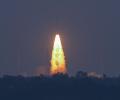
A PSLV rocket carrying Earth observation satellite EOS-09 failed to launch from the Sriharikota spaceport early on Sunday.

Rajasthan Sports Minister Ashok Chandna made the slip hours before the touchdown by Chandrayaan's lander on the lunar surface - an unmanned landing eagerly anticipated across the country.
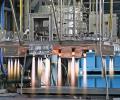
With these successful tests, ISRO has moved a step closer to India's first human spaceflight mission, Gaganyaan.

In a written reply, Singh said NASA has identified a private entity Axiom Space and ISRO had signed a Space Flight Agreement with the American firm for the joint mission to the International Space Station.

The successful launch of the maiden solar mission of the Indian Space Research Organisation came on the heels of the historic lunar landing mission - Chandrayaan-3.
