
Chinese leaders, including its generals, will have to weigh whether they can win a war if they ever attack Taiwan and if at all, can they sustain the subsequent devastation, notes Rup Narayan Das.

While the US continues to millions as financial aid to Pakistan to fight terror, it has also invited over 20 countries and five financial institutions to participate in the the Friends of Democratic Pakistan forum for the sake of Pakistan's better future.

India-US relations, like Rome, were not built in a day, nor can they be demolished in a day.
All said and done, when the new global order emerges, India can only remain with the democracies, asserts Ambassador T P Sreenivasan.

US Secretary of State Marco Rubio claims President Donald Trump was instrumental in bringing about the cessation of hostilities between India and Pakistan, a claim India has consistently denied.
If the US' renewed closeness with Pakistan ends up strengthening Pakistan's military, it will clearly show that Washington no longer wants a strong India and could be ready to let China dominate Asia, notes Colonel Anil A Athale (retd).

Pakistan made a tactical error in not investing enough in L K Advani, former R&AW chief A S Dulat tells Sheela Bhatt/Rediff.com

The bilateral and Quad summits, in which Prime Minister Modi played a significant role, has sent the right message to China, observes Ambassador T P Sreenivasan.

'Whatever comes in the minds of the Pakistani generals and Pakistan military, they just go for it.' 'They do not care about the consequences for their country or the consequences to the people of Pakistan.'

Engagement with neighbours is a strategic imperative, and not an option, asserts Rup Narayan Das.

The scaling up of the India-US strategic partnership to the level of non-NATO ally with defence deals, sharing and transfer of defence technology, interoperability, joint collaboration and joint production of defence equipment has exacerbated Moscow's anxiety, notes Rup Narayan Das.
At no other time has a single meeting of the leaders of two democracies been so critical and hazardous.

'The world is watching carefully. The choices India makes today have consequences beyond its borders.'
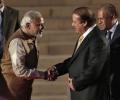
'India had nothing to gain by the talks except for some brownie points from the US for being reasonable. Pakistan desperately needed the talks to get arms and money from the Americans,' says T P Sreenivasan.

Many of the stories, the pictures going out of India worldwide lately with these provocative processions, taunting of Muslims, bulldozers targeting mostly their properties, the sweeping 'othering' of a community of 200 million are painting the front pages and TV screens in the democratic world. That is where most of the friends we covet lie. Soon enough, these will also make our vital friends among the Muslim nations, from Bangladesh to Saudi Arabia and the UAE, uneasy. The best time for course correction is now, asserts Shekhar Gupta.

In 2017, a retired R&AW officer conveyed that Uttar Pradesh Chief Minister Yogi Adityanath was keen to get monarchy restored in Nepal and suggested that I support these efforts.
The external affairs minister said PM Modi had discussed with his Pakistani counterpart of re-engaging with each other."

'The Senators were playing safe, not angering either the pro-India lobby or the pro-Pakistan lobby, but perhaps more importantly, the military-industrial complex -- the most powerful lobby of all -- which the majority of Senators are beholden to in terms of largesse to their campaign coffers.'
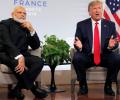
Modi said India and Pakistan were together before 1947 and he was confident that the two neighbours can discuss their problems and solve them.

Tillerson said China's behaviour and action is "posing a challenge to the rules-based international order".

During Vajpayee's tenure, he was there as an indispensable insider, witness to every action that had an impact on history: Pokhran-II (nuclear tests in 1998), the 1999 Kargil conflict between India and Pakistan, the Indo-Pak Agra Summit in 2001, intense engagement with the United States on nuclear issues besides the Kandahar hijack.
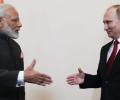
"We do not have any tight (military) relations with Pakistan," Putin said.

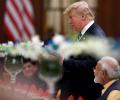
Modi may take satisfaction from his display of considerable political skill in managing a mercurial, temperamental and unpredictable US president and nudging him into uncharacteristic restraint and even carefully orchestrated remarks. This personal chemistry will come in handy if Trump returns as president in the November elections, says former foreign secretary Shyam Saran.
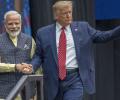
'The challenge before the two countries is to turn the peak into a plateau and enter an irreversible phase of cooperation,' notes Ambassador T P Sreenivasan.
'Now is the time for India, our biggest neighbour and oldest friend, to bring the full array of international policy instruments to bear.'

'The credit for managing Trump should go to Modi.' 'Biden is a predictable and rational person with plenty of administrative experience,' notes Ambassador T P Sreenivasan.

'Even in this age of self-willed and authoritarian leaders and spontaneous gestures, a script is still written,' notes Ambassador B S Prakash, imagining the 'talking points' are for the India-US summit on June 26.

'The National Conference and the Peoples Democratic Party, as recent events suggest, are quite content as New Delhi's collaborators rather than trying to be true representatives of the Kashmiri people,' says Athar Parvaiz.

With Donald Trump the appeal has to be to his business instincts in which his personal interests seem to play a significant role, says former foreign secretary Kanwal Sibal.

'If the US-Pakistan relationship continues to suffer, Pakistan may feel it has less to lose and decide that it need not keep a leash on LeT in order to appease America.' 'A tougher US policy toward Pakistan could lead to an emboldened and strengthened LeT and JeM, resulting in more terrorist attacks in India.'

'This is the first time that the Americans have agreed to refer to "cross-border terrorist attacks" in a joint statement.' 'No wonder Pakistan has called the joint statement "singularly unhelpful" and has blasted it, and its all-weather friend China has applauded Pakistan's frontline role in combating terrorism,' points out former foreign secretary Ambassador Kanwal Sibal.
Kashmiris hope that India and Pakistan can find a lasting solution to what many call the Kashmir 'problem'.

'By the time he came out after nearly five hours, he had a one-to-one conversation with the President, a delegation-level meeting, a reception, a dinner, a tour of the White House and a joint statement of a kind none of his predecessors ever had,' says Ambassador T P Sreenivasan.
US Assistant Secretary of State for South and Central Asia Nisha Desai Biswal believes the India-US nuclear deal is not in limbo and it is for India and Pakistan to set the pace for conversations to resolve their issues. Rediff.com's Aziz Haniffa reports from Washington, DC.

'To consider BRICS anything more than a temporary club with some common interests would be folly. The goal should be to induce others (Japan, ASEAN, South Africa) to align with us -- a non-threatening, democratic nation, rather than with malevolent China or waning America. For us to consider aligning with either China or the US would be absurd. India is just too big to be a sidekick,' says Rajeev Srinivasan.

Do Modi's foreign visits actually serve India or they nothing more than expensive tools for domestic positioning and image-building, asks Shehzad Poonawalla.

Moving ahead with their new mantra -- Chalein Saath Saath: Forward Together We Go -- Prime Minister Narendra Modi and United States President Barack Obama on Tuesday vowed to deepen cooperation in every sector for the benefit of global stability and people's livelihoods over the next ten years.
