
'SUV is a very intensely fought category, unlike hatchbacks and cars.'
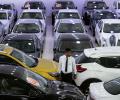
Auto majors Maruti Suzuki, Tata Motors and Mahindra & Mahindra reported robust sales in September as reduced price tags owing to GST rationalisation led to record demand in the Navaratri period. The month also saw Tata Motors and Mahindra & Mahindra settling at number two and three positions, respectively in vehicle wholesales ahead of Hyundai Motor India.

'Crude oil prices are around $66-67 per barrel now but could fall to $55-60 if global disturbances ease.'
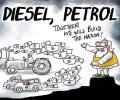
Union Petroleum and Natural Gas Minister Hardeep Singh Puri on Monday said India is the only country where rates of petrol and diesel have come down between November 2021 and April 2024. Replying to various queries during Question Hour in Rajya Sabha, the minister also informed that the government is encouraging dialogue between Oil Marketing Companies (OMCs) and dealers regarding margins for the latter. Puri noted that petrol and diesel were deregulated during the UPA government.
Indian rupee slipping below the record 88 level against the US dollar will enhance price competitiveness of Indian products in global markets and help exporters diversify beyond the US market, say exporters. However, import-dependent sectors such as gems and jewellery, petroleum and electronics may see lower benefits due to a rise in input costs, they stated.

Reliance Industries Ltd has consistently remained compliant with international sanctions and is expected to adhere to upcoming measures on Russian oil, analysts said, estimating that oil sourced from Russia contributes just 2.1 per cent to its consolidated EBITDA. Reliance operates the world's largest single location refining complex, with more than half of the capacity exclusively dedicated for exports.


Vin Diesel took to Instagram to share a throwback picture with Deepika Padukone, his co-star xXx: Return of Xander Cage, in an auto rickshaw and thanked her for bringing him to India.

While the Syros shines in many areas, its ride quality is a point of contention, notes Rajesh Karkera.

Mahindras unveil four stunning, eye-popping, concept SUVs: the Vision.S, Vision.X, Vision.T, and Vision.SXT.
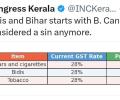
Union Minister Nityanand Rai launched a scathing attack on Congress, stating that the party takes "pleasure" in insulting Bihar and its people.

State-owned Oil and Natural Gas Corporation (ONGC) has reported a 10 per cent decline in its June quarter net profit on lower oil prices and stagnant production from its aging fields. The company reported a net profit of Rs 8,024 crore in the first quarter of 2025-26 fiscal year, compared to Rs 8,938 crore earning in the same period last year, a company statement said.
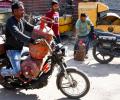
Cooking gas or Liquified Petroleum Gas (LPG) price has been raised by Rs 50 per cylinder by distribution companies, Union Oil Minister Hardeep Singh Puri said on Monday.

The price of jet fuel (ATF) was sharply increased by 7.5 per cent on Tuesday, while the cost of LPG used in commercial establishments was reduced by Rs 58.50 per cylinder, reflecting shifts in international benchmark rates. After three rounds of price cuts, aviation turbine fuel (ATF) price was increased by Rs 6,271.5 per kilolitre, or 7.5 per cent, to Rs 89,344.05 per kl in the national capital - home to one of the busiest airports in the country, according to state-owned fuel retailers.

These cameras will detect vehicles older than 10 years (diesel) or 15 years (petrol) and an alert will be sounded to the command centre and enforcement teams comprising traffic and transport department officials which will impound the vehicles.
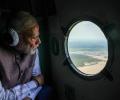
Prime Minister Narendra Modi announced a Rs 1,600-crore assistance package for flood-hit Punjab after reviewing the damage. He also announced ex gratia for the deceased and injured. The state is battling its worst deluge since 1988.

10 Heroes of the 1965 War which ended on September 23 60 years ago.

It's a proud moment for India.

GST, net of refunds, now yields close to 20 trillion to both the Centre's and states' exchequer.

State governments have requested the Centre for export incentives, lifting of import duty in the case of cotton for the textile sector and GST exemptions.
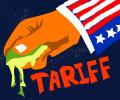
US President Donald Trump on Wednesday slapped an additional 25 per cent tariff on goods coming from India as penalty for New Delhi's continued buying of Russian oil.
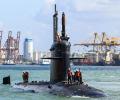
'There's an urgent requirement, particularly for the Indian Ocean region, as China's naval presence grows, and with Pakistan also acquiring more submarines.'
Some of the key names include: Maruti, M&M, Ashok Leyland, Britannia, Ultratech, JK Cement, Havells, Voltas, Amber, Metro, Trent, LemonTree, Indian Hotels, Niva Bupa, HDFC Life, IGL, Acme Solar, Suzlon, Swiggy, Delhivery, ICICI Bank, HDFC Bank, Bajaj Finance, Shriram Finance," according to a report by Motilal Oswal Financial Services.

'In the luxury car segment, the adoption of EVs is almost double compared to the mass market.'

Cooking oil is often discarded after being used for frying at home or in restaurants. However, a refinery of IndianOil has now won a certification to use the same oil to produce sustainable aviation fuel (SAF), the company chairman Arvinder Singh Sahney said.
Diesel sales in India fell 3 per cent in September as a receding monsoon continued to dampen demand and slowed industrial activity in some parts of the country, preliminary data of state-owned firms showed. While diesel sales by three state-owned fuel retailers fell year-on-year, petrol sales rose in September. Consumption of diesel, the most consumed fuel in the country -- accounting for about two-fifths of the demand, fell to 5.81 million tonnes in September from 5.99 million tonnes demand in the same period a year ago.

The blaze was quickly doused and no one was injured in the incident which occurred near Yevat in Pune district at around 8 am, an official from Daund railway police station said.

A three-member investigation committee, led by the deputy chief medical officer, has been formed to probe the incident.
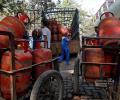
The government is likely to give a subsidy of Rs 30,000-35,000 crore to state-run oil companies - Indian Oil Corporation (IOC), Bharat Petroleum (BPCL), and Hindustan Petroleum (HPCL) - to compensate for losses incurred from selling LPG at below cost over the past 15 months, according to a senior official.

Indian Oil Corporation (IOC), the nation's largest oil firm, on Friday said ample stocks of petrol, diesel and cooking gas LPG are available in the country and there is no need for panic buying of fuel. The statement comes after social media was flooded with posts and videos showing people queuing at petrol pumps to stock fuel as tensions between India and Pakistan escalated.

The Delhi government has requested the Centre's air quality panel to suspend the fuel ban on older vehicles, citing implementation challenges and public discontent. The government is also seeking solutions to restrictions on end-of-life vehicles.

One of the key attractions of the park, which houses a wide array of plant, animal and bird species besides ancient caves, the revamped toy train is set to provide an elating and exciting experience to visitors, especially children.
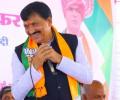
A video of Lonikar's controversial remarks surfaced on social media on Thursday and invited strong criticism from the opposition.

India's consumer price index (CPI)-based retail inflation rate is likely to have cooled further in June, thus remaining below the 4 per cent target of the Reserve Bank of India (RBI) for a fifth consecutive month, giving the central bank wiggle room to focus on growth. Economists reckon that the decline is on account of easing prices in various categories of goods, especially food items, and a favourable base effect.
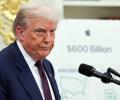
United States President Donald Trump has said India is 'very close' to China in terms of its purchases of Russian oil and will pay tariffs of 50 per cent as he indicated that 'you are going to see so much secondary sanctions'.
From just 0.2 per cent before the Russia-Ukraine war to now accounting for 35-40 per cent of total crude imports, India's reliance on Russian oil has surged -- drawing fresh scrutiny with US President Donald Trump announcing a penalty on top of a 25 per cent tariff, or tax, on all goods going to the US.

"India is not only buying massive amounts of Russian Oil, they are then, for much of the Oil purchased, selling it on the Open Market for big profits," Trump said in a social media post on Monday.
Billionaire Mukesh Ambani's Reliance Industries Ltd is estimated to have earned 724 million euros (about Rs 6,850 crore) from exporting fuel made from Russian crude oil to the US in one year, an European think tank said in a report. "From January 2024 to the end of January 2025, the US imported EUR 2.8 billion of refined oil from six refineries in India and Turkey that process Russian crude.
The government has cut the windfall profit tax on crude oil produced in the country while the levy on exports of diesel and ATF has been hiked, an official notification said. The tax, levied in the form of special additional excise duty or SAED, on domestically produced crude oil was reduced to Rs 6,700 per tonne from Rs 7,100 a tonne. SAED on the export of diesel was increased to Rs 6 per litre from Rs 5.50 a litre and on jet fuel or ATF to Rs 4 per litre from Rs 2, the notification said.

'The reported deal between the European Union and China should mitigate it (shortage) for the medium to long term. Let's wait and watch how this plays out.'
