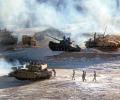
The sources said withdrawal of armoured elements from the south bank of Pangong Tso is almost complete and temporary structures erected by both sides will be demolished in the next few days.
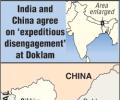
'While overall this is a face saving deal just before the BRICS meeting in Xiamen, any forward military movement at Doklam once again could bring the two Asian giants at loggerheads,' says China expert Srikanth Kondapalli.

'The MEA, hopefully, made it clear that the Indian PM can't be seen in Xi Jinping's company when China has, for all intents and purposes, annexed over 1,000 sq kms of Indian territory in eastern Ladakh, and essentially that the Wuhan spirit and the Mamallapuram spirit have turned into vinegar.'

The Central Military Commission, which is the overall high command of the Chinese military, is headed by Chinese President Xi Jinping.
India on Thursday blamed China's actions of amassing a large number of troops close to the border and attempts to unilaterally alter the status quo along the Line of Actual Control (LAC) last year for the continuing military standoff in eastern Ladakh, and asserted that these acts were in violation of Sino-India bilateral agreements.

The 30-member committee, chaired by senior Bharatiya Janata Party leader and former Union minister Jual Oram and of which Rahul Gandhi is also a member,wishes to visit the eastern Ladakh region in the last week of May or in June.

His attack on the government came a day after Defence Minister Rajnath Singh assured Parliament that India has not conceded anything in the sustained talks with China and it will not allow even an inch of its territory to be taken away by anyone.
The MEA said there has not been any change in India's position on the LAC and the mutual redeployment as a result of the disengagement process should not be misrepresented.
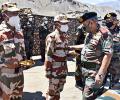
India and China should be able to achieve status quo in eastern Ladakh in a gradual manner as both sides understand that it is in the best interest of ensuring peace and tranquillity in the region, Chief of Defence Staff General Bipin Rawat said.

These missiles have a range of two to five km and they are capable of bringing down low flying helicopters and aircraft, they added.

Indian Army chief General Manoj Mukund Naravane on Tuesday said that as far as the western front was concerned, there is an increase in the concentration of terrorists in various launch pads and there have been repeated attempts of infiltration across the Line of Control.

Until last month more than two-thirds of the Indian Army was deployed against Pakistan. Of 14 army corps, just four-and-a-half faced China, while more than twice that number was ranged against Pakistan.
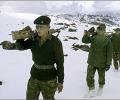
Three months after the 21-day stand-off in Depsang valley in Ladakh, Chinese troops again came deep inside the Indian territory in that area last week to reach upto 2 kms close to Indian posts, in one of five such incursions in the recent past.

The ex-foreign secy was the government's pointsman for China and the US.
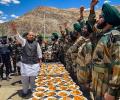
Defence Minister Rajnath Singh on Monday said India is a peace-loving nation that never resorts to any kind of aggression but is always prepared to give a befitting reply if provoked or threatened.
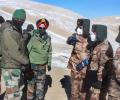
"The meeting thus did not result in resolution of the remaining areas," the Army said in a statement.
'The Chinese are only about 160-170 km behind.' 'It will not take much time for them to bring their troops back, considering that they have better infrastructure -- and the weather is now favourable.' 'They can move in much faster as the terrain favours them.'

The government must figure out what the Chinese game plan is and thwart the endgame before it is upon us, possibly in early winter, advises David Devadas.
During their hour-long in-person meeting on the sidelines of a Shanghai Cooperation Organisation (SCO) conclave in Dushanbe on Wednesday, External Affairs Minister S Jaishankar also told his Chinese counterpart and State Councilor Wang Yi that any unilateral change in the status quo along the Line of Actual Control (LAC) was 'not acceptable' to India and that the overall ties can only develop after full restoration of peace and tranquillity in eastern Ladakh.

The ministry's year-end review is silent on the continued occupation by Chinese troops of territory that India has always claimed and patrolled.
A feature of 'Third World-ism' is lack of accountability. Whether and how the Modi government is held to account politically is a matter for the future, observes T N Ninan.

'The numbers of troops on both sides are enormous.' 'They are about 50,000-60,000 soldiers facing each other in that sector -- that's about the total number of troops that both sides had in the 1962 War in all sectors.'
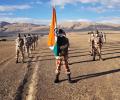
India and China on Friday agreed to hold the next round of military talks at an early date to achieve the objective of complete disengagement in remaining friction points in eastern Ladakh amid fresh sparring between the two sides on the prolonged Line of Actual Control (LAC) standoff.

India and China on Friday held 'in-depth' discussions on addressing the remaining issues along the Line of Actual Control (LAC) in eastern Ladakh, holding that disengagement in the North and South banks of Pangong lake provided a good basis to work towards their early resolution.

'We have to up our vigil everywhere, all along the LAC -- winter, summer or spring.'
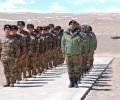
Chinese Foreign Ministry spokesman Wang Wenbin said this at his media briefing as he parried questions on India's assertion that consensus reached by the leaders on maintaining peace along the border cannot be swept under the carpet.
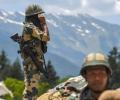
Gen Naravane said India is dealing with China in a "firm" and "non-escalatory" manner to ensure the sanctity of its claims in eastern Ladakh, and that it was even open to initiating confidence-building measures.
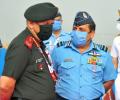
Gen Rawat's comments about the supporting role of the Air Force came at a conference when asked about the growing perception that the Indian Air Force was not keen on setting up the proposed theatre commands integrating the capabilities of the three forces.

'India has to prepare for future warfare where kinetic use of force at the border will be limited. War will take place in the realms beyond the border.'

Tacitly acknowledging the withdrawal of its troops from Depsang Valley in Ladakh, China on Monday said the "stand-off incident" with India has been resolved through "fruitful consultations," keeping the larger interests of bilateral relations in mind.

'Once positions are hardened and troops start building defences, it is difficult for soldiers to step back.'
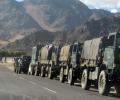
India on Friday said the onus is on China to address the remaining unresolved issues relating to the eastern Ladakh row and that peace and tranquillity along the frontier were key for the restoration of normal relations between the two sides.
Prime Minister Manmohan Singh and Chinese Premier Li Keqiang signed the border agreement to ensure that both countries do not tail each other's military teams along the LAC. Sheela Bhatt reports from Beijing

Through the past 18-month period, peace has prevailed in the disputed border regions, which was immensely helpful in the difficult situation that the country was passing through, observes Ambassador M K Bhadrakumar.

India and China on discussed the recent intrusion by Chinese troops at the Depsang Valley during External Affairs Minister Salman Khurshid's two-hour-long meeting with his Chinese counterpart Wang Yi.
China on Wednesday called for "proper and timely" settlement of the boundary issues with India to preserve peace at the borders in the light of the row over Depsang Valley in Ladakh where the troops of People's Liberation Army intruded recently.

India and China on Tuesday held talks to finalise details of External Affairs Minister Salman Khurshid's visit to Beijing and Chinese Premier Li Keqiang's trip to New Delhi, a day after both sides withdrew their troops from the Depsang Valley.

After 24 months of slowdown beginning in January 2018 before the pandemic and then 18 months of collapse since January 2020, we have become the world's worst performing economy, observes Aakar Patel.

China on Thursday declined to give any timeline for withdrawal of its troops from Depsang valley in Ladakh but said the issue that has sparked new tensions in bilateral ties "will be properly resolved soon through negotiations".

Chief of Army Staff General Bikram Singh briefed Prime Minister Manmohan Singh and the Cabinet Committee on Security on the incursion by Chinese troops in Ladakh. "The CCS met today and the army chief briefed us on the Ladakh situation," Finance Minister P Chidambaram told reporters after the meeting.
