Eminent public prosecutor Ujjwal Nikam, who was instrumental in sending Ajmal Kasab, the lone surviving militant of 2008 Mumbai attack to the gallows, has termed David Headley's sentence as meagre in comparison to the brutality and heinousness of the crime.

In a significant claim, Pakistani-American terrorist David Coleman Headley on Thursday said that Ishrat Jahan -- who was killed in an alleged fake encounter in 2004 in Gujarat --was actually a suicide bomber of Lashkar-e-Tayiba terror outfit.
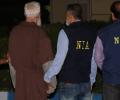
According to the chargesheet, Rana played a crucial role in supporting terrorist David Coleman Headley, a Pakistani-American operative linked to Lashkar-e-Taiba, by facilitating his reconnaissance missions across Mumbai.
"I'm very glad you raised this, Ishaan. I didn't plant it. I promise you. This guy does this to his dad," Tharoor replied amid laughter from the audience.

'There's a lot of sense in what Prime Minister Modi did, but the Indian government has to be really prepared for a really sharp escalation spiral.'

Tahawwur Hussain Rana, a Canadian national convicted in the United States for his role in the 2008 Mumbai terror attacks, has been extradited to India. Rana, a close associate of Pakistani-American terrorist David Coleman Headley, was involved in the conspiracy from 2005 onwards and assisted Headley in obtaining a visa for India. He is the third person to be sent on trial in India for the 26/11 attacks after Ajmal Kasab and Zabiuddin Ansari alias Abu Jundal. Rana's extradition comes after US President Donald Trump approved the request.
Tahawwur Rana, accused in the 2008 Mumbai terror attacks, has renewed his application to the US Supreme Court seeking a stay of his extradition to India. The Supreme Court will hear the application next month. Rana, currently detained in Los Angeles, claims his extradition would violate US law and expose him to torture in India due to his health and Muslim background. The US government has denied these claims and authorized his surrender to India, citing the Extradition Treaty between the two countries. The Supreme Court's decision will determine if Rana will face justice in India or remain in the United States.
Tahawwur Hussain Rana, a Canadian national accused of involvement in the 2008 Mumbai terror attacks, has been extradited to India from the United States. Rana's interrogation is expected to shed light on the role of Pakistani state actors in the attacks, which claimed 166 lives. Indian authorities are particularly interested in his travels across India in the days leading up to the attacks, including visits to Hapur, Agra, Delhi, Kochi, Ahmedabad, and Mumbai. Rana's extradition follows a lengthy legal battle, with the US Supreme Court ultimately denying his application to challenge it. Rana is known to be associated with Pakistani-American terrorist David Coleman Headley, one of the main conspirators of the 26/11 attacks. The investigation into the Mumbai attacks has implicated senior members of terror outfits Lashkar-e-Taiba (LeT) and Harkat-ul Jihadi Islami (HuJI), as well as officials from Pakistan's Inter-Services Intelligence (ISI).
'Had Haji Pir and/or Skardu been taken, the message would have gone out not just to General Asim Munir and his cohort in the Pakistan army but to the Pakistani people that every terrorist incident in India would lead to substantial loss of territory in PoK.'

American investigators who questioned Ajmal Amir Iman Kasab, the lone terrorist captured during the Mumbai attack, are convinced he is a Pakistani national and that the terrorist strike was planned and executed by the Lashkar-e-Tayiba, diplomatic sources said on Tuesday.These findings fit in with comments by top American leaders like Secretary of State Condoleezza Rice and Admiral Mike Mullen, the senior-most US military official, who have asked Pakistan to take quick action.
An NIA official, who was part of the team that interrogated David Headley in FBI custody, tells Vicky Nanjappa that the Pakistani-American terrorist was beaming with pride each time they asked him about his association with the Lashkar and also his role in the 26/11 attacks.

'Fears in Washington began to intensify when it was realised that subsequent Pakistani and Indian attacks on major military facilities -- which were significant in terms of geographic scope and intensity -- could rapidly take both sides to where neither actually wanted to go.' 'The US objective was to stop the fighting as soon as possible. Everything else was secondary.'

Tahawwur Hussain Rana, a Pakistan-born Canadian national and close associate of David Coleman Headley, is set to be extradited to India from the US. Rana was involved in the planning and execution of the 2008 Mumbai terror attacks, which killed 166 people, including six Americans. He assisted Headley in obtaining a visa for India, established a front company in Mumbai, and helped in reconnaissance of targets in Mumbai and New Delhi. Rana was convicted in the US for providing material support to Lashkar-e-Taiba (LeT) and sentenced to 14 years in prison. His extradition to India will allow authorities to question him about his involvement in the Mumbai attacks and potentially uncover new information about the role of Pakistani state actors.
Evidently on the strength of continuing information provided by Lashkar-e-Tayiba operative and Pakistani American David Coleman Headley alias Daood Gilani, who was an integral protagonist in the conspiracy that led to the horrific 26/11 Mumbai terror attacks, four new Lashkar handlers of Headley have been chargesheeted in the US District Court for the Northern District of Illinois (Chicago).
'It is typical of China's strategic deception of making virtue out of necessity,' observes Rup Narayan Das.

'Pakistan's only concern has been while they were on the FATF watch list was to distance their State institutions and organs from any direct connection with the actual execution of militancy inside Kashmir.'

Former interior minister Rehman Malik has termed Pakistani-American terrorist's testimony in the 2008 Mumbai attack case as "a pack of lies".

'Illegal aggression of India on East Pakistan... Why Pakistan is avoiding advocating for Kashmiri people' written by "Professor Hafiz Mohammad Saeed" appeared in Daily Dunya (an Urdu publication of Dunya media group of Mian Amer Mahmood) on Sunday.
Even after Lashkar-e-Tayiba's David Coleman Headley identified his Inter-Services Intelligence handler Major Iqbal as Chaudhery Khan, mystery continues to shroud his presence. Hoping to get another access to Headley, the National Investigation Agency on the 26/11 money trail, is positive of hunting down the major. Vicky Nanjappa reports.
In the third of the four-part series ProPublica's Sebastian Rotella reveals how the United States continued to believe that David Headley was an informant, even after receiving complaints from two of his wives about his radicalisation and his Lashkar-e-Tayiba links. The US State Department communicated the warnings to the CIA and FBI, but it remains unclear why they failed to act upon it.
Pakistan-based Lashkar-e-Tayiba is acting in a more Al Qaeda-like manner after being 'infected' by the ideas of Osama bin Laden's terror network and poses the highest risk to the United States, according to a top American counter-terrorism expert.

'There is gradual rise in the number of nations viewing Pakistan as the nursery of global terror.'

"The difference between the state and non-state actors will come to an end after this statement," Minister of State for Home Kiren Rijiju told reporters.

A recent ProPublica investigation termed Pakistani-American Lashkar-e-Tayiba operative and 26/11 accused David Coleman Headley as a double agent working for both the American Central Intelligence Agency and the Pakistani Inter Services Intelligence.
International arrest warrants have been issued by the Interpol against five Pakistani nationals for their alleged role in the Mumbai terror attack and plotting to carry out more strikes.

In the audio clip, he is heard directing the attack on Chabad House during Mumbai 26/11 terror attacks.
David Coleman Headley, the American Lashkar-e-Tayiba suspect in the Mumbai terror attack case, did not disclose his Pakistani-origin while seeking an Indian visa, raising no alarm bells at the Indian Consulate in Chicago. Headley, who was earlier called Dawood Gilani, gave 'Headley' as his last name at birth in his visa application and wrote his father's name as 'William Headley', according to reliable information.
Three years prior to the 2008 Mumbai attacks, the Federal Bureau of Investigation was warned of the strikes and David Headley's links with the Lashkar-e-Tayiba by the wife of the Pakistani-American terrorist, says an investigative report.
Giving his testimony on the second day of the trial of 26/11 co-accused Tawahhur Rana, a Canadian of Pakistani origin, Headley, a Pakistani-American, talked about the hatred against Shiv Sena among his Pakistani handlers. 166 people were killed in the November 2008 attack in Mumbai.
Pakistani-American terrorist David Headley, who confessed to plotting the Mumbai terror attacks, had a dual personality that enabled him to switch between a Westerner and a devout Muslim and evade suspicion, according to his maternal uncle. "It could not have been more different between the two worlds. In one world, where he wants to be Pakistani, he was considered to be an American. With Americans, he was being seen as a Muslim. So he had to get used to a duality of life."
The government has given its sanction to charge sheet nine people including Pakistani-American terrorist David Headley, Lashkar-e-Tayiba founder Hafiz Saeed and two Inter Services Intelligence officers for plotting terror attacks in India including the 26/11 strikes.

Pakistani-origin Canadian businessman Tahawwur Rana, sought for his involvement in the 2008 Mumbai terror attacks, has approached a US court for a status conference after waiting for an order on his extradition to India for more than 20 months.

Pakistan on Friday freed Saeed, the Lashkar-e-Tayiba founder, who immediately launched his anti-India rhetoric and vowed to mobilise people for the "cause of Kashmir".
Speaking at a hearing of the Foreign Relations Committee, Maryland Democrat Ben Cardin, a member of the Senate Foreign Relations Committee, said: "There are mixed signals here that are very, very troubling and that the United States needs to be able to have alternatives for carrying out its foreign policy in that region."

Headley also said that LeT boss Hafiz Saeed, the mastermind behind the November 2008 attack that killed 166 persons, motivated him for carrying out a 'jihad'. Saeed told him that the satisfaction of one second of 'jihad' is equal to "100 years of worship."
In an interview to Rediff.com's Vicky Nanjappa, Stephen Tankel, who is currently in India to study home grown terror, talks about Headley, co-accused Tawwahur Rana and LeT founder Hafiz Saeed.
American prosecutors may seek a lesser sentence for Lashkar-e-Tayiba operative David Headley -- under a plea agreement the latter has clinched with the Federal Bureau of Investigation -- at the sentencing of the Pakistani-American terrorist in a United States court on Thursday.
However, Rana's lawyer Patrick Blegen has said in a new motion filed in a Chicago court that as a result of FBI raids on Rana's businesses and his detention, his businesses have effectively been shut down and are worth nowhere near what they were previously estimated. According to court filings, Rana allegedly conspired to bring foreigners to the US under false pretences.
Bangladesh has handed over three suspected Lashkar-e-Tayiba operatives to Pakistan, a year after they were arrested on suspicion of plotting attacks on Indian and American embassies in Dhaka, officials said.
Ever since Headley was arrested in US, there has been a lot of talk regarding the Karachi Project, considered to be one of the most ambitious projects staged by the ISI where it plans to combine Pakistani forces and home-grown terrorists to launch a spate of terror attacks on India, reports Vicky Nanjappa.
 © 2026 Rediff.com - Advertise with us - Disclaimer - Privacy Policy - Sitemap - Feedback - About us - Terms of use - Grievances