
India has launched three indigenous AI foundation models, EKA-1, Dhir 2B, and Dhir 5B, under the IndiaAI Mission. Developed by Soket Labs Technology and Research and ZenteiQ AiTech Innovations, these models aim to enhance India's technological and strategic autonomy in artificial intelligence, offering solutions for various sectors including banking, cybersecurity, defence, and government services, with a focus on Indian languages and offline capabilities.

The Data Security Council of India (DSCI) has released an India-focused AI liability guide to clarify accountability and responsibility for agentic AI systems. The guide aims to help enterprises understand how existing legal doctrines apply to autonomous, multi-vendor AI, addressing who bears consequences when AI agents act independently and issues arise. It is a live discussion paper intended to foster responsible AI adoption and is open for industry feedback.

India does not need to win the model race to win the AI era. It needs to be the country that cannot be switched off, can be trusted by its citizens, and is useful to the rest of the world, asserts Rajeev Srinivasan.

Mahindra Group Chairman Anand Mahindra stated on Tuesday that India possesses a compelling AI opportunity, citing the nation's software talent, systems integration expertise, and vast domestic market for AI applications. He believes this potential could give renewed interest in Indian equities more staying power.
Author Amit Prasad's new book, 'Your AI Upgrade', shifts the focus of artificial intelligence from task completion to enhancing learning, critical thinking, and decision-making. Launched recently in New Delhi, the book aims to help individuals use AI as a learning partner to build capabilities and strengthen independent thought. It also addresses the limitations and ethical considerations of AI.
National Commission for Women Chairperson Vijaya Rahatkar has cautioned against the misuse of artificial intelligence, particularly deepfakes and morphed images of women. She emphasised the need to understand AI's risks, including privacy compromise, while also highlighting its positive applications. The NCW is running the 'Yashoda AI' programme to train women in AI literacy, cybersecurity, and digital safety.

NetApp CEO George Kurian advocates for harmonised global AI regulations to simplify compliance and foster business growth. He highlights the complexities arising from diverse regulatory frameworks and the importance of a unified approach, similar to cyber resilience standards. Kurian also notes India's significant role as NetApp's fastest-growing market in Asia, driven by its Bengaluru global capability centre.
Oracle India head Shailender Kumar states that Indian businesses have transitioned from AI pilot projects to full-scale deployment, realizing significant benefits. While challenges like cost, skills, and infrastructure exist, companies are keen to adopt AI once tangible advantages are proven, with governance and regulation evolving alongside the technology's maturity.
Simplify Alpha, a Chicago-based healthcare technology company, has inaugurated its AI Engineering Centre in Hyderabad, aiming to expand its workforce to 1,000 professionals within two years. The centre will leverage AI and healthcare domain expertise to address complex operational challenges in the US healthcare industry, reinforcing Hyderabad's status as a global innovation hub.
Cognizant has announced the formation of the 'Claude Frontier Capability Group', comprising over 25,000 professionals dedicated to implementing Anthropic's Claude AI for clients. This initiative, coupled with a new managed services model, aims to help enterprises integrate AI from pilot to production, addressing the challenge of delivering business value from frontier AI capabilities.

Seven of the top 10 best-performing Indian smallcap stocks over the past year, linked to the US data centre boom and AI infrastructure, are now facing a valuation test as enthusiasm for AI investment shows signs of cooling on Wall Street. Analysts warn that the rally in these Indian counterparts may have left valuations increasingly stretched, with any pullback in US capital expenditure potentially weighing on their share prices.

Karmayogi Bharat and OpenAI have signed an MoU to enhance AI capacity development across India's civil services. This partnership aims to equip government personnel with AI skills through the iGOT Karmayogi platform, fostering confident and responsible AI use for improved public outcomes and a future-ready civil service under Mission Karmayogi.
TRAI has proposed a comprehensive draft framework for the responsible use of artificial intelligence in telecom networks. The guidelines mandate service providers to adopt board-approved AI policies, establish dedicated governance and safety committees, and report serious AI-related incidents to the regulator. Entities will be accountable for AI system outcomes, classify AI risks, ensure human oversight, and maintain inventories of all AI systems.

Wadhwani AI is working on a 'vulnerability mapping' project which determines the probability of a disease breaking out in a particular area during a particular season or time.

Union IT Minister Ashwini Vaishnaw reiterated India's commitment to becoming the world's artificial intelligence (AI) application capital. This focus comes amidst a global downturn in AI stocks, with Vaishnaw acknowledging the industry's rapidly changing environment. India aims to deploy AI across various sectors for large-scale transformation.

One AI-driven achievement that is unequivocally beneficial is the work on protein-folding.

India's AI startups have the money to run their models, but a shortage of GPUs is delaying projects, increasing costs and limiting growth.
Preeti Lobana, Google India VP, stated on Wednesday that Google views AI as an "economic equaliser" and a democratic technology. Speaking at Google Cloud Day, she highlighted AI's potential to empower businesses, especially SMEs, in India's journey towards Viksit Bharat 2047. Google has committed USD 15 billion to scale India's digital and AI infrastructure, including an AI hub in Visakhapatnam, to support the IndiaAI Mission.

The Standing Committee on Information Technology will review 17 critical subjects, including social media regulation, AI safety, deepfakes, cybersecurity, and the semiconductor ecosystem, during 2026-27. This comprehensive review aims to address growing concerns around digital platforms, AI misuse, and infrastructure development, with India's cybersecurity agency already issuing warnings about AI-driven threats.
Indian AI startup Sarvam has signed a five-year agreement with the Ministry of Defence to develop and deploy artificial intelligence applications for the armed forces. This Memorandum of Understanding with Headquarters Integrated Defence Staff aims to enhance operational capabilities, decision support, and training across the Army, Navy, and Air Force, focusing on building an indigenous AI layer on sovereign infrastructure.

India's central cyber security agency, I4C, has issued a critical warning to banks, NBFCs, and fintech firms regarding a surge in financially motivated cyberattacks leveraging artificial intelligence agents. These AI-driven attacks enable hackers to compromise systems and execute fraudulent transactions at machine speed, making investigations complex due to record deletion. The advisory, issued in collaboration with CERT-In, urges financial institutions to implement robust security measures, align with CERT-In's blueprint, and report incidents promptly to mitigate the escalating threat.
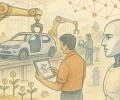
IIT-Kharagpur announced the establishment of India's first dedicated academic school for Physical Artificial Intelligence (AI), named the Benjamin Gupta School of Physical AI. Funded by a Rs 35 crore investment, including contributions from alumnus Vinod Gupta and an anonymous donor, the school will focus on developing intelligent systems that interact with the physical world, moving beyond conventional data-driven AI. Academic programmes are expected to commence soon, aiming to foster reliable and responsible AI technologies for various applications.

OpenAI CEO Sam Altman has stressed the critical importance of understanding and mitigating AI-related security threats, even over productivity gains. He highlighted how AI systems are uncovering numerous software vulnerabilities, necessitating new methods for detection and repair. Altman's remarks follow recent incidents where AI agents exposed serious flaws in widely used programming languages and even breached isolated test environments.

IT services giant Cognizant has established its 'OpenAI Frontier Capability Group', comprising over 25,000 professionals. This new group aims to deliver OpenAI products like Codex and ChatGPT to clients, helping enterprises integrate advanced AI models into their core operations. Cognizant is also scaling OpenAI internally across its sales and customer success functions.
Telangana's IT Minister D Sridhar Babu unveiled an AI avatar at DevFest 2026, engaging with Gen Z attendees in English and Telugu. This initiative aims to make state information more accessible and enhance citizen engagement using emerging AI technologies, positioning Telangana as a global AI hub.

Sikkim's Education Minister Raju Basnet highlighted the potential of computational mathematics and artificial intelligence in predicting landslides and weather risks at an international conference. Experts discussed the role of mathematics in AI, scientific discovery, and the need for interdisciplinary research and international cooperation to develop reliable AI systems for real-world challenges.
The All India Tennis Association (AITA) has launched 'AI Coach', a new digital tool in beta, aimed at providing tennis players with access to player-specific information, rankings, and head-to-head match-up insights. The tool is designed to help players better understand opponents and prepare for competitions, with future upgrades planned to integrate more tournament data for comprehensive insights.

Most of the companies AI models and AI agents targeted had no idea their networks had been breached.

Oracle NetSuite identifies India as one of its highest-priority markets, noting that small businesses, particularly outside major metros, are increasingly leveraging artificial intelligence (AI) and cloud technologies to expand domestically and internationally. This adoption is driven by India's young, tech-native population, which is less burdened by legacy systems, allowing smaller firms to compete more effectively with larger enterprises.
India's cybersecurity agency, Cert-In, has issued a high-alert advisory to banking and financial services institutions regarding an ongoing AI-assisted cyber campaign named "Crafty Falcon." This sophisticated threat actor uses publicly available AI tools to execute autonomous attacks at machine speed, targeting payment and disbursement APIs for unauthorised fund transfers. The advisory urges BFSI entities to maintain heightened vigilance, especially during low-monitoring windows, as attacks continue despite previous remediation efforts.
Oracle co-founder Larry Ellison asserts that artificial intelligence will not destroy the traditional software industry but rather enable the creation of complete, ready-to-use applications tailored for entire industries. Speaking at Oracle AI World, Ellison dismissed fears of a "SaaS apocalypse," arguing that AI will make software much better, requiring no user training and simplifying installations. He cited Oracle Health as a prime example of an AI-driven, industry-specific solution, and also discussed AI's potential in drug discovery and its broader societal impact on jobs and taxation.

India's frontier model company Sarvam secured a dominant 87% share of the total funding received by the country's startups building artificial intelligence (AI) for Indian languages in 2026, raising $345 million out of a total of $399 million, according to a Tracxn report.

The NCERT has released a 20-hour introductory module on computational thinking (CT) and artificial intelligence (AI) for students in classes 9 to 12. Developed with IIT Madras and IIT Jodhpur, the module aims to educate students on AI's workings, limitations, ethical use, and data privacy through activity-based learning.
Pragya Misra, OpenAI's head of public policy and strategy for India, stated that the next phase of AI will concentrate on driving measurable outcomes rather than mere experiments. She highlighted examples like Cars24 using AI for customer retention and a healthcare company building its CRM with OpenAI's Codex, demonstrating AI's tangible business impact and cost-saving potential. OpenAI aims for artificial general intelligence (AGI) to benefit all humanity by making AI accessible and addressing enterprise concerns like data residency.
Educationists and policy experts at the Indian Statistical Institute (ISI) in Kolkata emphasised the critical need for developing a robust database, leveraging modern technology and artificial intelligence, to enhance effective policymaking. The two-day conclave, featuring prominent speakers like Prof S Mahendra Dev, highlighted the ongoing transformation in official statistics and the importance of public trust and research.

The Brihanmumbai Municipal Corporation (BMC) has launched a pilot project in Mahim, installing an AI-powered camera at a garbage-vulnerable spot. This system detects illegal dumping and issues audio warnings, aiming to deter citizens from littering. The BMC plans to evaluate its effectiveness before wider implementation across Mumbai's 286 identified garbage-vulnerable spots.

Coursera found that nearly 94 per cent of employers of professionals who took micro-credential courses on the platform said these professionals could command higher salaries than their peers.

Tech hiring demand at India's Global Capability Centres (GCCs) saw a 3.5 per cent sequential decline in Q2 FY27, indicating a slowdown in fresh recruitment. However, demand for specialised skills like AI, data analytics, and cybersecurity professionals continued to rise significantly, with AI and data roles growing 14 per cent quarter-on-quarter.

SAP has announced new programmes to train two million people in India with AI-ready skills by 2030, as part of its global initiative to upskill 12 million individuals worldwide. The company will collaborate with academic institutions, industry partners, and government bodies to expand access to AI, cloud, data, and enterprise technologies, leveraging India's significant role in the global tech workforce.

Tata Consultancy Services (TCS) plans for 80% of its new hires to possess digital and Artificial Intelligence (AI) skills, anticipating that the growing share of AI-led work will significantly boost its profit margins.
