
According to an official Iranian military statement, Qader anti-ship cruise missiles were launched at the carrier, forcing it to alter its position in the region.

'As result, Netanyahu 'convinced' Trump to go to war with the help of overoptimistic Israeli intelligence assessments, essentially explaining to him that they only need to bomb Iran for 3-4 days, and the regime would then collapse.' 'Rather unsurprisingly, Netanyahu is ever since blaming his own intel service for the entire operation failing.'

The big question is whether Trump is any longer in command of the situation. For all practical purposes, the war seems set to cascade as the US is preparing for a potential ground operation in Iran and threatens to destroy 'bridges next, then electric power plants', points out Ambassador M K Bhadrakumar.

Secretary of State Marco Rubio urged its citizens to immediately depart from several Middle Eastern countries, citing "serious safety risks."

This weekend, Donald Trump has begun to say the quiet part out loud -- that he wants to take control of Iran's oil, a formulation more in line with his robber-baron style of international relations.

'The next two to three weeks will not be decided in Washington.' 'They will be decided in Tehran, in whatever calculation Iran makes about the costs of continued resistance against the costs of appearing to have yielded.'

'Strikes into the Gulf countries are proof that the security guarantees offered by the US are ineffective and that the Gulf countries cannot rely on American security assurances for their safety.'

With inadequacies in the Russian MiG-29Ks that India bought to operate off the INS Vikramaditya and INS Vikrant, the acquisition of a capable, long-range multi-role carrier-based fighters will be critical for India's naval power.

The US Air Force's (USAF) two newest fifth-generation supersonic multirole F-35A aircraft made a historic debut at Aero-India here on Monday, drawing strong interest and adding lustre to the five-day marquee event.

Two B-1B Lancer supersonic heavy bomber jets of the US Air Force on Tuesday joined the American exhibits at Aero India at the Yelahanka air base, in a reflection of the deeper strategic ties between the two countries.

India's historical focus on its continental borders has overshadowed its maritime ambitions, but that is changing quickly, notes Ajai Shukla.

The Indian Navy has decided that the twin-seat Rafale will not be disqualified on the basis of its inability to operate from an aircraft carrier.
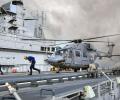
The navy is pushing hard for IAC-2 to be a 65,000-tonne, flat deck carrier that is designed and built in India, with technical and tactical consultation from the US navy -- the global masters in aircraft carrier operations.

The latest avatar of the F-15 is designed to deal with the world's most potent air threats that are emerging from China.
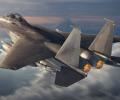
Capable of flying at Mach 2.5 (two-and-a-half times the speed of sound), the F-15EX is the world's fastest fighter aircraft. It carries 13.5 tonnes of weapons load, more than the Rafale or the Sukhoi-30MKI.
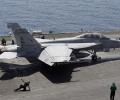
Boeing is pressing hard to win the Indian Navy contract for 57 aircraft carrier-borne fighters. It could offer the Super Hornet in the ongoing IAF procurement of 114 medium fighters; its upgraded F-15EX fighter also on the list.

For the defence ministry, Aero India 2021 is an opportunity to show its commitment to the prime minister's 'Atmanirbhar Bharat' initiative.
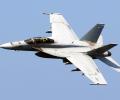
Boeing's confirmation that the Super Hornet has flown off a ski-jump is a statement that it is ready to operate off existing Indian aircraft carriers.

Boeing's plan involves setting up an Indian factory and the aerospace ecosystem to build the Block II Super Hornet.

'It is hard to justify $225 million a plane for an increasingly obsolete mission.' The purchase of the 36 Rafales has changed little for the IAF.
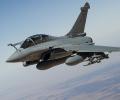
The IAF has paid French aerospace firms Dassault and Thales about Euro 350 million for 'performance-based logistics'. This requires the vendors to ensure that 75 per cent of the Rafale fleet is combat-ready at all times, notes Ajai Shukla.

Costing Rs 500 billion, the INS Vishal will be the Indian military's single most expensive defence platform.
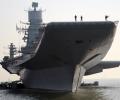
'The INS Vishal -- a 65,000 tonne giant with 54 aircraft, including fighters, electronic warfare aircraft, airborne command posts and anti-submarine helicopters -- can both protect and dominate,' says Ajai Shukla.

General Mattis has been the most steadfast champion in Trump's cabinet of the US-India defence relationship. If Trump chooses a more pliable successor, the Pentagon's attention could go off India.
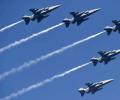
With the IAF having rejected variants of 4 of the contending aircraft -- the Super Hornet, F-16, Gripen C/D and MiG-35 -- in flight trials carried out between 2009-2011 in the MMRCA tender, are the current contenders improved enough to pass flight trials conducted to the same standards?
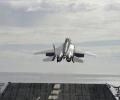
>The Indian Navy wants 'day and night capable, all weather multi-role deck based combat aircraft which can be used for air defence, air-to-surface operations, buddy refuelling, reconnaissance, electronic warfare missions' from its aircraft carriers.

The company wants to make F 16-Block 70 "for India, from India and export to the world".

The Raksha Mantri was unable to address media queries about how much the Modi government was paying for 36 Rafales compared to what the UPA government had negotiated.

Beyond the British and Russian strands interwoven into the Indian Navy's equipment profile and the strong drive towards indigenisation evident today, its future in aircraft carriers appears increasingly linked with America.
Along with HAL, Boeing intends to involve the Mahindra Group in building Super Hornets in India.

Boeing expects the IAF to soon place an inquiry for twin-engine fighter jets to bridge a 200-aircraft gap in its armoury. And the Super Hornet is ready to fly in.

Lockheed Martin's offer involves transferring the world's only F-16 production line from Fort Worth, Texas, to India. Thereafter, every F-16 built, and a large share of the spare parts and sub-systems for every F-16 flying across the globe would come from India.

The IAF has just 33 squadrons, 9 short of the 42 squadrons needed to tackle China and Pakistan together, says Ajai Shukla.

In the light of India's increasingly 'darkening' threat environment and the convergence of strategic interests between China and Pakistan, the IAF's declining combat capabilities are a cause for concern, says Brigadier Gurmeet Kanwal (retd).

New Delhi remains a priggish suitor to Washington's overtures, but it has begun appreciating potential tech benefits to ties with the US.
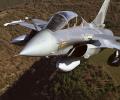
Even as three Rafale fighters line up in Bengaluru for eye-popping aerobatics displays at the Aero India 2015 exhibition this week, senior ministry of defence sources say the proposal to buy the French fighter is "effectively dead".
