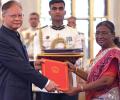
Praising the Indian students awarded at the function, he said the young generation is the hope of the two countries.

India and China reviewed the situation along the Line of Actual Control (LAC) in eastern Ladakh and prepared for the next Special Representatives' dialogue on the boundary question.

Twenty-six foreign leaders, including Vladimir Putin and Kim Jong Un, will attend China's V-Day commemorations on September 3. Japan has expressed concerns about the event's anti-Japanese overtones.
China welcomes Prime Minister Narendra Modi's planned visit to the Tianjin Summit of the Shanghai Cooperation Organisation (SCO), expressing hope that the event will be a 'gathering of solidarity, friendship and fruitful results'.

Xi Jinping will visit Pakistan this year after a cancelled a trip in 2014.

Gearing up for Trump 2.0 era, Chinese President Xi Jinping on Tuesday cautioned there will be no winner in a tariff or tech wars between China and the United States and vowed that Beijing would firmly safeguard its interests.
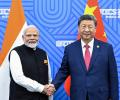
Prime Minister Narendra Modi has emphasized dialogue over discord in India's relationship with China, acknowledging natural differences between the two countries but stressing that stronger cooperation is essential for their mutual interests and global stability. In a podcast with Lex Fridman, Modi highlighted the ongoing efforts to restore normalcy along the border following the 2020 clashes, emphasizing the importance of a stable and cooperative relationship.

Prime Minister Narendra Modi and Chinese President Xi Jinping are expected to hold bilateral meetings on the sidelines of the SCO summit in Tianjin, as both nations look to strengthen ties amid global trade tensions.

China has objected to Indian Minister Kiren Rijiju's remarks on the Dalai Lama's reincarnation, urging India to be cautious on Tibet-related issues to avoid impacting bilateral relations. China insists any future Dalai Lama must receive its approval.

Japan is expected to increase its investment target in India from the earlier 5 trillion yen ($34 billion) to almost 10 trillion yen.
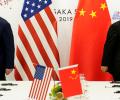
The call lasted approximately one and a half hours, and resulted in a very positive conclusion for both countries.
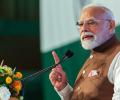
Prime Minister Narendra Modi on Friday said it is important for India and China to work together to bring stability to the world economic order as he asserted that New Delhi is ready to advance bilateral ties from a strategic and long-term perspective based on mutual respect, mutual interest and mutual sensitivity.

China is set to build a rail link connecting Xinjiang province with Tibet, part of which will run near the Line of Actual Control (LAC) with India.
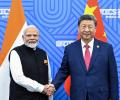
India and China celebrated the 75th anniversary of their diplomatic relations on Tuesday, with leaders from both countries exchanging congratulatory messages. The anniversary comes as the two countries are working to restore ties after a four-year freeze due to the military standoff in eastern Ladakh. Both countries have expressed a willingness to enhance strategic mutual trust and step up cooperation in various fields. The two sides are also exploring ways to rebuild ties and promote people-to-people exchanges.
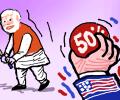
'Things may get much worse before they get better,' predicts Ajay Chhibber.
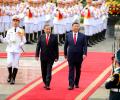
'A small boat with a single sail cannot withstand the stormy waves, and only by working together can we sail steadily and far,' Xi told the Vietnamese leadership.
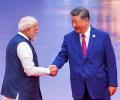
'Xi is an individual led by a harder calculus and would scoff at melting over gestures.' 'That we did not know this was our failure,' asserts Aakar Patel.

If Beijing succeeds in this multipronged effort to challenge the current dominant power, it will have not just economic but political and security consequences. There is no let-up in the South China Sea nor any de-escalation moves on the India-China border. This portends to ominous signalling from Beijing, observes China expert Srikanth Kondapalli.

On July 10, 2024, Bangladesh Prime Minister Sheikh Hasina met Chinese President Xi Jinping and her Chinese counterpart Li Qiang in Beijing.

'We should watch -- in the near term -- for signs that the two have totally fallen out at a personal, political level.' 'Trump and Modi know how to be dealmakers, but they also know how to hold a grudge.'
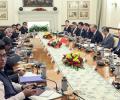
Chinese Foreign Minister Wang Yi's visit to India focuses on border talks with NSA Ajit Doval, amidst efforts to rebuild relations after the Galwan Valley clashes and rising India-US tensions.

Defence Minister Rajnath Singh has conveyed to his Chinese counterpart Admiral Dong Jun that India and China should maintain the positive momentum in the bilateral ties and avoid adding new complexities.

Chinese Ambassador to Pakistan Jiang Zaidong urged that the government should launch a crackdown against all anti-China terrorist groups after two deadly attacks took place in Pakistan within only six months, The Express Tribune reported.

China appears determined to upgrade Pakistan's military capabilities, sufficient to ensure local parity with India, alerts former foreign secretary Ambassador Shyam Saran.
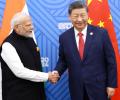
Chinese President Xi Jinping on Wednesday pledged to strengthen the strategic relationships with neighbouring countries by 'appropriately' managing differences and enhancing supply chain ties as China's tariff war with the United States escalated.

Prime Minister Narendra Modi and Chinese President Xi Jinping will hold bilateral talks on Wednesday on the margins of the Brazil, Russia, India, China, South Africa (BRICS) summit in Russia, in their first structured meeting since the eastern Ladakh border row erupted in May 2020.
United States President-elect Donald Trump has invited Chinese President Xi Jinping to attend his January 20 inauguration, CBS News reported citing sources.

'While the President has been critical of India, he has gone out of his way to compliment PM Modi. They have an incredible relationship.'
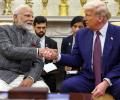
A US lawmaker and former officials warn that President Trump's policies are damaging the strategic partnership between the United States and India, potentially driving India closer to China and Russia.

The BRICS nations condemned the Pahalgam terror attack, advocated for a zero-tolerance approach to terrorism, and criticized rising tariffs during their summit in Rio de Janeiro. They also addressed global challenges and called for reforms in international institutions.

Since the Pahalgam terrorist attack, China, Pakistan's "ironclad ally", while condemning it, has called for restraint, besides a fair and swift investigation into the attack.

National Security Advisor Ajit Doval on Monday emphasised the need to counter terrorism in all its forms for overall regional peace and stability during a meeting with Chinese Foreign Minister Wang Yi in Beijing.

'Just as we cannot surrender the interests of our farmers and dairy industry, Trump is also looking for markets for the produce of the farmers in the Midwest, which are his support base.'
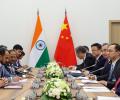
According to informed sources, Doval will arrive in Beijing on Tuesday to attend the crucial talks, which were expected to provide a way forward for the two countries to normalise the relations.
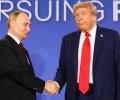
'No respite from economic pain is worth the loss of dignity and self-respect,' asserts former foreign secretary Shyam Saran.

A total of 750 pilgrims have been selected through a computerised draw for the upcoming Kailash Manasarovar Yatra in Tibet, marking the resumption of the pilgrimage after a five-year gap. The Yatra's resumption is seen as an attempt to normalize India-China relations, which were strained by the eastern Ladakh border standoff. The pilgrimage will begin in June and continue until August, with pilgrims traveling in five batches via the Lipulekh route and ten batches via the Nathu La route. The selection process was deemed "fair, computer-generated, random, gender-balanced" by the Ministry of External Affairs (MEA), which organized the pilgrimage.
Chinese Foreign Minister Wang Yi said on Friday that India-China relations have made positive strides and achieved a series of encouraging outcomes at all levels after last year's breakthrough ending the over four-year-long military standoff in eastern Ladakh. Wang's remarks came during his annual press conference as he replied to a question on how Beijing views the course of bilateral ties after the two countries ended the prolonged stalemate in the ties.

'However, we must implement a tit-for-tat approach -- reciprocating their conduct with precision.' 'If they demonstrate respect, we respond accordingly. If they adopt hostile positions, we mirror that hostility with equal intensity.'
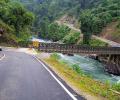
India on Wednesday outright rejected China's attempts to rename some places in Arunachal Pradesh, saying such 'preposterous' attempts will not alter the 'undeniable' reality that the state 'was, is, and will' always remain an integral part of India.
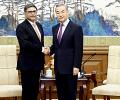
The Chinese Defence Ministry has stated that the Indian and Chinese militaries are implementing the resolutions to end the standoff in eastern Ladakh in a "compressive and effective manner." This follows the disengagement process completed late last year after a pact for troop withdrawal from Depsang and Demchok, the last two friction points in eastern Ladakh. The disengagement has paved the way for the resumption of various dialogue mechanisms between the two countries, with the aim of normalizing bilateral relations.
